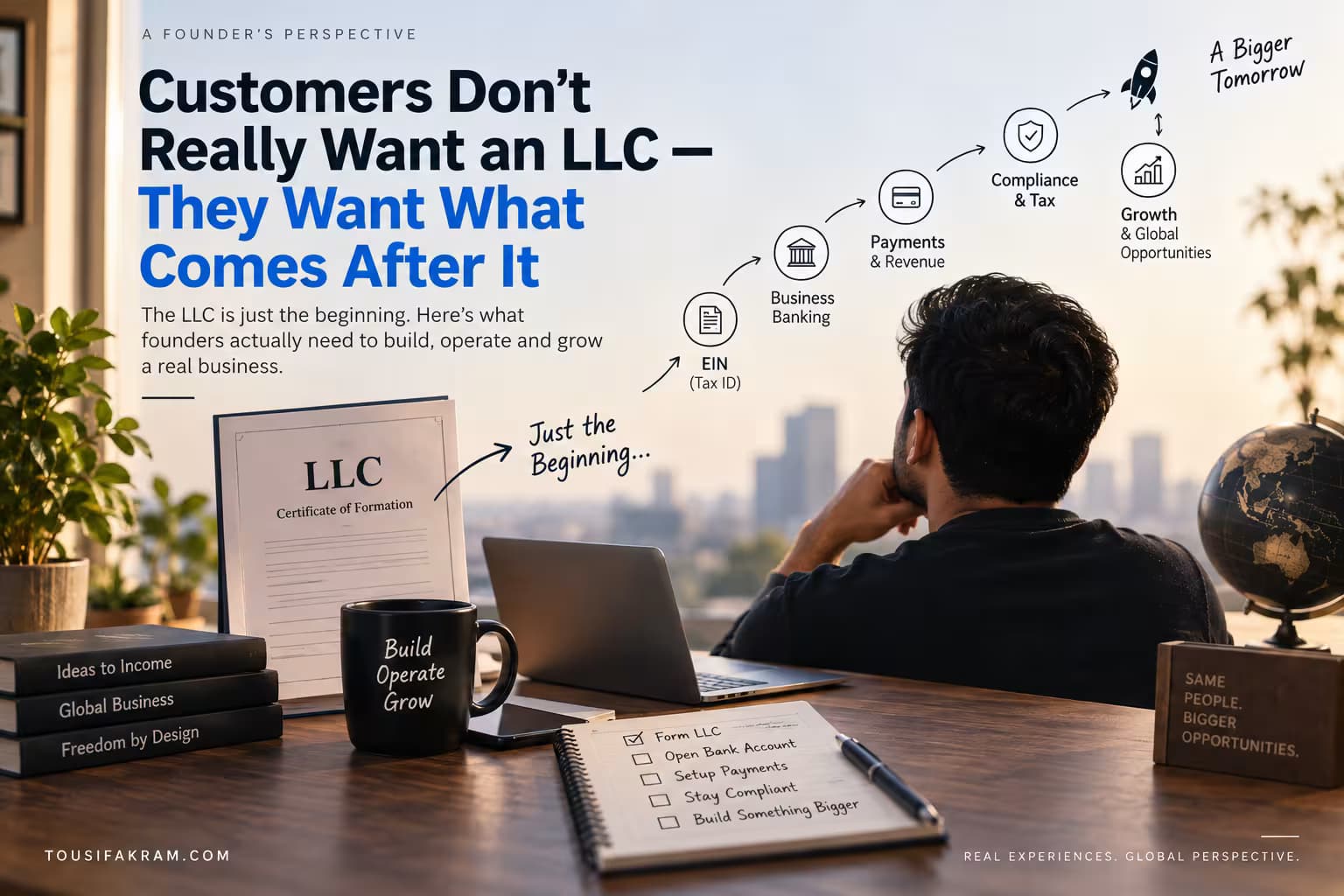
Customers Don’t Really Want a US LLC — They Want What Comes After It

Tousif Akram
IRS CAA | Founder, FormLLC
Customers Don’t Really Want an LLC — They Want What Comes After It
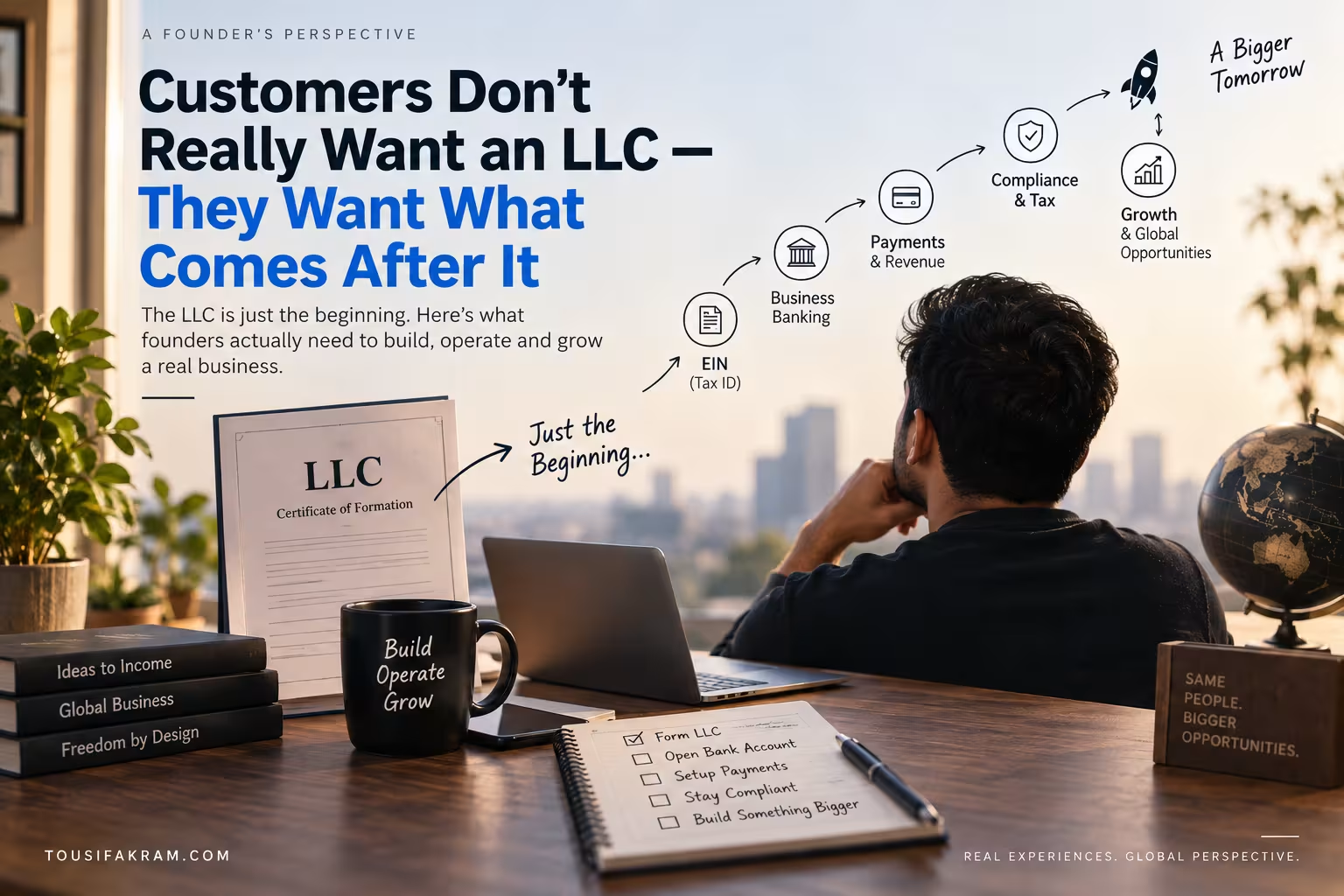
When someone contacts me and says, “I want to form a US LLC,” I’ve learned not to stop at that sentence. I usually want to know why. After helping entrepreneurs from different countries, I’ve realized something that changed the way I think about company formation: most people don’t actually want an LLC. They want what the LLC allows them to do next. They want to get paid, open a business bank account, work with international customers, use payment platforms, build a SaaS business, sell online, establish credibility with customers, separate their business from personal activities, or create a structure they can build on. The LLC is often just the first piece of a much bigger puzzle.
That realization came from countless customer conversations, but it also changed how I think about what a company-formation business should actually do. Helping someone register a company is important, but registration alone does not necessarily solve the problem that brought the entrepreneur to you in the first place. The real question is what they want to accomplish after the company exists.
The Day I Stopped Thinking of Company Formation as the Finish Line
When I first became involved in helping entrepreneurs establish US companies, it would have been easy to define the job very narrowly: the customer pays, the company gets formed, the documents are delivered, and the transaction is complete. Technically, that is a completed service. But it does not necessarily mean the customer has achieved what they originally came to us for.
Imagine a founder living outside the United States who has spent weeks researching how to start a US business. They finally decide to form an LLC, complete the registration process, receive their formation documents, and then ask, “What do I do now?” That question is where the real journey begins. They may need to understand how to get an EIN, how to handle applicable tax obligations, how to open a business bank account, how to receive payments, which compliance filings may apply, whether they need bookkeeping, and what they will need to do in the following year.
That is why I now see company formation differently. Forming the company is not the finish line. It is the point where the founder can start dealing with the practical requirements of operating the business.
An LLC Is a Legal Structure, Not an Operating Business
This distinction sounds obvious, but it is surprisingly easy to forget. When you form an LLC, you have created a legal structure. You have not automatically created customers, revenue, a banking relationship, payment infrastructure, accounting records, a website, a brand, a sales process, or a functioning business.
For an international entrepreneur, the difference can be even more important. The founder may have a great product and international customers, but the company still needs the right infrastructure around it. That can include tax identification, banking, payment processing, recordkeeping, compliance, and other operational requirements depending on the business.
I often explain it this way: formation gives you the foundation, but you still have to build the house. The LLC can be an important part of the structure, but it is not the business itself.
The Questions Usually Start After the LLC Is Formed
One of the most interesting things I’ve observed through our customers is that the questions do not disappear after formation. They simply change. Before formation, founders usually ask which state they should choose, whether they should form an LLC, how much it costs, and whether a non-US resident can own a US LLC.
After formation, the questions become much more practical. How do I get my EIN? What do I need for a business bank account? How can I receive payments? What tax filings apply to me? Do I have filing obligations even if my business has little or no revenue? What happens if I miss a filing? What do I need to do next year?
That is what I think of as the Day-2 problem. Day 1 is forming the company. Day 2 is figuring out how to actually operate it. And Day 2 is where many founders discover that the company-registration document was only the beginning.
The EIN Is a Perfect Example
For many founders, especially people outside the United States, the EIN becomes one of the first major questions after formation. An EIN is an Employer Identification Number issued by the IRS and is used to identify a business for federal tax purposes. Depending on the entity and circumstances, obtaining an EIN can be an important part of becoming operational.
But the process is not identical for every founder. The IRS has specific rules for different situations, including foreign-owned US disregarded entities and EIN applications connected with certain Form 5472 requirements. That is why I do not like simplistic promises that make the process sound identical for everyone.
If you are a non-resident founder, you can learn more about the process in our guide to EIN without an SSN for non-residents. The important lesson is that getting an EIN is one step in setting up the business, not a signal that every other responsibility has automatically been handled.
Then Comes Banking
Once the company exists and the EIN situation is understood, many founders naturally ask, “Where do I keep the business money?” This is another place where the difference between forming a company and operating a company becomes obvious.
A business bank account is not simply another document you receive after incorporation. Financial institutions have their own application, identity, ownership, and compliance requirements. For an international founder, the practical experience can be even more nuanced because the founder may live outside the United States, have no US physical presence, operate an entirely online business, or need to provide additional information during the application process.
I have written separately about US bank accounts for non-residents because banking is one of the areas where founders often realize that having an LLC does not automatically give them access to every financial service they expect.
This is why I tell founders not to choose their company structure while thinking only about the formation fee. They should also think about how they intend to operate the company afterward.
Then Founders Ask About Payments
For many entrepreneurs, payments are actually the reason they started thinking about a US company in the first place. A SaaS founder may want to charge customers, an ecommerce entrepreneur may want to receive marketplace payouts, a consultant may want to invoice international clients, an agency may want to collect recurring payments, and a creator may want to sell digital products.
The company provides part of the infrastructure underneath these activities, but payment providers have their own eligibility, verification, and compliance requirements. That means I would never want a founder to assume that forming a US LLC automatically guarantees approval by every payment platform.
A legitimate company structure can help create the foundation for operating internationally, but approval by a bank or payment provider is a separate decision. Founders should therefore think about their actual business model and the financial services they expect to use rather than assuming that incorporation solves every payment problem.
The founder does not wake up the day after incorporation thinking, “Great, I’m finished.” They usually wake up thinking, “Now how do I make this thing work?” That is the real post-formation journey.
And Then Comes Compliance
This is probably the biggest lesson my experience in this industry has taught me. Founders often focus intensely on the formation price. They compare different packages and try to save money wherever possible. I understand why. When you are starting a business, every dollar matters.
But the formation fee is only one part of the financial picture. Depending on the company’s ownership, structure, activities, transactions, and location, there can be federal, state, and other compliance responsibilities.
For example, certain foreign-owned US disregarded entities can have Form 5472 reporting requirements when applicable reportable transactions occur. The IRS also provides specific rules concerning the filing of Form 5472 with a pro forma Form 1120 in certain circumstances.
This is one reason I dislike the phrase, “Just form an LLC. It’s easy.” Yes, forming an LLC can be relatively straightforward. Maintaining the business correctly is where the responsibility begins.
If you want to understand this area in more detail, you can also read our guide to Form 5472 for a foreign-owned LLC.
I Learned This Lesson From Customers, Not From a Textbook
One of the experiences that changed my thinking involved a customer who was facing a very significant penalty of approximately $25,000. I remember spending a long night working through the situation, dealing with the relevant information, and trying to understand what could be done.
That experience stayed with me. Not because it made me think that compliance was simply another service to sell, but because it made me think about how important it is for founders to understand what happens after formation.
If someone trusts you enough to help them establish a company, I do not think the relationship should end the moment the formation documents are delivered. I want customers to understand what they are getting into, what responsibilities may come next, and when they may need professional tax or legal advice.
There are limits to what a company-formation provider should pretend to be. Being honest about those boundaries is part of good service.
The Cheapest Formation Service Isn’t Always the Cheapest Decision
I’ve learned to look at formation pricing differently now. Suppose one provider charges $50 less than another. That may look attractive when you are comparing packages, but the real question is what you receive for that price and what responsibilities remain yours after formation.
Does the service clearly explain ongoing compliance? Does it explain registered-agent responsibilities? Does it help you understand state requirements? Does it make clear what happens after formation? Do you know where to get help when something changes?
I am not saying that a more expensive provider is automatically better. It isn’t. I am saying that price should be compared alongside what you actually receive and what responsibilities remain yours. The cheapest formation fee is not necessarily the cheapest way to build and maintain a business.
A US LLC Is Not a Shortcut to Success
This is another idea I want to make very clear. A US LLC is not magic. It will not automatically bring customers, make a weak product successful, guarantee a bank account, guarantee payment-processor approval, eliminate taxes, eliminate compliance responsibilities, or turn a freelancer into a scalable company.
A company is infrastructure. You still have to build the business.
That is why my own journey matters to how I think about this. Before I helped other entrepreneurs form companies, I was a freelancer. I know what it is like to start with a small amount of money and an internet connection. I know what it is like to find an international customer and get paid for the first time. I also know that getting the legal structure right is only one part of building something people will actually pay for.
For founders in India and other countries who are exploring the US structure, our guide on forming a US LLC from India explains the formation side in more detail. But formation is only the starting point.
So What Does a Founder Really Want?
After thousands of conversations with entrepreneurs, I think the answer is surprisingly simple. They want to be able to operate. They want to take an idea and turn it into something real. They want to form the company, get the necessary tax identification, set up appropriate financial infrastructure, accept payments, understand their compliance responsibilities, build credibility, find customers, deliver their product or service, keep the business running, and eventually grow.
The exact steps are different for every founder. A US-based startup founder may have a very different path from a freelancer in India. An ecommerce seller may have different requirements from a SaaS founder. A consultant may have different considerations from an agency.
That is why I do not believe in one-size-fits-all advice. The right question is not simply, “What LLC package should I buy?” The better question is, “What am I actually trying to build, and what infrastructure does that business require?”
This Changed How We Think About FormLLC
This realization has influenced how I think about our own company. I do not want FormLLC to be known simply as the place where you register a US LLC. There are plenty of companies that can help with registration.
I want the business to help entrepreneurs understand the broader journey. Formation is one part. Compliance is another. Business infrastructure is another. A professional online presence is another. Ultimately, the entrepreneur’s ability to build and operate the business is what matters most.
That is also why our conversations with customers should not stop at, “Your company has been registered.” The more useful conversation is, “What are you trying to build?” Once we understand that, we can better explain what the founder may need to think about next.
Sometimes the answer is formation. Sometimes it is compliance. Sometimes it is banking or business infrastructure. Sometimes the best answer is simply better information before the entrepreneur spends any money. And sometimes the right answer is that the founder may not need to form the company yet.
I am comfortable with that answer because I would rather help someone make an informed decision than sell them something they do not need.
What I Would Do Differently If I Were Starting Today
If I were starting an online business from scratch today, I would not begin by asking, “Which LLC should I buy?” I would first ask who my customer is, what I am selling, where my customers are located, how they will pay me, what financial infrastructure I need, what ongoing responsibilities apply to my business, and what happens if the business grows.
I would also think about who can help when something changes. Formation is a transaction, but business is an ongoing process. Your customers change, your revenue changes, your business model can change, and your responsibilities can change with them.
That is why I believe founders should think beyond the formation date. The company may be created in one day, but the business can continue for years.
The Real Product Isn’t the LLC
When I look back at the entrepreneurs we have worked with, I do not think most of them were excited simply about receiving a certificate of formation. They were excited about what that certificate represented.
For one founder, it might represent access to a new market. For another, it might mean a new payment opportunity. For someone else, it might be the beginning of a SaaS business, an international consulting business, an ecommerce company, or a new source of income.
That is why I have stopped thinking of company formation as the final product. The LLC is the beginning of the infrastructure. The real goal is the business the founder wants to build.
My own journey started with teaching students, moved into freelancing, and eventually led me to building businesses around helping other entrepreneurs operate internationally. The first payment I received from an international client was only around $20. The amount was small, but the lesson was not. It showed me that geography did not have to determine the full size of my opportunity.
Years later, that is still one of the ideas I care about most. A founder should not think only about how to form a company. They should think about what they are going to build with it.
The LLC is only the beginning. What comes after it is the real business.
This article is for general informational purposes only and does not constitute legal, tax, or financial advice. Tousif Akram and FormLLC are not a law firm or CPA firm. Consult a licensed professional for advice specific to your situation.
Ready to Form Your US LLC?
Free 30-minute consultation with no obligation and no sales pressure.
Book Free Call