How to Set Up a Delaware C-Corp From India, and When I Tell Founders Not To

Tousif Akram
IRS CAA | Founder, FormLLC
How to Set Up a Delaware C-Corp From India, and When I Tell Founders Not To
When Indian founders ask me about setting up a Delaware C-Corp from India, I usually start with a question that has nothing to do with registration: *Are you building a startup to raise investment, or a business you plan to grow using your own revenue?* The answer can change my recommendation completely.
Through my work helping international entrepreneurs establish US companies, I have seen how easy it is to focus on incorporation without considering what comes afterward. A Delaware C corporation can be a suitable structure for a startup preparing to raise venture capital. However, for a founder who simply wants to invoice US clients and run a profitable service business, it may introduce costs, tax obligations, and administrative responsibilities that are not necessary for their goals.
If you are researching a Delaware C-Corp from India, start by deciding whether your business needs a corporation for venture capital, equity ownership, and future investment. The formation process is only one part of the decision; you should also consider ongoing compliance, tax obligations, and the rules that may apply to Indian residents investing overseas.
My approach is to understand the business first and choose the company structure second.
Two Indian Founders, Two Different Decisions
Imagine two founders starting software businesses from India. Both want access to the US market, but their long-term plans are very different.
The first founder is developing a SaaS product, speaking with potential investors, and preparing to raise venture capital. They expect to issue shares to co-founders, establish an employee stock option pool, and bring investors onto the company's ownership structure. For this founder, I would seriously consider a Delaware C corporation because its familiar corporate structure can support the share ownership and equity arrangements commonly used in venture funding.
The second founder is building a profitable software agency with a handful of international clients. They have no immediate plans to raise outside investment and want a practical way to manage contracts, payments, and business expenses. I would not automatically recommend a C corporation in this situation. Instead, I would compare an LLC and other appropriate structures, taking account of US tax treatment, Indian tax and foreign-exchange rules, and the founder's long-term plans.
These are illustrative examples rather than descriptions of specific clients. They demonstrate why I believe the business plan should come before the incorporation package. If you are still comparing structures, my guide to starting a US LLC from India provides a useful starting point for understanding the alternative.
How to Set Up a Delaware C-Corp From India
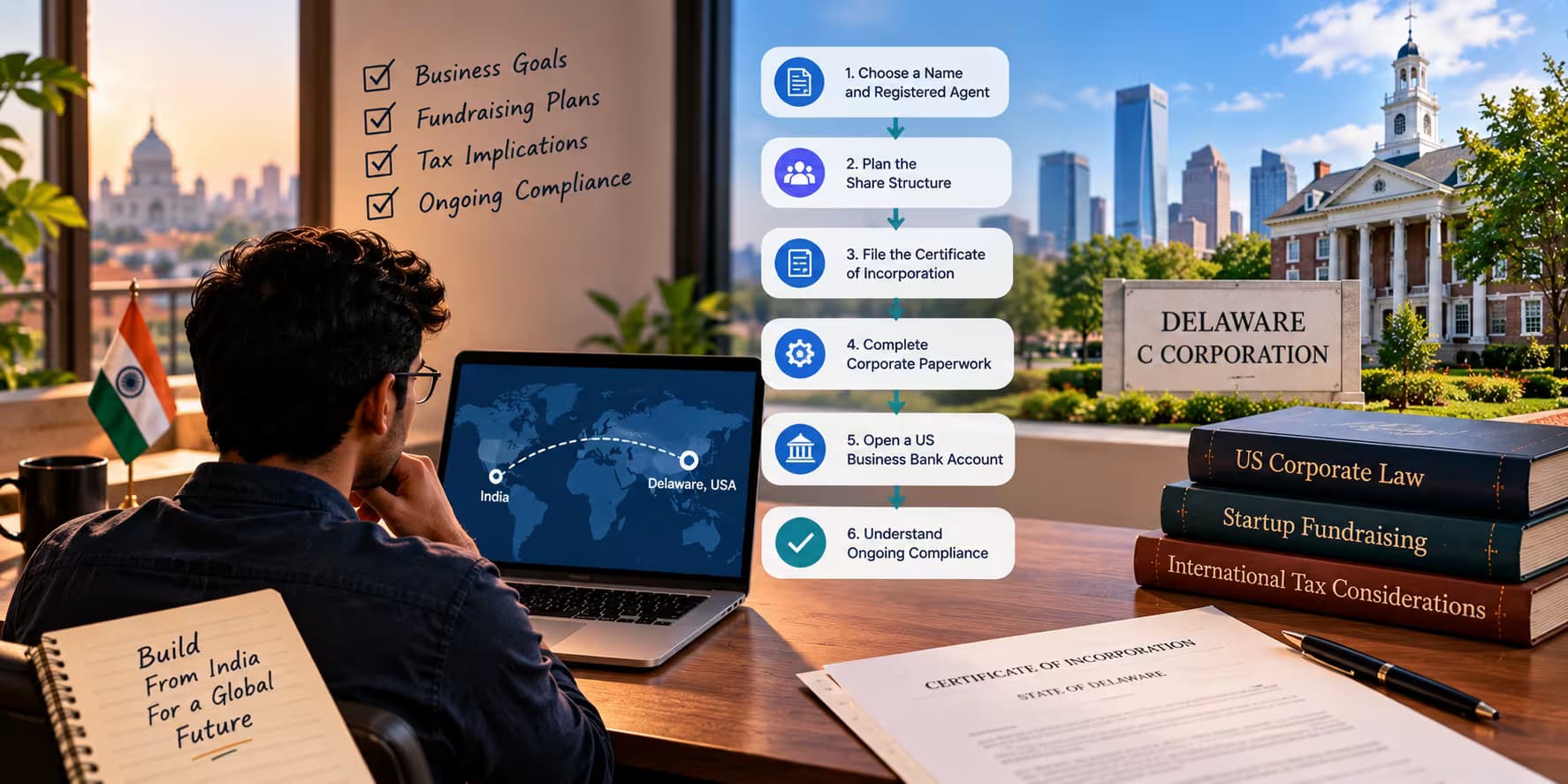
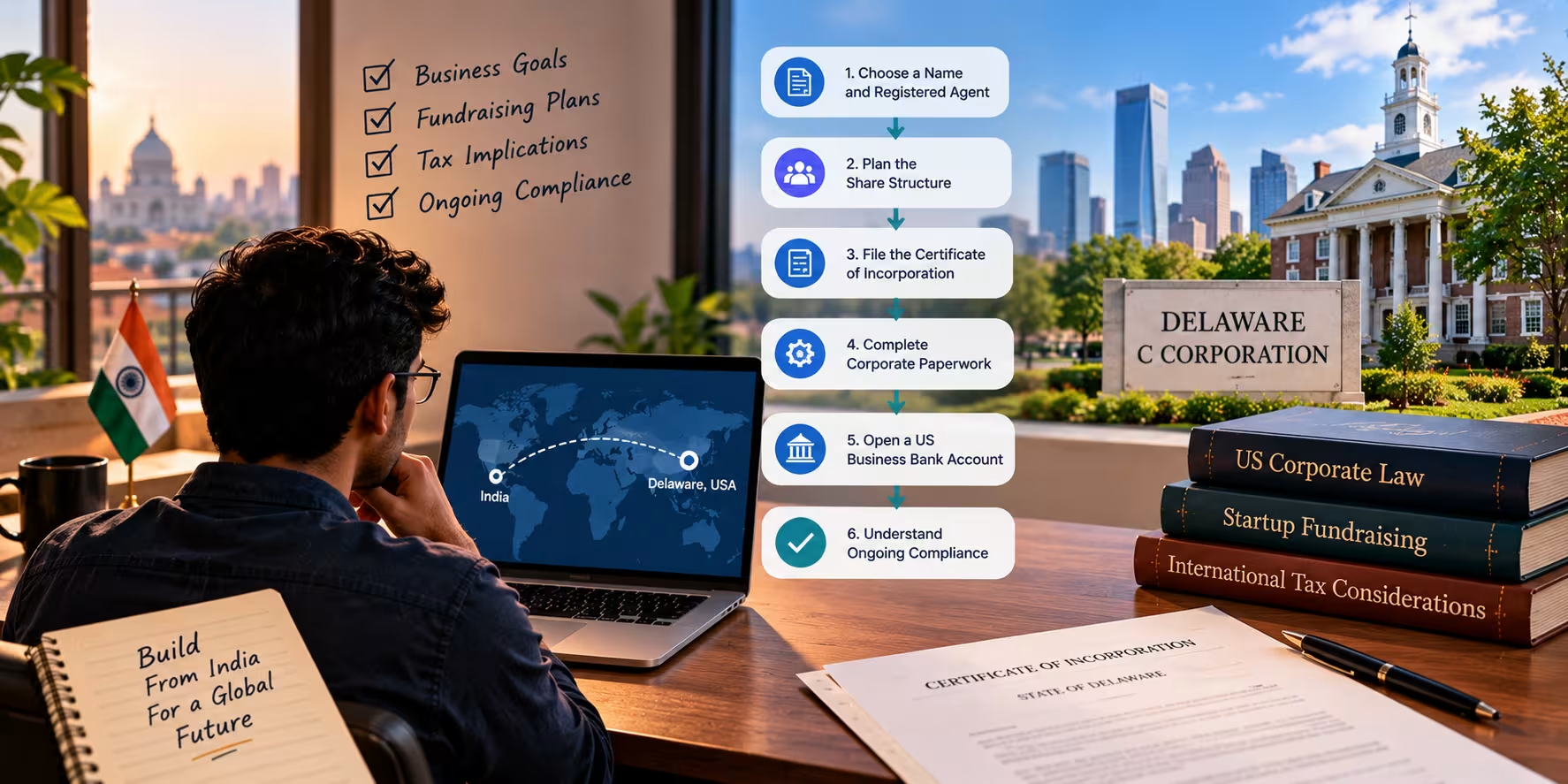
Once a founder decides that a C corporation fits their business goals, the formation process is manageable. The more important work is making informed decisions about ownership, shares, documentation, and ongoing compliance. Setting up a Delaware C-Corp from India involves more than filing incorporation documents; founders should also prepare for banking, tax administration, and their responsibilities after formation.
Step 1: Choose a Company Name and Registered Agent
Start by checking whether your preferred company name is available in Delaware. You will also need a registered agent with a physical address in the state to receive official notices and legal documents on the corporation's behalf.
A registered agent is an ongoing requirement, not just something to arrange on the day you incorporate. Before choosing one, understand the annual fee, renewal process, and what happens if you change providers.
Step 2: Plan the Share Structure Before Filing
A Delaware corporation's Certificate of Incorporation includes details such as the number of authorized shares and their par value. These decisions deserve more attention than they might initially appear to require.
For a startup, the share structure can affect franchise-tax calculations and the way founder equity and future investment are organized. Founders should consider anticipated ownership percentages, co-founder arrangements, employee equity, and fundraising plans before finalizing the documents.
Do not choose a share structure simply because it appears in a template or another startup's incorporation paperwork. Obtain appropriate legal and tax advice for your specific circumstances.
Step 3: File the Certificate of Incorporation
After confirming the name and preparing the required information, submit the Certificate of Incorporation to the Delaware Division of Corporations and pay the applicable state filing fee.
The corporation legally comes into existence once the filing is accepted. However, incorporation alone does not complete the company's organizational, tax, or operational setup.
Keep the approved formation documents in a secure place. You will need them for corporate records and may be asked to provide them when applying for financial services or completing other business processes.
Step 4: Complete the Corporate Paperwork
After formation, the company generally needs to establish its board and officers, adopt bylaws, approve founder share issuances, and maintain appropriate ownership records. The specific requirements depend on the company's circumstances and applicable law.
If founder shares are subject to vesting, speak with a qualified tax adviser promptly about whether a Section 83(b) election is relevant and whether a filing deadline applies. Do not assume that every founder needs the same election or that you can address it whenever convenient.
Proper documentation matters because investors and their legal teams may review the corporation's records during due diligence. Fixing incomplete share issuances or unclear ownership arrangements later can become more complicated and expensive.
Step 5: Apply for an EIN
A Delaware corporation generally needs an Employer Identification Number (EIN) for federal tax administration and various business activities.
Indian founders without a US Social Security Number may still be eligible to apply through the appropriate IRS process for international applicants. The application must be completed accurately, including the information requested about the responsible party.
An EIN is a tax identification number, not a guarantee of bank approval or permission to operate in every jurisdiction. For more information about the process, read my guide to getting a US EIN without an SSN.
Step 6: Prepare for Banking and Ongoing Compliance
Once your corporation has been formed and its EIN obtained, you can begin preparing for business banking and payment processing. Providers may request formation documents, tax identification details, identification documents, ownership information, and an explanation of the company's activities.
Approval is subject to the provider's eligibility criteria and review process. Incorporating in Delaware does not guarantee that a particular bank or payment platform will accept your application.
You should also plan for bookkeeping, federal tax returns, Delaware annual filings, franchise tax, registered-agent renewals, and any additional reporting obligations that apply to your company. These responsibilities should be part of your budget from the beginning rather than an afterthought.
What Indian Founders Should Check Before Issuing Shares
This is where I would slow the process down and make sure the founder has received advice specific to their situation.
If you are resident in India, acquiring shares in a foreign corporation can raise questions under India's overseas-investment framework. The applicable rules, reporting requirements, funding arrangements, and permitted routes depend on the transaction and the founder's circumstances.
Before transferring capital to a new Delaware corporation or finalizing its ownership structure, consult an Indian chartered accountant or qualified adviser familiar with FEMA and overseas investment. You may also need advice from a US attorney or tax professional to understand how the proposed structure works across both jurisdictions.
The key point is that being permitted to incorporate a company in Delaware does not automatically mean every method of funding or owning that company complies with Indian rules. The source of the investment, the nature of the business, the ownership arrangements, and the movement of funds may all matter.
Do not treat this as a routine paperwork step. Resolve the relevant questions before transferring money or issuing shares, particularly if multiple founders or future investors will be involved.
What Does a Delaware C Corporation Cost Every Year?
One mistake I try to prevent is treating incorporation as a one-time expense. A Delaware C corporation comes with recurring state and federal obligations, and the total cost depends on its structure and activities.
Delaware Franchise Tax and Annual Report
Delaware corporations generally need to file an annual report and pay franchise tax by March 1. The amount payable depends on the applicable calculation method and the company's share structure. Additional state filing or processing charges may also apply.
Because the calculation can vary significantly between corporations, check the current requirements before estimating your annual budget. Do not assume that every company will pay the same minimum amount.
Registered-Agent and Professional Fees
You should also budget for registered-agent services, bookkeeping, corporate recordkeeping, and any legal advice needed to maintain the company. If you change your ownership structure, issue new shares, or raise investment, additional professional fees may arise.
These costs can be worthwhile for a startup preparing for institutional investment. However, they may represent unnecessary overhead for a small, bootstrapped business that does not need a venture-backed corporate structure.
Federal Tax Returns and Information Reporting
A domestic C corporation generally has its own federal income-tax filing obligations. If the company has foreign ownership or engages in reportable transactions with related parties, additional information-reporting requirements may apply. Form 5472, for example, can be relevant when the applicable conditions are met.
Do not assume that every foreign-owned corporation has identical filing obligations. Confirm the company's specific requirements with a qualified tax professional and establish a reliable process for meeting deadlines.
When I Would Tell a Founder Not to Form a C Corporation
I would hesitate to recommend a Delaware C corporation if the founder has no clear fundraising plan, has not reviewed the Indian ownership and tax implications, or is choosing Delaware only because someone told them that investors prefer it.
A Delaware C-Corp from India may not be necessary for every founder. If you are running a small consulting agency or bootstrapped business without plans to raise outside investment, compare the ongoing costs and responsibilities with an LLC or other suitable structures before making a decision.
For founders who expect to build a business using their own revenue, the priorities may be simpler administration, manageable recurring costs, appropriate tax treatment, and a structure that supports day-to-day operations. An LLC may be worth evaluating, although it is not automatically the right choice for every non-resident founder.
The correct answer depends on ownership, tax treatment in the relevant countries, where the business operates, whether outside investment is expected, and how the company may evolve over time.
My rule is simple: understand what the founder wants the business to become before deciding how to register it.
How to Decide Whether a Delaware C-Corp Is Right for You
Before incorporating, I would work through a few practical questions. These are not a substitute for professional advice, but they can help you identify which issues need attention.
Are You Planning to Raise Venture Capital?
If you are building a startup with a realistic plan to raise venture capital, issue employee equity, or accommodate multiple investment rounds, a Delaware C corporation may be a strong candidate. Its corporate structure is familiar to many US venture investors and can support conventional equity financing.
If fundraising is only a vague possibility with no clear timeline or strategy, consider whether you need that structure immediately. Your decision should account for both your current needs and the likely cost and complexity of changing structures later.
Will Your Business Be Bootstrapped?
If you plan to fund the business through customer revenue and have no intention of bringing in equity investors, compare the C corporation's ongoing responsibilities with those of an LLC or other suitable structure.
For a business that mainly needs to serve international clients, issue invoices, and manage payments, the benefits of a corporation may not justify its additional complexity. The answer still depends on the specific tax and legal circumstances.
Have You Reviewed the India-Side Implications?
If you are resident in India, do not finalize the ownership or funding arrangements without understanding the applicable Indian rules. Review the proposed investment route, relevant reporting requirements, and potential tax implications with qualified professionals.
Can You Maintain the Company Properly?
Be realistic about your ability to manage annual filings, tax returns, accounting, corporate records, and professional support. A structure that fits your fundraising plans still needs to be maintained correctly after formation.
If you need help comparing your options before making a decision, you can explore US business formation services and review the support available for non-resident founders.
Frequently Asked Questions
Can an Indian Resident Set Up a Delaware C Corporation From India?
An Indian resident can generally explore forming a Delaware corporation without travelling to the United States. However, the formation process and the founder's ownership, funding, tax, and reporting obligations are separate questions. Before proceeding, obtain advice on the applicable US requirements and Indian overseas-investment rules.
Do I Need a US Social Security Number to Form a Delaware C Corporation?
A US Social Security Number is not generally a prerequisite for every foreign founder to incorporate a Delaware corporation. However, individual service providers and later processes may have their own identification requirements. Applying for an EIN also follows a separate process, and eligible international applicants may be able to apply without an SSN.
Is a Delaware C Corporation Better Than an LLC for Indian Founders?
Not automatically. A C corporation may be suitable for a startup planning to raise venture capital or issue conventional corporate equity. An LLC may be worth considering for a founder seeking a simpler operating structure. The right choice depends on the business model, ownership, fundraising plans, and tax and legal treatment in both countries.
What Are the Main Ongoing Costs of a Delaware C Corporation?
Common expenses include Delaware franchise tax, the annual report fee, registered-agent services, accounting, tax preparation, and legal or corporate-recordkeeping support. The actual total depends on the company's share structure, activities, and reporting obligations.
Can I Open a US Business Bank Account After Incorporation?
You may be eligible to apply for a US business bank account after forming the corporation and obtaining the required documentation. However, approval depends on the bank or financial provider's eligibility criteria and compliance review. Incorporation and an EIN do not guarantee approval.
Should I Issue Founder Shares Immediately After Incorporation?
Founder share issuances should be planned and documented properly. The appropriate timing and paperwork depend on the corporation's structure and the founder arrangements. If vesting or a potential Section 83(b) election is relevant, seek qualified advice promptly so you do not overlook an applicable deadline.
My Final Advice
If you are considering a Delaware C-Corp from India, remember that filing the incorporation document is usually the straightforward part. Choosing the right structure, documenting founder shares, reviewing Indian investment rules, and maintaining the corporation are the decisions that deserve the most attention.
For an Indian startup preparing for venture capital, a Delaware C corporation may be a sensible foundation. For a founder building a business through customer revenue without outside investors, I would first ask whether that added complexity is necessary.
The best company structure is not the one that sounds most impressive. It is the one that fits the business you intend to build.
This article is for general informational purposes only and does not constitute legal, tax, or financial advice. Tousif Akram and FormLLC are not a law firm or CPA firm. Consult a licensed professional for advice specific to your situation.
Ready to Form Your US LLC?
Free 30-minute consultation with no obligation and no sales pressure.
Book Free Call