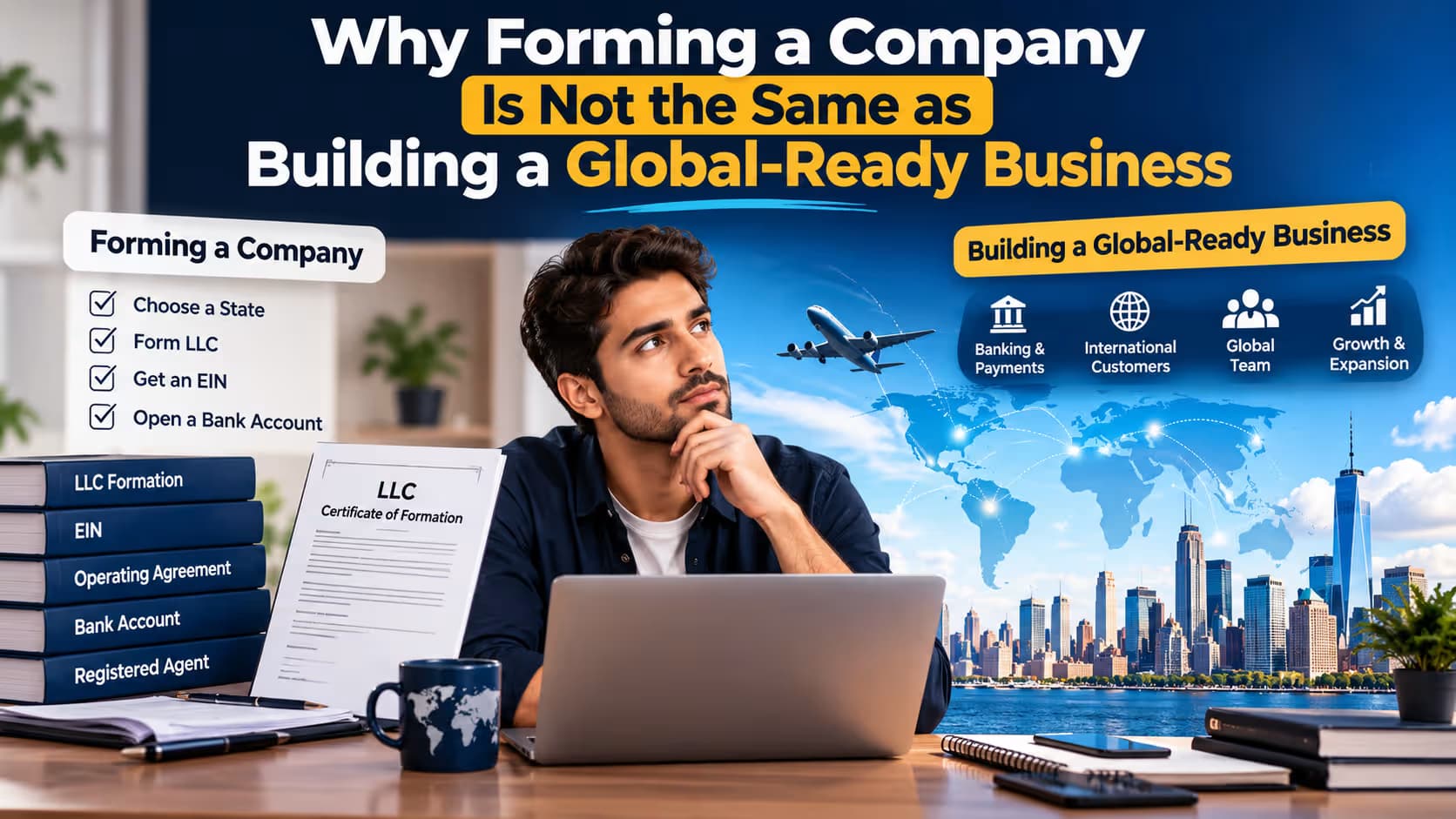
Why Forming a Company Is Not the Same as Building a Global-Ready Business

Tousif Akram
IRS CAA | Founder, FormLLC
Why Forming a Company Is Not the Same as Building a Global-Ready Business
One thing I have learned after working with thousands of entrepreneurs is that many founders confuse having a company with having a business. The difference becomes even bigger when you are building from outside the United States. A founder may form a Wyoming LLC, receive an EIN, open a business account, and feel like the difficult part is finished. I understand that feeling because company formation is a visible milestone. You have documents, a company name, and something official that proves you have created a business entity. But the entity is only the structure. The real business still has to be built.
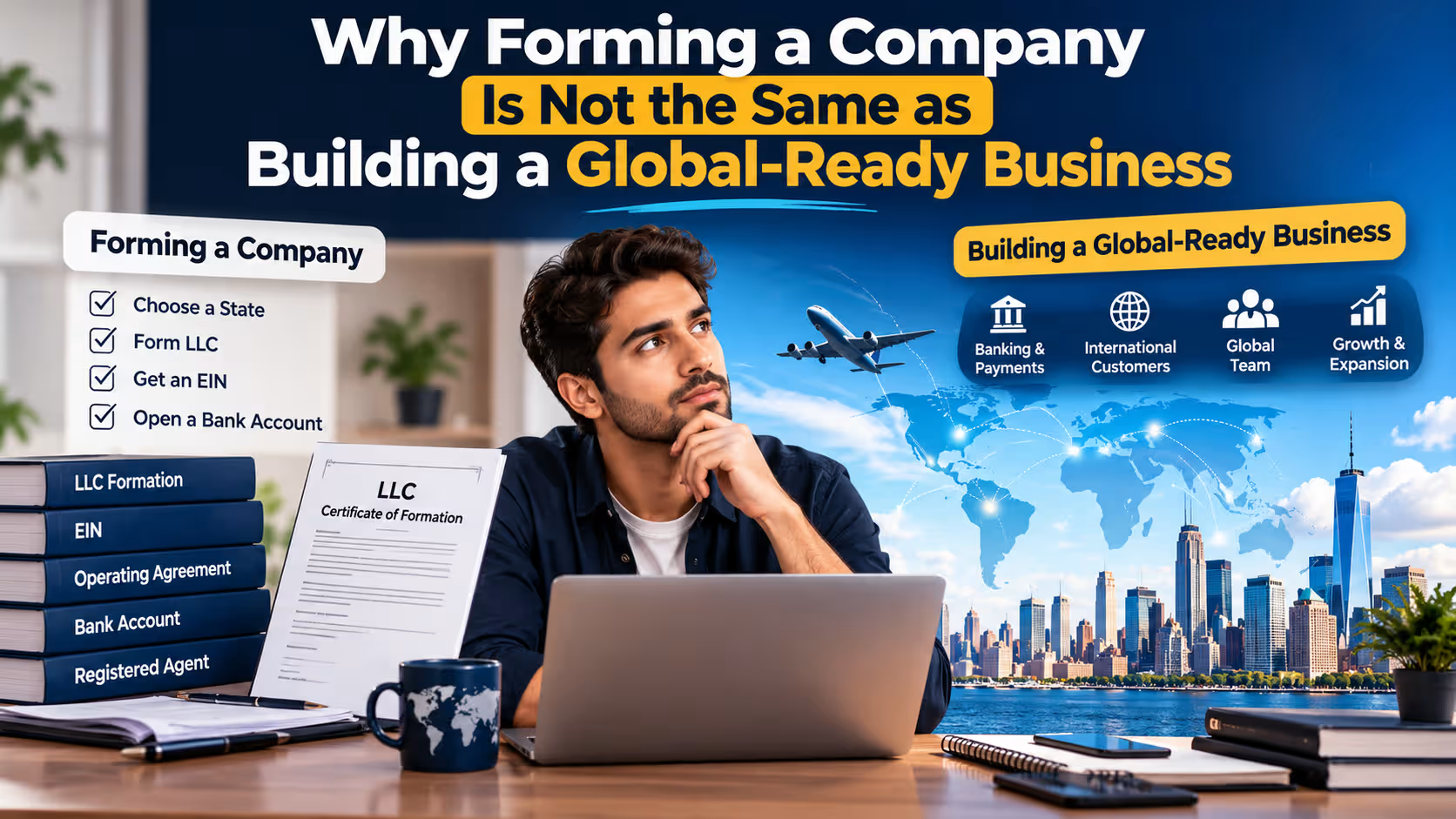
A US LLC Is a Structure, Not a Finished Business
When I started helping international founders, I initially thought the biggest challenge was getting the company formation right. Over time, I realized that formation is often one of the easier parts. The harder questions come afterward: How will you receive money? How will you pay suppliers? How will you handle taxes and compliance? How will customers trust you? Which payment processors can you use? Where will your team work? How will you manage the company from your home country?
Even something as basic as an EIN is only one piece of the system. The IRS explains that an EIN can be used for purposes such as opening a bank account, but the tax treatment and reporting obligations of an LLC depend on its ownership, elections, and circumstances. If you are a non-US founder who needs an EIN, our guide on how to get an EIN without an SSN explains the process in more detail.
This is where I think many non-US founders make their first mistake: they build the company structure before thinking deeply about the business that structure is supposed to support.
Build the Business Before Optimizing the Entity
I have seen founders spend a lot of time comparing states, formation prices, and registered-agent packages while spending very little time thinking about their actual operations. Choosing the right structure matters, but the structure should serve the business rather than become the main objective.
If your customers are in the United States, your team is in India, your software is hosted somewhere else, your payments come through several platforms, and your suppliers are spread across different countries, your business is already global whether your website says so or not.
That creates a different set of responsibilities.
You need systems for banking, payments, accounting, tax reporting, contracts, customer support, data, compliance, and eventually hiring. You also need to understand which responsibilities belong to the company and which belong to you personally.
If you're still deciding whether a US company fits your situation, our US LLC guide for non-resident founders can help you understand the broader formation and operating considerations.
A Global Business Needs More Than Company Documents
For an international founder, forming a US company does not erase the realities of operating from another country. Your US entity may have its own US obligations while you may also have obligations in the country where you personally live and operate.
That is why I now think about a US company as infrastructure, not the finished product.
The goal should not simply be to have a US LLC. The goal should be to build a business that can actually operate through it.
That means thinking about how money enters the business, how expenses are paid, how transactions are recorded, how customers are served, how contracts are managed, and how compliance responsibilities are handled.
For example, having an LLC and EIN does not automatically mean that every bank or payment platform will approve your application. Banking providers have their own requirements and may want to understand your business, ownership, location, customers, expected transactions, and source of funds. If banking is part of your plan, our guide on how to open a US bank account as a non-resident LLC owner is a useful next step.
The Real Work Starts After Formation
I also learned this from customers. Some founders come to us thinking their biggest problem is forming the company. A few months later, their questions are completely different. They are asking about banking, payment gateways, compliance, bookkeeping, taxes, websites, contracts, and how to operate internationally.
That is the real Day 2.
And honestly, this is one of the reasons I believe company-formation businesses should not simply disappear after sending the formation documents. A founder does not wake up the next morning thinking, “Great, I have an LLC. My work is finished.”
They wake up thinking, “Now how do I build this?”
That shift in perspective is important because formation is a transaction, while building a business is an ongoing process.
Banking and Payments Are Part of the Business Infrastructure
A company can exist on paper without having a practical system for receiving and moving money. A global-ready business needs to think about banking and payments as part of its operating infrastructure.
For a non-US founder, that may mean understanding which financial providers are available, what documentation they require, how customer payments will arrive, how international expenses will be handled, and how business transactions will be separated from personal finances.
The same principle applies to payment processors. Being incorporated in the United States does not automatically mean that every payment provider will accept your business.
The business model, ownership, geography, transaction flow, and provider requirements all matter.
This is why I recommend thinking about banking and payments before formation rather than treating them as problems to solve afterward.
Compliance Is Part of Building the Business
Another part of becoming global-ready is understanding that compliance doesn't end when your LLC is approved.
Depending on the company's ownership, tax classification, state, and activities, there can be federal, state, and other reporting responsibilities. For some foreign-owned US entities, specific federal information-reporting requirements may also apply.
This is one reason I encourage founders to learn about their obligations early rather than waiting until they receive a notice or discover a missed filing.
If your business is foreign-owned, you can also read our guide on Form 5472 for foreign-owned US LLCs to understand why certain US LLCs can have additional information-reporting responsibilities.
The exact requirements depend on the company's circumstances, so formation should be viewed as the beginning of the compliance process rather than the end of it.
Your Customers See a Business, Not Just an LLC
Another lesson I have learned is that customers generally don't care that much about the certificate of formation.
They care whether you can solve their problem.
They want to know whether your company looks legitimate, whether you communicate professionally, whether you can deliver what you promised, whether payments work smoothly, whether contracts are clear, and whether someone is available when they need support.
That means building a global-ready business also involves creating a professional customer experience.
Your website, email address, proposals, contracts, invoices, payment process, customer support, and company information should work together.
The LLC may establish the legal structure, but your operations establish the business.
A Global-Ready Business Is Designed Around Operations
A global-ready business is therefore not defined simply by where the company was registered. It is defined by whether the business has the infrastructure to serve customers, move money, stay organized, and remain compliant across borders.
That requires thinking beyond the formation certificate.
You may need systems for accounting, bookkeeping, contracts, payments, customer support, document storage, team communication, data management, and compliance. The exact systems will depend on the size and nature of the business, but the principle remains the same: the company structure should support the way the business actually operates.
This is particularly important when your company, customers, founders, employees, contractors, and suppliers are located in different countries.
Not Every Founder Needs a US Company
I don't believe every entrepreneur needs a US company either.
The right structure depends on what the founder is building, where the business operates, who the customers are, and what the business actually needs. A company should solve a business problem, not become the business itself.
For some international founders, a US LLC may fit their business model. For others, another structure or a company in their home country may make more sense.
The important thing is to start with the business rather than assuming the company structure is the answer to every problem.
Choose the structure around the business you are trying to build, not the other way around.
Think Beyond Company Formation
My biggest lesson from working with international founders is simple: don't build a company just so you can say you have one. Build the company around the business you are trying to create.
The LLC is the beginning of the journey.
After formation, the real work starts. You need to build the systems that allow the business to accept money, serve customers, manage expenses, maintain records, handle compliance, and operate across borders.
That is what turns a company into an operating business.
And if your goal is to build something that can serve customers internationally, the question shouldn't simply be, “How do I form a US company?”
A better question is:
“What does my business need to operate successfully after the company is formed?”
That is where the journey from a US LLC to a global-ready business really begins.
This article is for general informational purposes only and does not constitute legal, tax, or financial advice. Tousif Akram and FormLLC are not a law firm or CPA firm. Consult a licensed professional for advice specific to your situation.
Ready to Form Your US LLC?
Free 30-minute consultation with no obligation and no sales pressure.
Book Free Call