Why Opening a US Bank Account Is Often Harder Than Registering the Company

Tousif Akram
IRS CAA | Founder, FormLLC
Why Opening a US Bank Account Is Often Harder Than Registering the Company
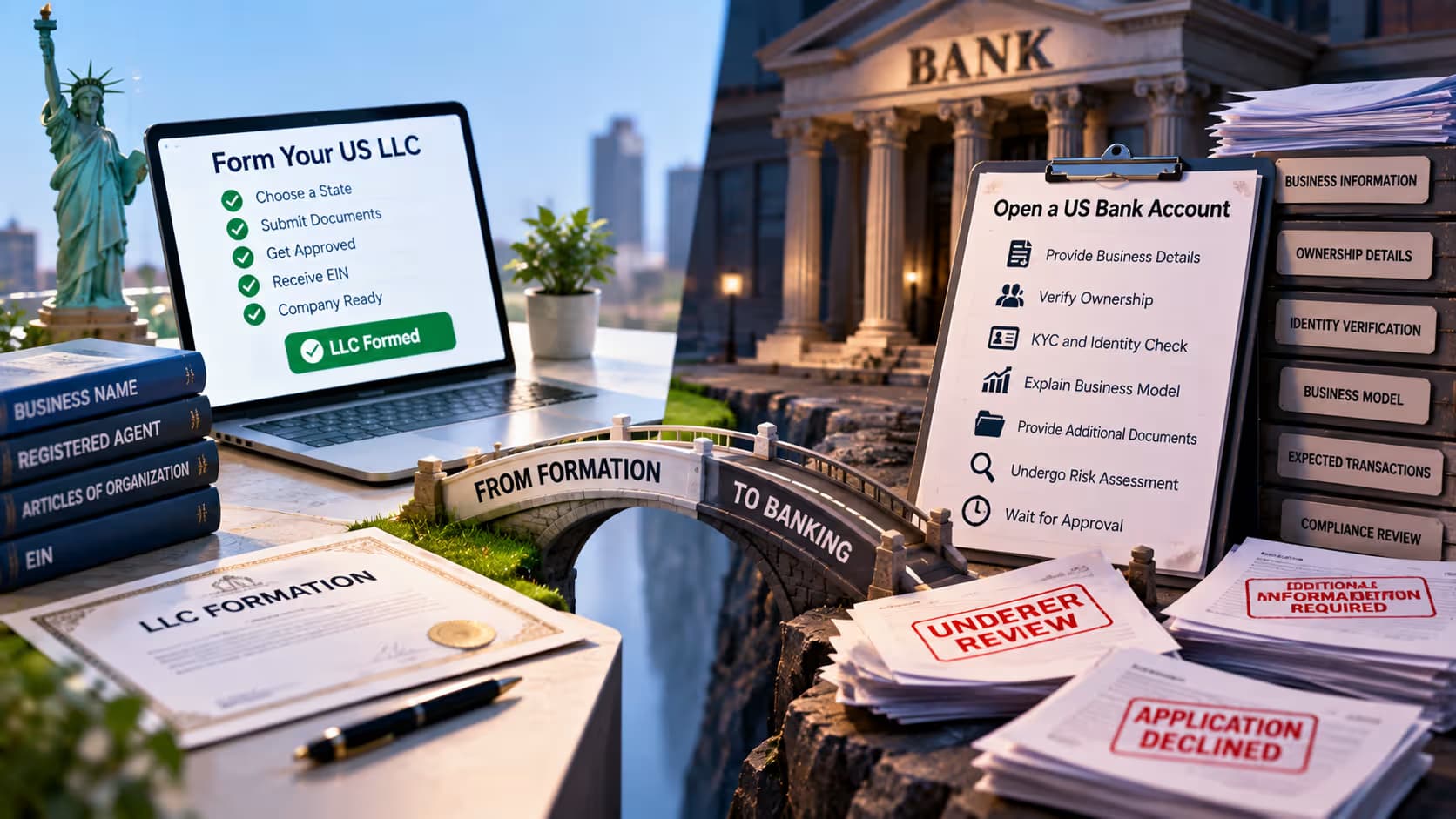
Opening a US bank account can be more complicated than forming the company itself, especially for international founders. When a founder comes to us to form a US company, I often hear the same assumption: “Once my LLC is formed, opening the bank account should be easy.” It sounds logical. You have a company name, formation documents, and eventually an EIN, so why shouldn't a bank simply open an account? After working with international founders for years, I have learned that registering the company and getting approved for business banking are two completely different decisions.
Why Opening a US Bank Account Is Different From Forming an LLC
When you form an LLC, the state is processing the creation of a legal entity. The process is primarily about registering the company and satisfying the state's formation requirements.
Banking is different.
A bank or financial platform needs to understand the business and the people behind it. Depending on the provider, you may be asked about the company's business address, industry, ownership, expected sales, customers, suppliers, employees, and the types and volume of transactions the account is expected to handle.
That means having an LLC does not automatically mean you have a bank account.
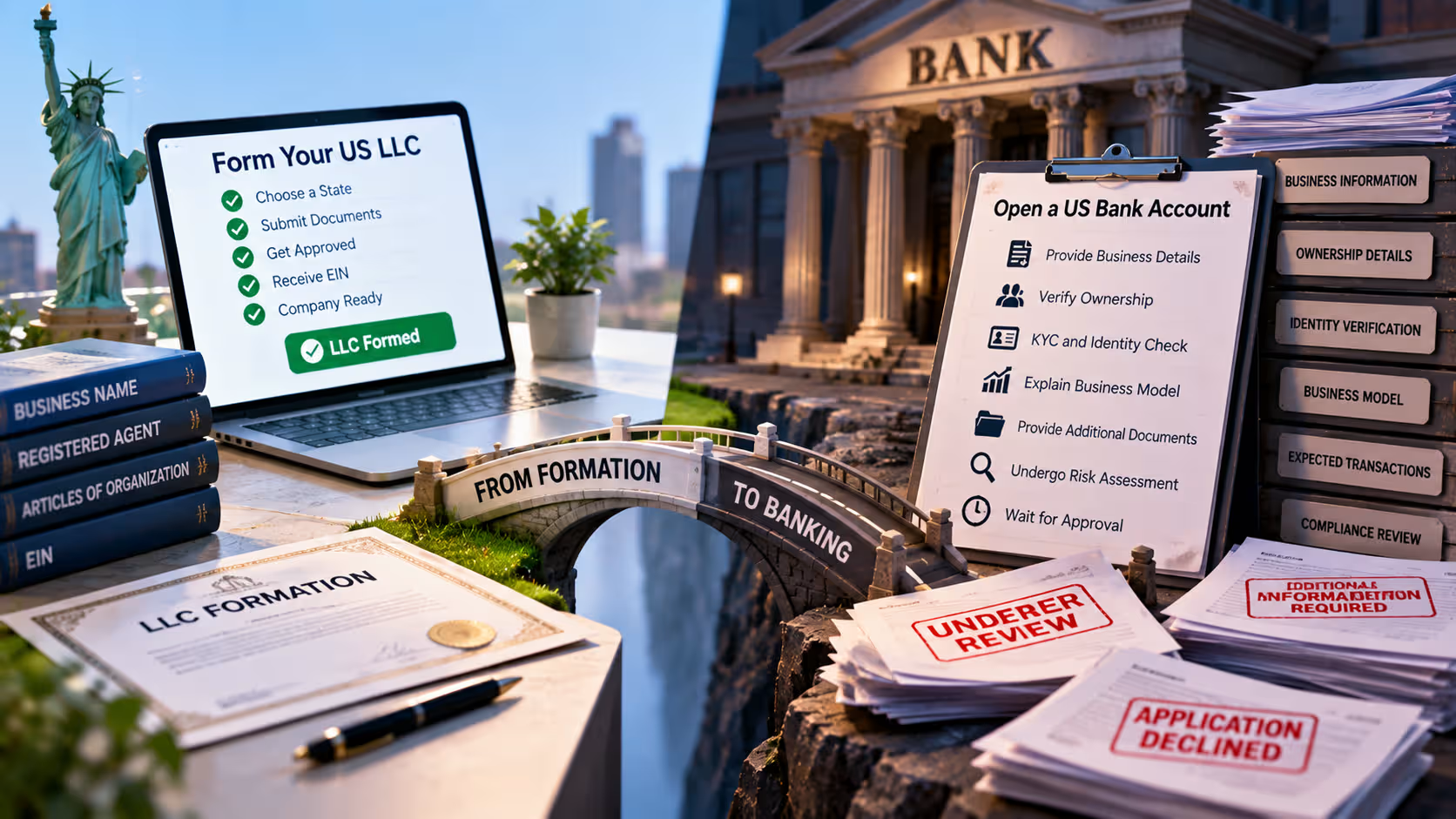
The company can exist legally while the banking application is still being reviewed, declined, or delayed.
International Founders Face an Additional Layer
For a non-US founder, the situation can involve another layer of questions.
You might live in India while your company is registered in Wyoming. Your customers could be in the United States and Europe. You may have no US employees and operate the business entirely online.
None of those facts automatically mean you cannot apply for a US business account. Some financial platforms specifically work with eligible international founders and US companies owned by people living outside the United States.
But there is an important distinction that I always want founders to understand:
Being eligible to apply does not mean approval is guaranteed.
Every financial institution has its own eligibility, verification, risk, and compliance requirements.
Your Business Story Matters to the Bank
I have seen founders spend a lot of time getting their LLC formed and then realize they were not prepared to explain the business clearly to the banking provider.
Sometimes the website does not clearly describe what the company sells. Sometimes the business address creates questions. Sometimes ownership information is not organized properly. In other cases, the founder simply does not understand what documents the provider is requesting.
These issues can create unnecessary friction during the application.
That is why I believe founders should prepare their business information and documentation before they reach the banking stage.
You should be able to clearly explain what the company does, who owns it, where the business operates, who the customers are, how the company expects to make money, and what kinds of transactions the account will handle.
An EIN Does Not Guarantee Banking Approval
Another assumption I hear is that getting an EIN means the difficult part is finished.
It does not.
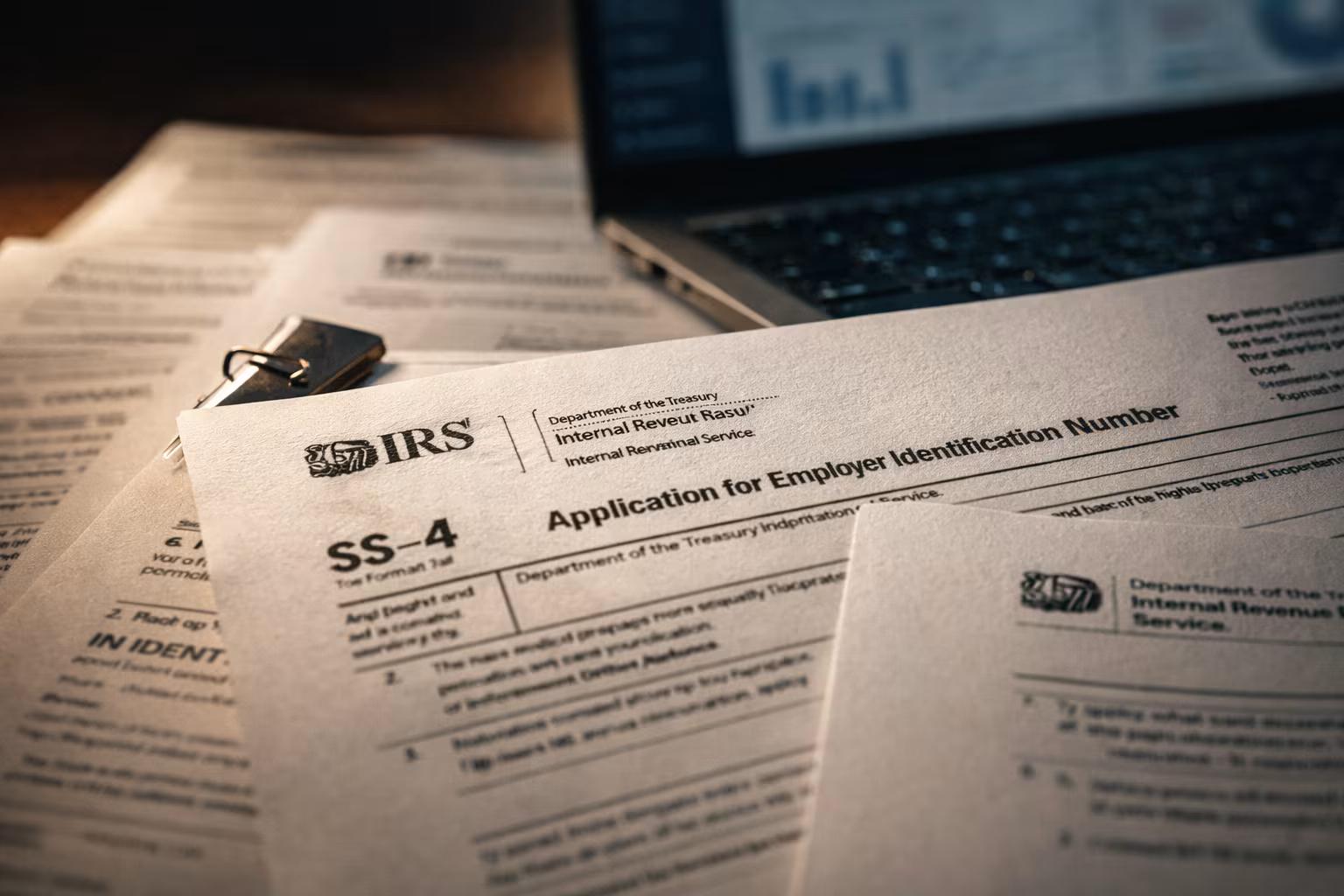
An EIN is an important federal tax identification number for many US businesses, but it does not guarantee approval for a business bank account or financial platform.
The same applies to your LLC formation documents.
Formation documents prove that the company exists. They do not guarantee that a financial institution will approve the company's account application.
That distinction is particularly important for non-US founders who may assume that completing the formation process automatically unlocks the rest of the US business infrastructure.
If you still need an EIN, our guide on getting an EIN without an SSN explains the process for non-resident founders.
Banking Should Be Considered Before Company Formation
This is one of the biggest lessons I have learned from working with international entrepreneurs.
I believe banking should be considered before company formation, rather than treated as something you figure out after everything else is finished.
You should have a basic idea of how your business makes money, where your customers are located, how you expect to receive payments, what currencies you may handle, and which financial platforms your business may need.
That does not mean you need to know exactly which provider will approve your application before forming the company.
It means you should understand the banking requirements that are relevant to your business before choosing the structure.
Your Banking Needs Depend on the Business
A founder running a small consulting company may have very different banking needs from a SaaS business processing recurring subscriptions or an e-commerce company receiving payments from customers around the world.
You may need to receive USD payments, pay international contractors, connect a payment processor, send money to suppliers, manage recurring expenses, or maintain multiple financial accounts.
That is why I would not tell every founder to use the same banking provider.
The right banking setup depends on what the business actually does.
Before choosing an account, think about how money will enter the business, where it will go, how frequently transactions will occur, and which payment platforms need to connect to the account.
A US LLC Does Not Automatically Solve Payments
Banking is also different from payment processing.
A founder may successfully form a US LLC and later discover that a particular payment platform has separate eligibility requirements.
The same principle applies to financial services generally. Your LLC is the underlying business entity, but banks, payment processors, fintech platforms, and other providers can each have their own onboarding processes.
So I encourage founders to think of the business as a system rather than a collection of disconnected steps.
Company formation, EIN registration, banking, payment processing, and compliance are related, but they are not the same thing.
If you are still planning the overall structure, our US LLC guide for non-resident founders can help you understand the broader formation process.
Banking Is Part of Building the Operating Business
This is where the difference becomes especially important.
You can have an LLC that exists legally but still struggle to operate the business if you cannot establish the financial infrastructure you need.
A functioning business may need to receive customer payments, pay vendors and contractors, manage operating expenses, move funds, and connect other financial tools.
The bank account becomes part of the bridge between the company on paper and the company that actually operates.
That is why I do not like treating banking as an afterthought.
The company is not truly operational just because the formation certificate has arrived.
What I Tell Founders About Banking Support
This is also where FormLLC tries to make the process easier for the founders we work with.
We do not want to tell a founder, “Here is your LLC—good luck with the bank.”
Our banking support is designed around the questions non-resident founders commonly face. We help founders understand available banking and fintech options, prepare the information and documents they may need, and work through issues that can arise during an application.
Depending on the founder's business and circumstances, that can include discussing providers such as Mercury, Wise Business, Payoneer, or Relay.
The important word here is guidance.
We do not control a bank's decision, and we do not promise approval. Every financial institution has its own underwriting and compliance process.
Our role is to help the founder approach that process properly and avoid preventable mistakes.
Do Not Choose a Bank Based Only on a Recommendation
I also think founders should be careful about treating someone else's successful banking experience as a guarantee for their own business.
A provider that worked for one founder may have different requirements for another company.
The business model may be different. The ownership may be different. The transaction volume may be different. The founder's country of residence may be different. The company's documentation may be different.
So rather than asking only, “Which bank did another founder use?”, I would ask, “What does my business need from its financial provider, and do I meet that provider's current requirements?”
That approach gives you a more useful starting point.
Prepare Before You Submit the Application
One practical lesson I have learned is that preparation can make the banking process much easier to navigate.
Before applying, make sure your company information is consistent across your formation documents, EIN records, website, business address, ownership information, and other relevant materials.
You should also understand your business model well enough to explain what you sell, who your customers are, where your business operates, and what transactions you expect.
The goal is not to create a complicated presentation for the bank.
The goal is simply to make sure your business information is clear, accurate, and consistent.
Banking Is One Part of the Bigger Compliance Picture
There is another reason I encourage founders to think about banking as part of the broader business structure.
Opening an account does not remove your other responsibilities.
Depending on the company and its ownership, there may still be state compliance requirements, federal reporting obligations, bookkeeping responsibilities, and tax filings.
For certain foreign-owned US disregarded entities, for example, Form 5472 and a pro forma Form 1120 can be required in applicable circumstances.
Our guide on Form 5472 for foreign-owned US LLCs explains why federal reporting should be considered separately from the banking question.
The Bank Account Is Not the Finish Line
I think international founders sometimes imagine the process as a simple sequence:
Form the LLC → get the EIN → open the bank account → everything is finished.
In reality, each step can have its own requirements.
The LLC creates the legal structure. The EIN provides federal identification where required. The bank or financial platform provides part of the operating infrastructure. Payment providers handle their own processes. Compliance and tax responsibilities continue after formation.
Once you understand that, the process becomes much easier to approach realistically.
What I Want Non-US Founders to Understand
After working with international entrepreneurs for years, my view has become straightforward.
Do not think of banking as the step after company formation. Think of it as part of building the company from the beginning.
Before forming the LLC, understand what your business does, where your customers are, how you expect money to move, and what financial infrastructure you may need.
Then choose the company structure and service providers with those requirements in mind.
A US LLC can give you the legal structure for your business, but it does not automatically give you banking, payment processing, or financial approval.
The LLC creates the structure. The bank account helps turn that structure into an operating business.
And for a founder sitting thousands of miles away from the United States, understanding the banking process before formation can save a lot of confusion later.
That is one of the reasons we built FormLLC in the first place. We do not want to stop at “your company is formed.” We want founders to understand what comes next.
This article is for general informational purposes only and does not constitute legal, tax, or financial advice. Tousif Akram and FormLLC are not a law firm or CPA firm. Consult a licensed professional for advice specific to your situation.
Ready to Form Your US LLC?
Free 30-minute consultation with no obligation and no sales pressure.
Book Free Call