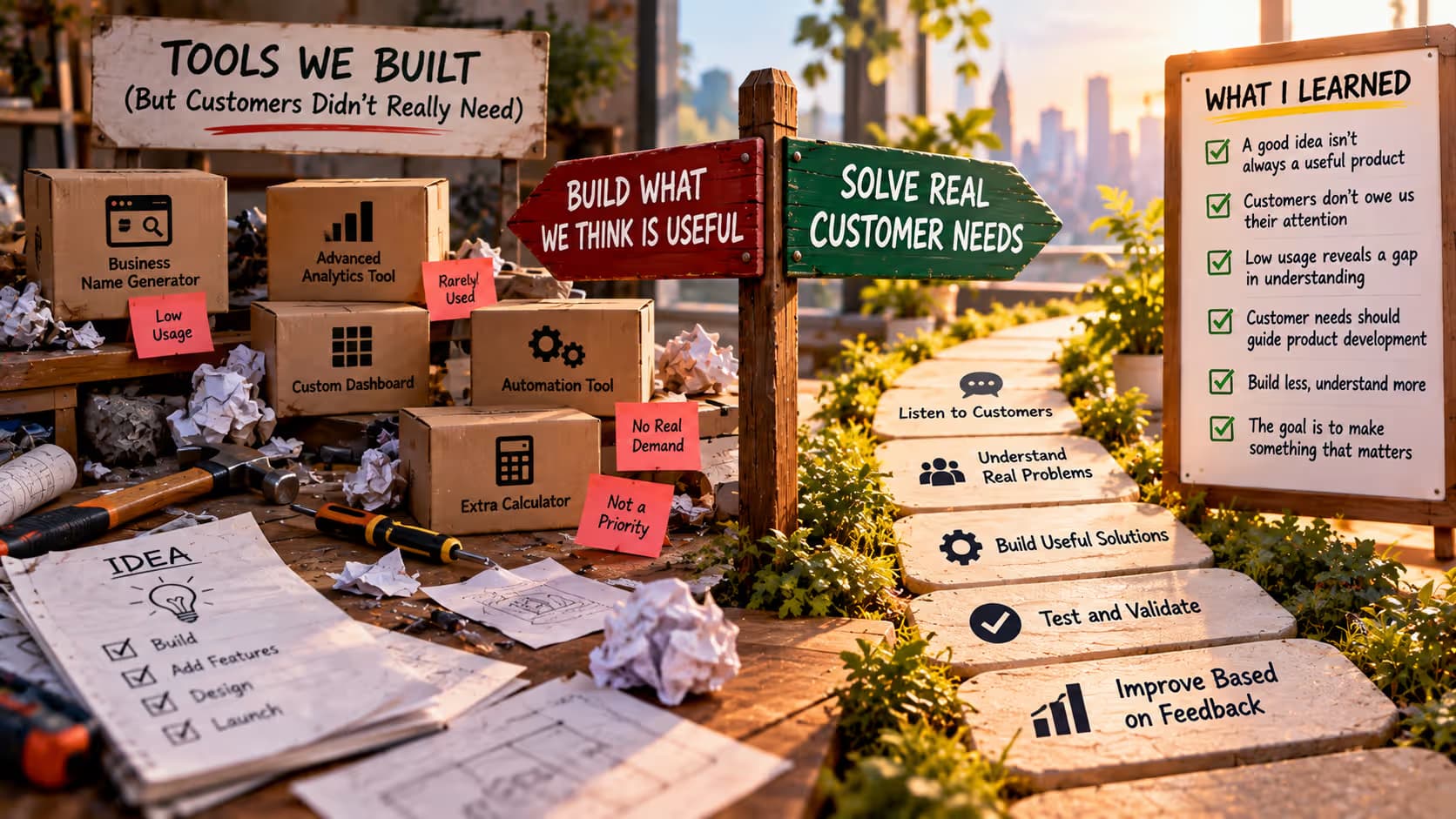
Why Customer Needs Should Guide Product Development

Tousif Akram
IRS CAA | Founder, FormLLC
We Built Tools Our Customers Didn't Really Need — Here's What I Learned
Understanding customer needs is one of the most important lessons I have learned while building FormLLC. When you build a business, it is easy to believe that every new idea has the potential to make things better. You notice a problem, imagine a solution, and start thinking about how to turn it into a feature or a tool. As a founder, that instinct can be useful because it pushes you to experiment and improve what you offer.
But I learned something important while building FormLLC: just because we can build something doesn't mean our customers actually need it.
There were times when we invested effort in building tools that we believed would improve the customer experience. The intention was good. We wanted to make things easier, offer more value, and create something useful beyond our core service. But the response and usage were not always what we expected. That experience changed how I think about product development and reminded me that understanding customer needs should come before adding more features.
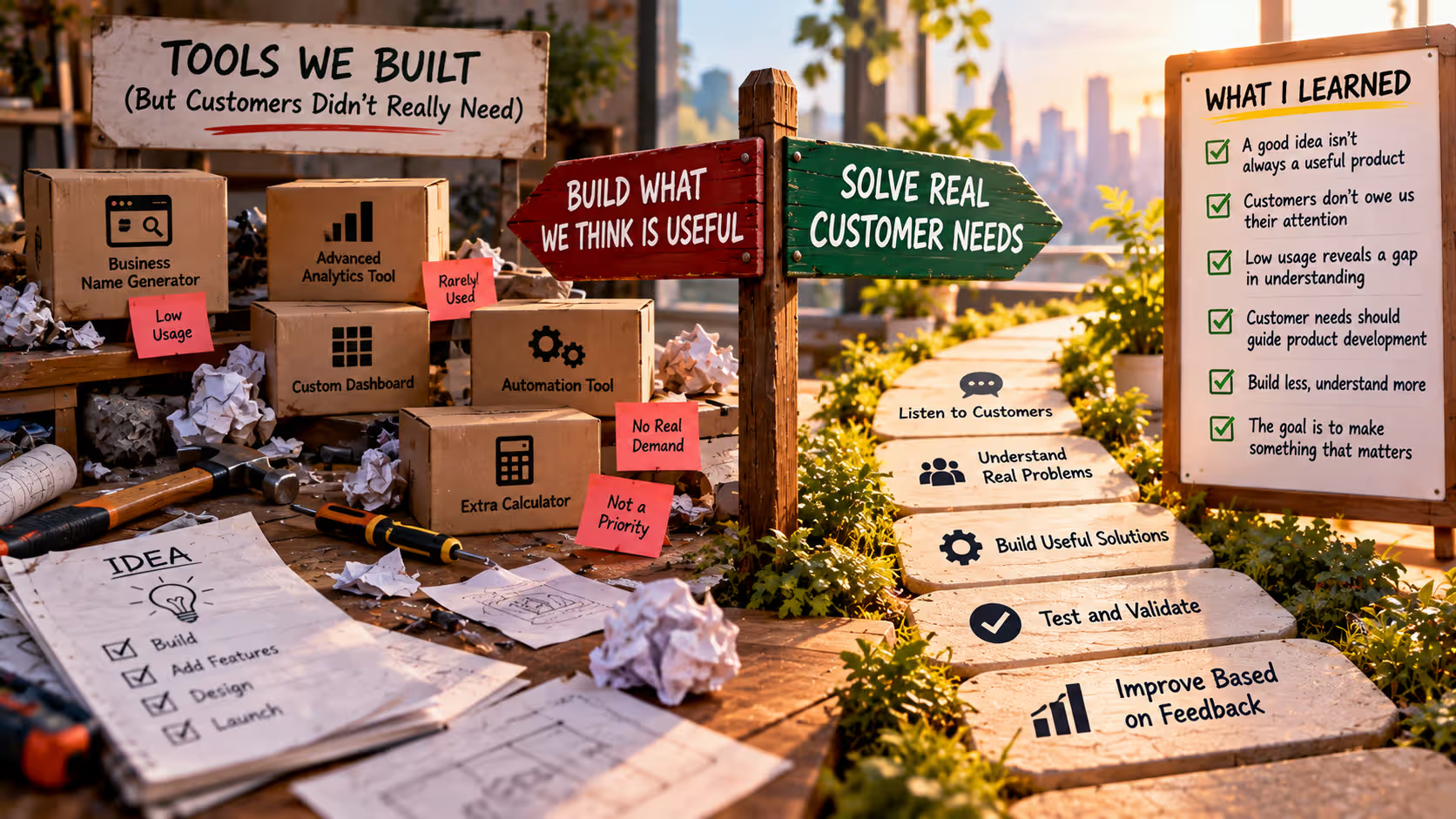
A Good Idea Is Not Always a Useful Product
One mistake founders can make is judging an idea from their own perspective. Something may look useful when we discuss it internally, plan its features, and imagine how customers might use it. But the customer's priorities can be very different. We may spend time thinking about how a tool works, how it looks, or how many features it offers, while the customer may simply want one problem solved without another process to learn.
I began to understand that the value of a tool is not measured by how much effort goes into building it. It is measured by whether it genuinely helps someone do something they already need to do. A product can be technically sound and still fail to become part of a customer's routine. That doesn't necessarily mean the product is badly built. Sometimes it means we misunderstood the problem or created something that wasn't important enough to the people we wanted to help.
Solve a Real Problem Before Adding Features
Before investing time in a new tool, founders should ask a simple question: What specific customer problem will this solve? If the answer is unclear, the idea may need more research before development begins.
Understanding customer needs also means recognizing the difference between something that sounds interesting and something that makes a customer's work easier. A simple feature that removes a frustrating step may be more valuable than a complicated tool with several options that customers rarely use.
Customers Don't Owe Us Their Attention
This was another important lesson. When a founder builds something, there is naturally a sense of excitement and attachment. We want people to try it. We want them to appreciate the work behind it. But customers are not evaluating our effort. They are trying to get their own work done.
If a tool adds another step, creates confusion, or solves a problem that isn't important to them, they may simply ignore it. And that response is useful information. Low usage should make us curious, not defensive. Instead of asking why customers aren't using something we worked hard to create, we should ask whether we understood their needs in the first place.
That shift sounds small, but it changes the way a company makes decisions. It encourages founders to look at customer behaviour honestly rather than assuming that every feature deserves attention simply because the team invested time in creating it.
Low Usage Can Reveal a Gap in Understanding
When customers don't use a tool, there may be several reasons. They might not understand how it works, they may not need it, or the tool may not fit naturally into their existing process. Rather than immediately adding more features, it is worth finding out what is preventing people from using it.
Customer feedback, support conversations, and actual usage patterns can help identify the problem. Sometimes the right improvement is a simpler interface. In other cases, the best decision may be to stop investing in a feature that does not solve an important customer problem.
Why Customer Needs Should Guide Product Development
I now believe that product development should not happen only inside a founder's head or a team's planning meetings. It should be connected to real customer behaviour. What questions do customers repeatedly ask? Where do they get stuck? Which parts of the service do they actually use? What do they keep asking us to explain? These observations can reveal more than a long list of feature ideas.
In a business like FormLLC, customers come to us because they want to establish and operate a US company. Their attention is on getting the important things done, understanding the process, and knowing what comes next. Any additional tool or feature should support that journey rather than distract from it.
I have learned to value repeated customer problems more than ideas that sound exciting in a planning session. When the same question comes up in multiple customer conversations, it may indicate an area where better information, a clearer process, or a more useful service could make a real difference.
Use Customer Questions to Improve the Experience
For example, international founders may have questions about choosing a state, obtaining an EIN, or understanding their responsibilities after forming a company. Our US LLC guide for non-resident founders and guide to getting an EIN without an SSN address questions that are relevant to this customer journey.
Founders also need to understand their ongoing responsibilities after formation. Our guide to Form 5472 for foreign-owned LLCs explains one of the important compliance topics that may apply to foreign-owned US businesses.
These examples reflect an important principle: useful improvements should be connected to what customers are already trying to understand or accomplish. Listening carefully can help a business decide whether it needs a new tool, clearer instructions, or simply a better way to explain an existing service.
Build Less, Understand More
I don't think the lesson is that businesses should stop experimenting or avoid building new tools. Innovation matters. Sometimes customers don't know what is possible until someone creates a useful solution. But experimentation should be connected to evidence. Before investing heavily in an idea, it helps to understand who has the problem, how they currently solve it, and whether the proposed solution makes their work meaningfully easier.
It is also important to observe what happens after launch. Are people returning to use the tool? Does it reduce confusion? Does it help them complete something faster? If not, the right response may be to improve it, simplify it, or accept that it isn't a priority. Not every idea needs to become a permanent product.
Test Ideas Before Making Major Investments
Founders can learn a lot by discussing an idea with potential users, reviewing support questions, and testing a simple version before committing significant resources. These steps help reveal whether a solution addresses a genuine need.
The goal is not to avoid taking risks. It is to make better-informed decisions about where time and development effort should go. When product development is guided by customer needs, businesses have a clearer reason for building each feature and a better way to evaluate whether it is working.
The Real Lesson I Took From It
Building a company has taught me that progress isn't always about adding more. Sometimes progress means removing unnecessary steps, making an existing service clearer, or deciding not to build something at all.
At FormLLC, I want our work to be guided by the problems founders actually face, not by how many features or tools we can put in front of them. A simple solution that people genuinely use can create more value than a sophisticated tool that sits unnoticed. This is why understanding customer needs remains an important part of how I think about improving our services and the overall customer experience.
If I could give one piece of advice to another founder, it would be this: don't fall in love with what you are building before you understand why someone needs it. Listen to customers, pay attention to their behaviour, and be willing to change direction when the evidence suggests that an idea isn't useful.
The goal is not to build more. The goal is to make something that matters.
This article is for general informational purposes only and does not constitute legal, tax, or financial advice. Tousif Akram and FormLLC are not a law firm or CPA firm. Consult a licensed professional for advice specific to your situation.
Ready to Form Your US LLC?
Free 30-minute consultation with no obligation and no sales pressure.
Book Free Call