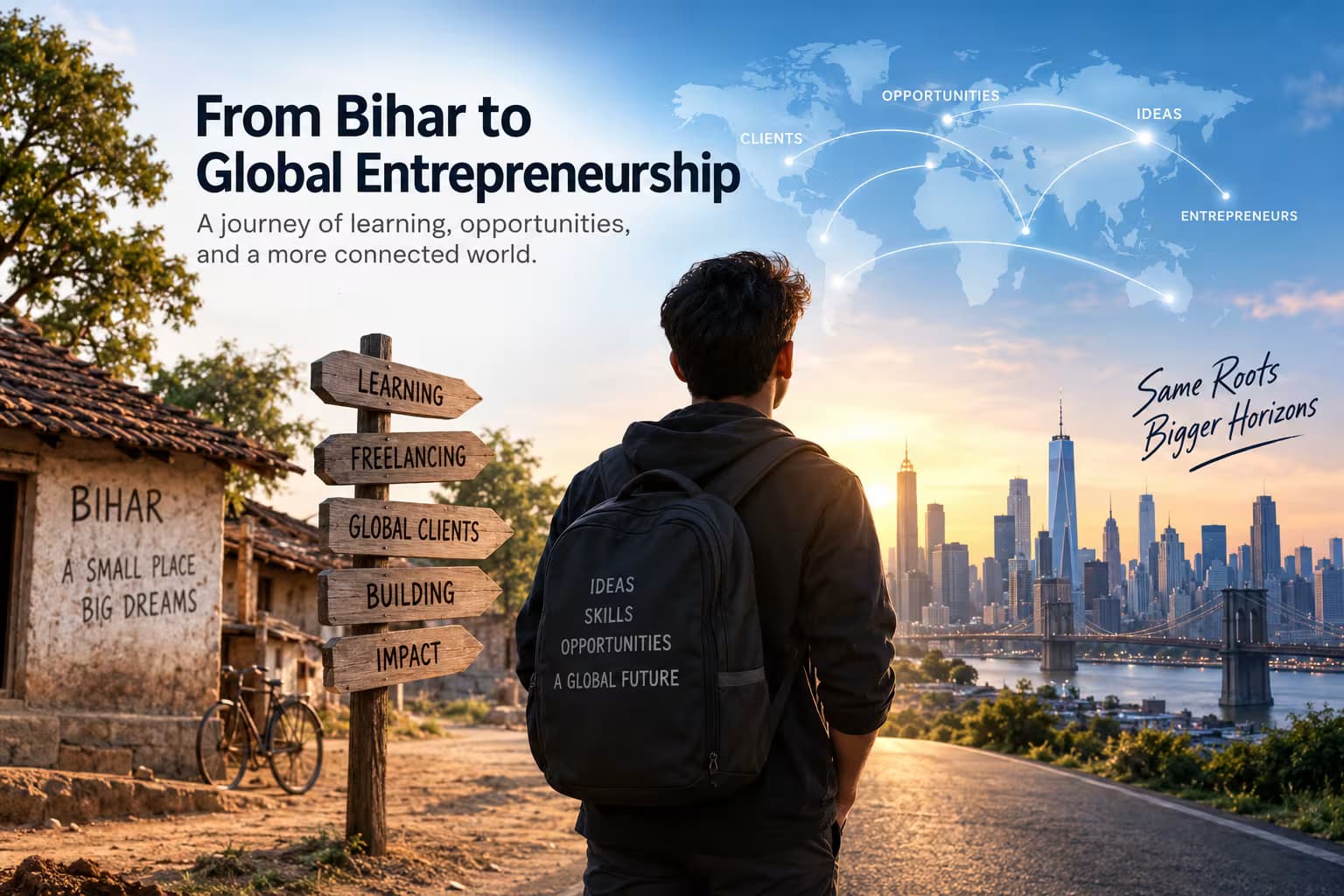
From Bihar to Global Entrepreneurship: My Journey

Tousif Akram
IRS CAA | Founder, FormLLC
From Bihar to Global Entrepreneurship: My Journey
There was a time when I thought my world was much smaller than it actually was.
I grew up in a small village in Bihar, India. Like many people growing up in a place where most opportunities were local, I had a fairly simple understanding of what a career could look like. You studied, found a job, worked hard, and tried to build a stable life.
The idea that someone sitting in a small village could work with people thousands of kilometres away, build a business around those relationships, and eventually serve entrepreneurs across different countries was not something I had a clear picture of when I was younger.
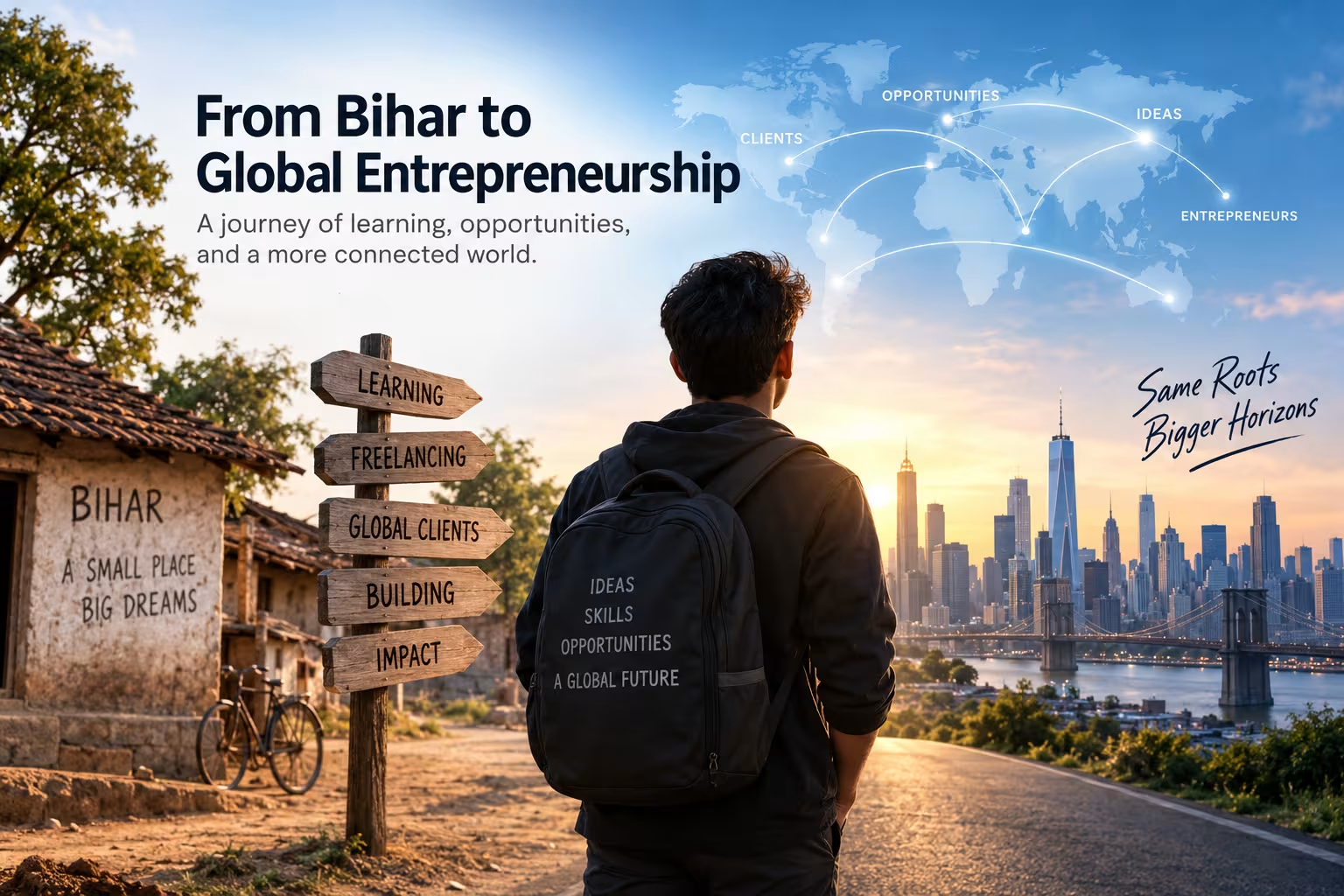
My understanding of work started changing quite early.
While I was still in Class 11, I started teaching students. Eventually, I also ran a small coaching centre. At that stage, I was not thinking about entrepreneurship in the way I think about it today. I was simply trying to become more independent, earn my own money, and figure out what I could do with the opportunities available to me.
But teaching gave me something that became much more valuable later: I learned how to understand people.
When you teach someone, you quickly realize that simply knowing something is not enough. You have to understand what the other person is struggling with, explain things in a way they can understand, and sometimes change your approach completely depending on the person sitting in front of you.
I didn't know it at the time, but that lesson would follow me into every business I built afterward.
Global Entrepreneurship Started With a Small Opportunity
My thinking changed significantly when I discovered freelancing. For the first time, the person paying me for my work did not have to live in my city, my state, or even my country.
I could sit where I was and provide a service to someone somewhere else.
That sounds normal today. Millions of people work remotely, sell services online, build digital businesses, and collaborate across borders. But when you experience it for the first time, especially when you come from a place where most opportunities have traditionally been tied to geography, it feels very different.
I remember receiving my first payment through Fiverr. It was around $20. It was not a large amount of money. It would be easy to look at it today and think that $20 is insignificant.
For me, it wasn't.
That payment changed the way I looked at the internet and, more importantly, the way I looked at myself.
Someone somewhere in the world had a problem. I had a skill that could help solve it. They were willing to pay me for that value, even though we were thousands of kilometres apart.
That was the real breakthrough. The money mattered, but the realization mattered much more. I began to understand that my location did not necessarily have to define the size of my opportunity.
I Started Thinking Beyond My Location
Once I had experienced working with people online, I became much more interested in international clients and global businesses.
I enjoyed talking to clients, understanding what they were trying to achieve, figuring out where they were stuck, and finding ways to help them. Sometimes I would do more than what was originally required simply because I enjoyed solving the problem.
That experience gradually changed my definition of work.
I stopped thinking only in terms of getting a job or finding customers in my immediate surroundings. I started thinking about skills, problems, markets, trust, and the possibilities created when technology connects people.
The internet had effectively expanded the market available to me. But there was another lesson hidden inside that experience.
Getting access to the world is one thing. Learning how to operate in the world is something completely different.
As I worked with more people and learned more about online business, I started seeing how many barriers entrepreneurs face when they try to build internationally.
A founder might have a great product but struggle with payments. Someone might have customers in multiple countries but not understand the business structure they need. Another person might want to establish a US company but have no idea what happens after the company is formed.
These weren't theoretical questions to me. They came through conversations with real people. And those conversations eventually influenced the business I decided to build.
From Helping Clients to Building a Business
My journey into building FormLLC did not start with a grand plan to create a global company. It came from seeing a problem repeatedly.
Entrepreneurs were trying to build businesses across borders, but the infrastructure around them was often confusing. Company formation was only one part of the problem. After incorporation came questions about compliance, Banking, taxes, payments, annual requirements, and simply understanding what they were supposed to do next.
That distinction became increasingly important to me.
Forming a company is relatively easy to describe. Building a business that can operate properly after the company is formed is much more complicated.
The more founders I spoke with, the more I understood that people were not really looking for a piece of paper saying that their company existed.
They were trying to build something.
They wanted to sell internationally. They wanted to work with customers outside their home country. They wanted to build credibility. They wanted access to global infrastructure. They wanted to turn an idea into a real business.
That realization shaped the way I thought about FormLLC.
The company was not simply about helping someone register an LLC. It was about helping entrepreneurs navigate some of the infrastructure that comes with building internationally.
And that mission felt personal to me because I knew what it was like to start from a place where the traditional path could feel geographically limited.
Global Entrepreneurship: What International Founders Taught Me
Over the years, I've had the opportunity to work with entrepreneurs from many different countries and backgrounds.
Some were experienced founders. Some were starting their first business. Some had technical skills but knew very little about business administration. Others already had customers and revenue but needed better infrastructure to support their next stage of growth.
Their circumstances were different, but I noticed something surprisingly consistent.
Most entrepreneurs do not lack ambition.
What they often lack is access.
Access to information. Access to infrastructure. Access to reliable guidance. Access to the right people. Sometimes even access to the belief that what they want to build is possible from where they currently live.
That last part is something I understand personally.
When you grow up in a small place, it is easy to unconsciously put limits around what you think is realistic.
You look at the people around you and use their lives as the reference point for your own possibilities.
The internet changed that reference point for me.
Instead of looking only at what people around me were doing, I could see what people everywhere were building.
I could learn from founders in other countries. I could work with international customers. I could discover new business models. I could build relationships with people I might never have met otherwise.
That is one of the reasons I believe the internet has been such a powerful force for entrepreneurship and global entrepreneurship.
It doesn't remove every barrier.
But it can remove the assumption that opportunity has to be geographically close to you.
Geography Still Matters
I don't believe geography is irrelevant. Where you live can affect access to capital, networks, infrastructure, education, customers, talent, and many other things. Pretending those differences don't exist would be unrealistic.
But I also don't believe geography should automatically determine how ambitious someone is allowed to be. A talented developer in a small town can work with a company in another country. A designer in India can build for customers in Europe.n A marketer in a developing market can serve companies in the United States.
A founder with customers around the world can build a business from a place that most people outside that region have never heard of.
I've seen enough of this firsthand to believe that the old relationship between geography and opportunity is changing.
The important question is no longer simply, "Where are you?"
It is also, "What can you create, who can you help, and can you reach them?"
That shift has completely changed the way I think about entrepreneurship, global entrepreneurship, and the opportunities created by cross-border work. Building a Global Business Is About More Than Incorporation
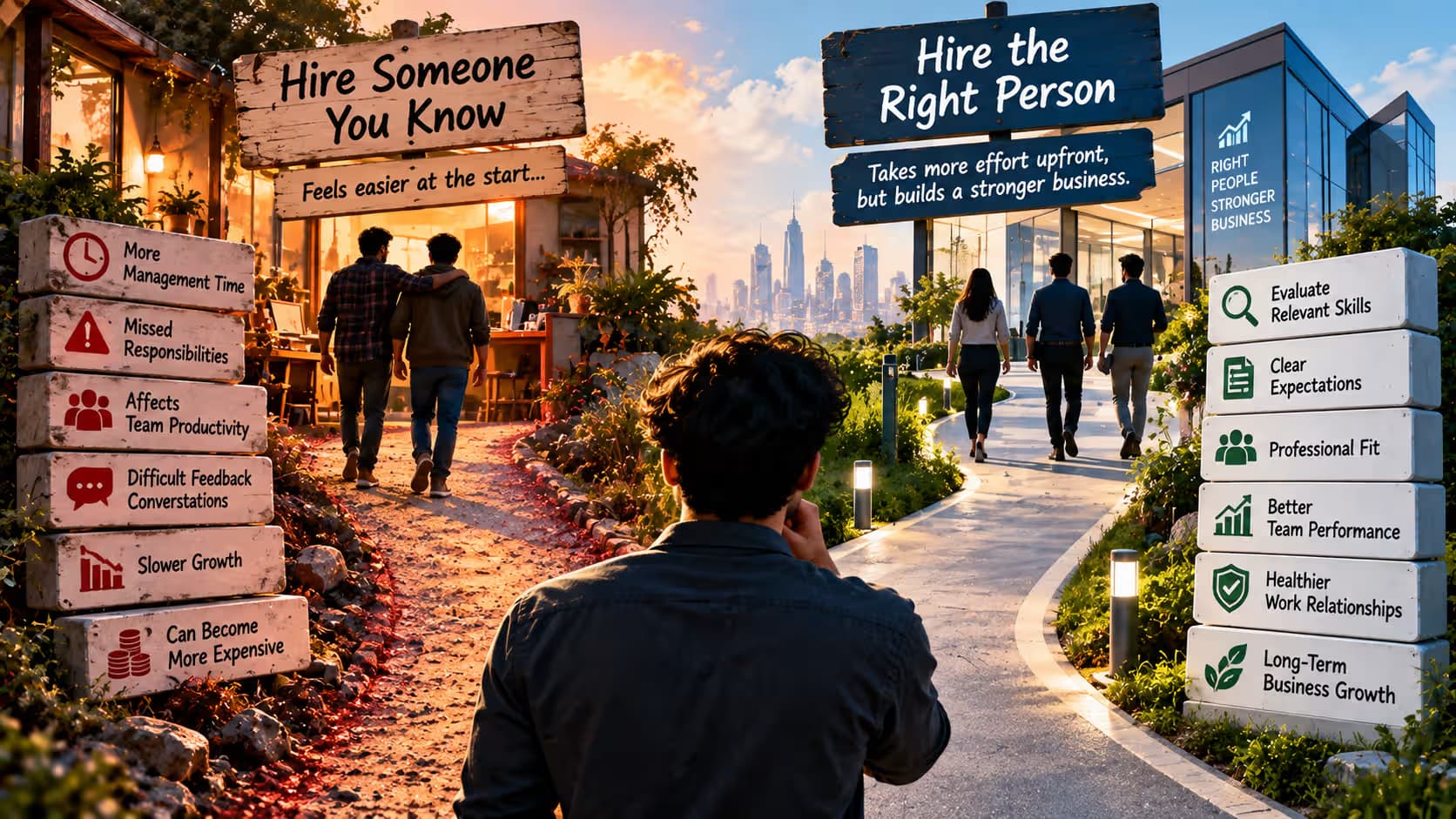
One thing I have learned from working with so many founders is that starting internationally can look much easier from the outside than it actually is.
Someone might think, "I'll form a US company and then everything will be solved." It doesn't work that way. A company is a legal structure. It is not a complete business.
You still need customers. You need a product or service people want. You need a way to receive and manage money. You need to understand your responsibilities. You need to maintain compliance. You need to build trust. You need to figure out operations.
For non-resident founders, getting an EIN can also be an important step when setting up a US business.
For foreign-owned US LLCs, understanding ongoing filing requirements can also be an important part of staying compliant. This is one of the reasons my thinking around company formation has evolved over time. Earlier, I might have thought more about the formation itself. Today, I think much more about what happens afterward.
That is where many founders actually need help. And it is also where I think the industry has an opportunity to become much more honest. Founders deserve to understand not only what they can buy, but also what responsibilities come with it.
The Business Became More Than Just My Own Journey
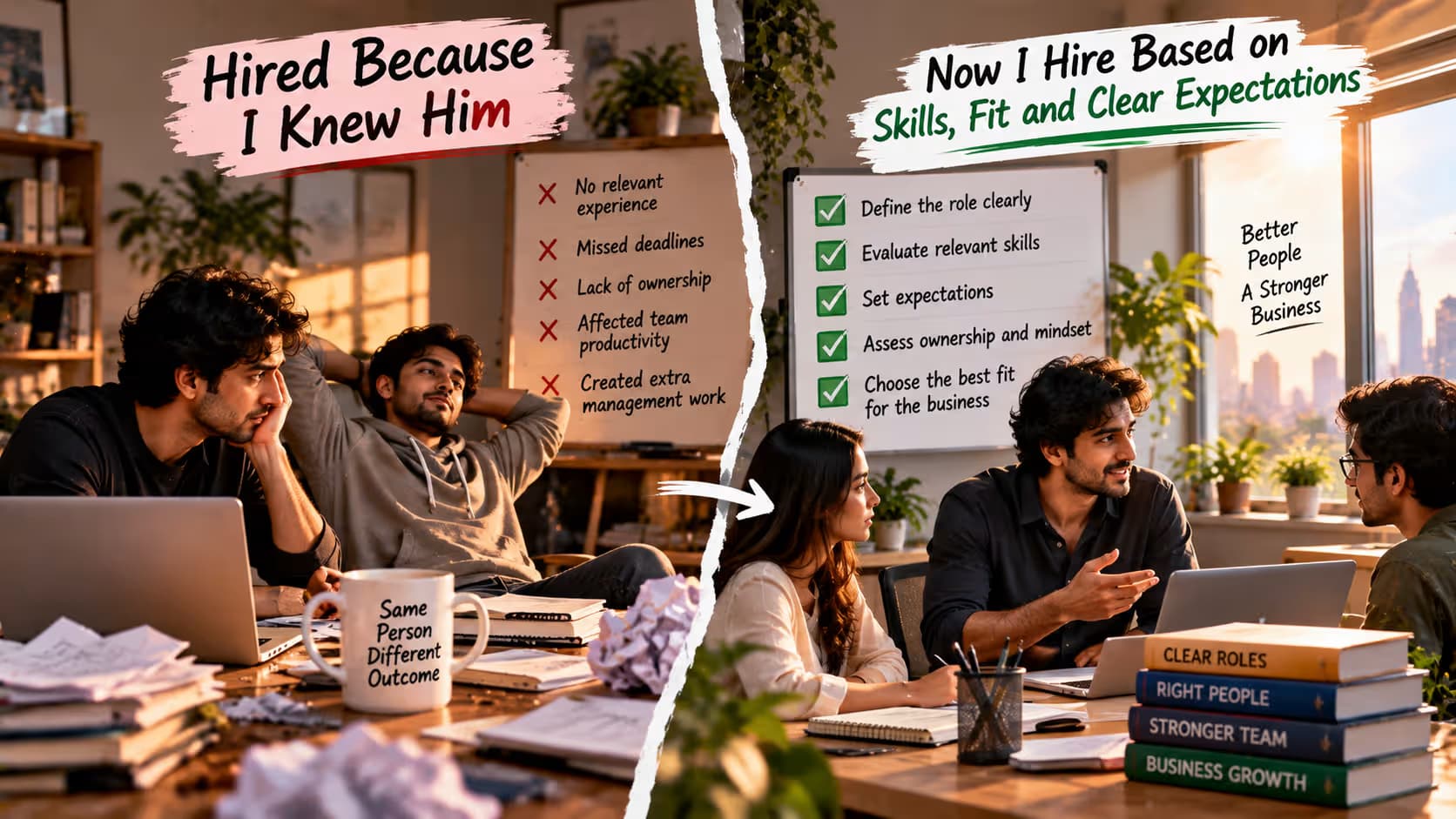
Another major change happened when I started hiring people. Until you have employees, it is easy to think of a business primarily as something you are building for yourself. Once other people depend on the business, that changes. Your decisions affect their income. Their families. Their growth. Their stability.
I remember realizing that the business had become bigger than my own personal journey. It was no longer just about whether I succeeded. Other people were building their careers through the company too.
That created a different kind of responsibility. It also changed how I think about leadership. Building a business is not only about getting customers or increasing revenue. It is also about creating an environment where other people can do meaningful work and improve their own lives. That is something I did not fully understand when I first started.
What Starting From a Small Place Taught Me
If I could go back and speak to the younger version of myself — the person teaching students in Class 11, trying to earn independently, and eventually discovering freelancing — I would tell him something very simple. You don't need to know exactly where the journey will take you. You need to start learning how to create value. Teaching taught me that. Freelancing reinforced it. Working with international clients expanded it.
Building a company made me understand the responsibility that comes with it. And working with entrepreneurs has shown me how universal that principle really is. The starting point can be different for everyone.
One person starts in a major technology hub. Another starts in a small town. Someone begins with funding. Someone else starts with a laptop and a skill. One founder has a large network. Another has to build every relationship from scratch.
The circumstances are different. But the process of turning a skill, idea, or problem into something valuable is surprisingly universal.
Talent Is Global. Infrastructure Still Isn't.
This is probably one of the strongest beliefs I have developed through my journey. Talent is global. Ambition is global. Ideas are global.
Customers are increasingly global. But business infrastructure is still much more fragmented.
A founder can have a great idea and international customers but still struggle with the basic infrastructure required to operate across borders.
That gap is one of the reasons I became interested in this space in the first place. It is also one of the reasons I continue to believe there is a bigger opportunity for global entrepreneurship.
More people can build businesses across borders, work with international customers, hire globally, and create companies from places that were historically considered too far away from major business centres.
The technology already makes much of this possible. The next challenge is making the infrastructure simpler, clearer, and more accessible.
From Bihar to the World
When I look back, the journey feels much less predictable than it probably looks from the outside. I didn't start with a detailed plan to build a company that would serve founders around the world. I started by teaching students.
Then I started trying to earn independently. Then I discovered freelancing. Then came that first small international payment.
Then came more clients, more conversations, more problems to solve, and eventually the realization that many entrepreneurs were facing problems I could help solve at a larger scale. The distance between a small village in Bihar and entrepreneurs around the world may sound enormous.
For me, the internet became the bridge.
But the bridge only mattered because I was willing to walk across it. That is probably the biggest lesson I carry with me today. You don't always need to begin in the place where the opportunity is. Sometimes you need to find a way to bring the opportunity closer to you.
And once you learn how to do that, your starting point doesn't have to be the limit of your destination.
I'm still learning. I'm still building. And I still believe there are millions of talented people sitting in places that the world doesn't associate with entrepreneurship who could build remarkable businesses if they had better access to global markets and infrastructure.
My journey started in a small village in Bihar.Today, I have the privilege of working with founders from around the world.
And in many ways, I think I'm still working on the same problem that first fascinated me years ago:
How do you make the distance between where someone starts and what they can build a little smaller?
That is a question I expect to keep exploring for a very long time.
This article is for general informational purposes only and does not constitute legal, tax, or financial advice. Tousif Akram and FormLLC are not a law firm or CPA firm. Consult a licensed professional for advice specific to your situation.
Ready to Form Your US LLC?
Free 30-minute consultation with no obligation and no sales pressure.
Book Free Call