Geography and Opportunity: My Journey From Bihar to Global Entrepreneurship

Tousif Akram
IRS CAA | Founder, FormLLC
Geography and Opportunity: My Journey From Bihar to Global Entrepreneurship
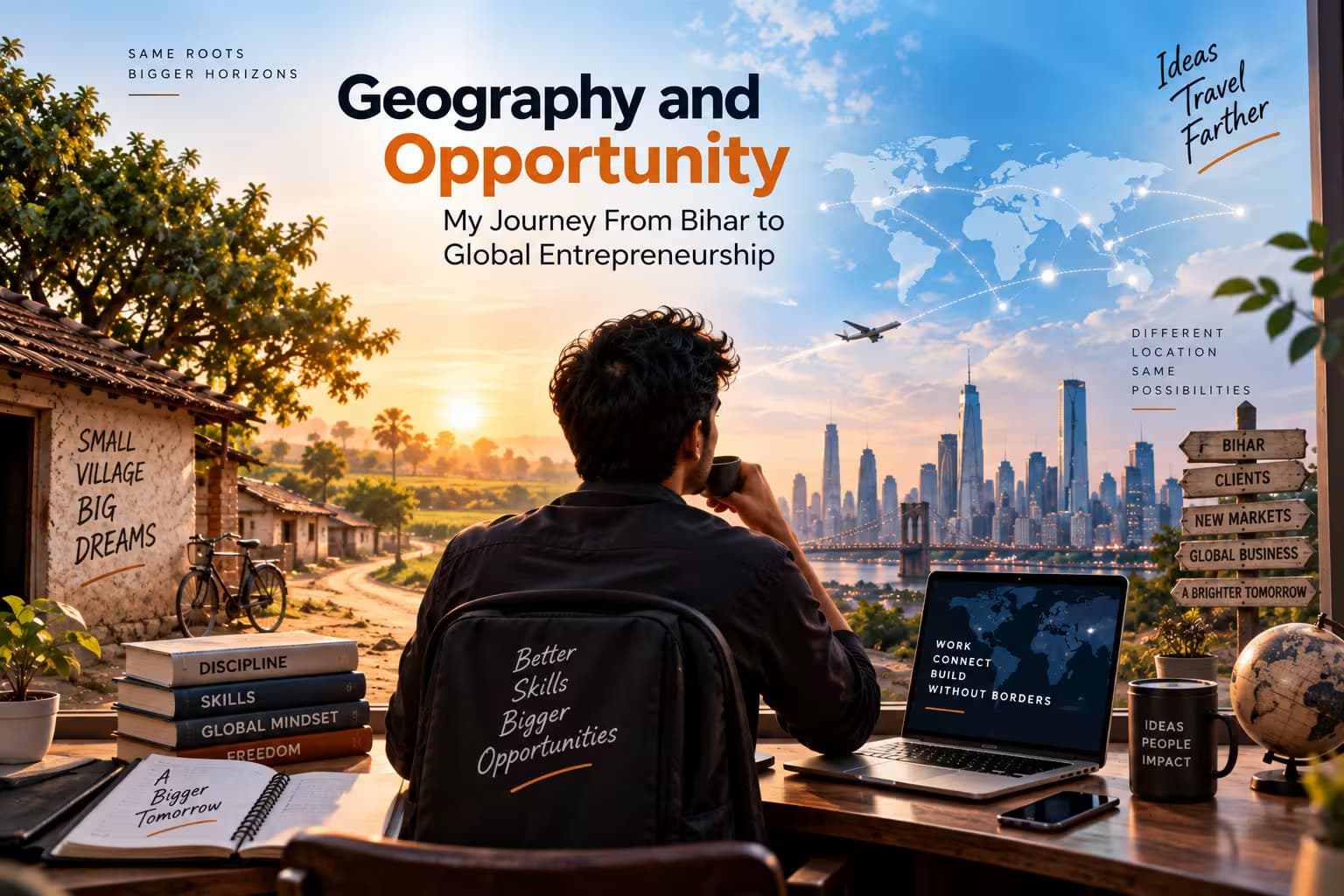
For a long time, I thought geography and opportunity were closely connected, and that where you were born had a lot to do with how far you could go.
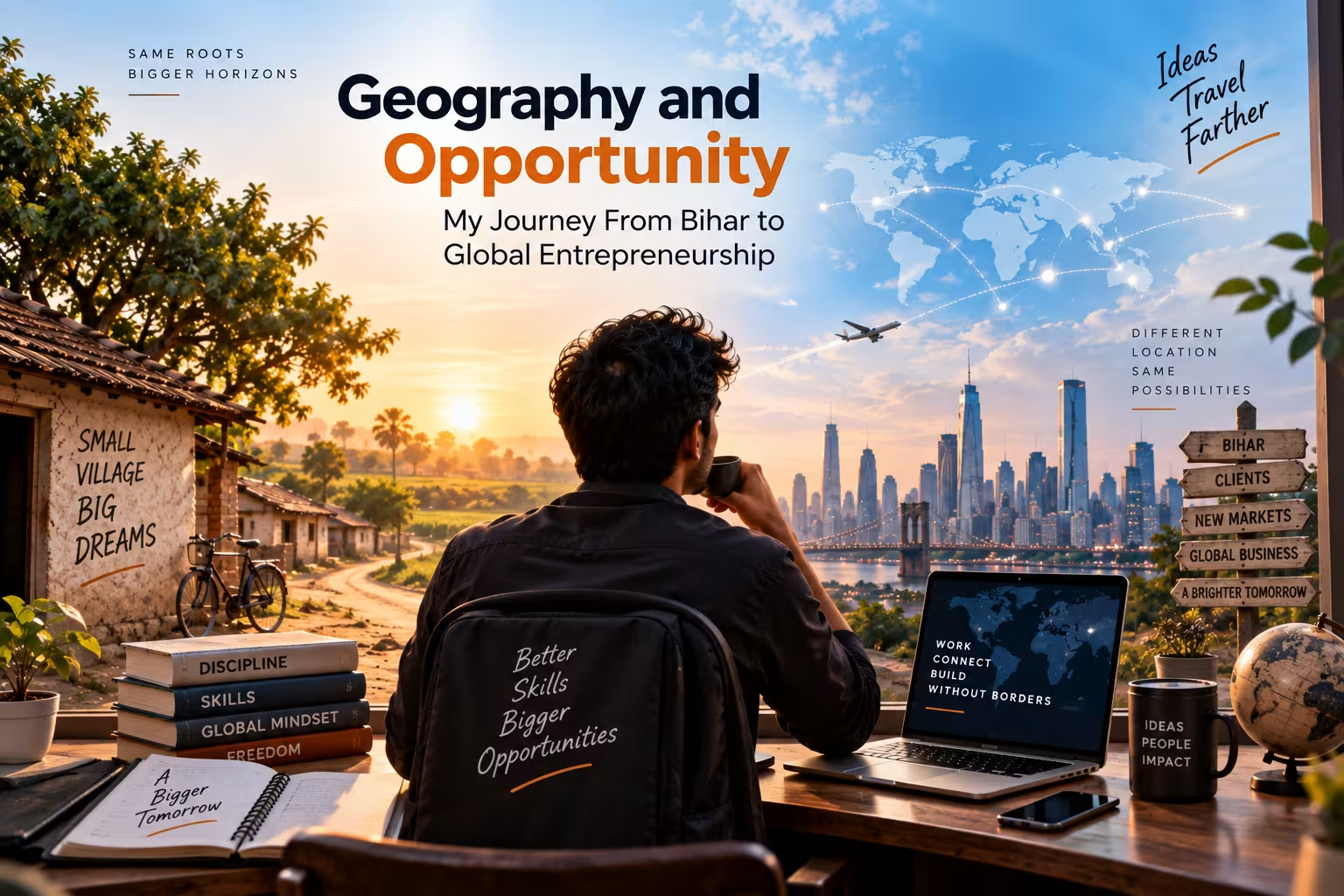
I grew up in a small village in Bihar, India. When you grow up in a place where most people build their lives around the opportunities available locally, it is natural to think about your own future in the same way. You look around, you see the careers people have, the businesses people run, the places people travel to, and the opportunities available to them, and those things quietly become the boundaries of what you imagine for yourself.
I don't think I was consciously limiting myself. I simply didn't know that there could be a much bigger world outside those boundaries.
My understanding of opportunity started changing when I was still young. While I was in Class 11, I started teaching students. Eventually, I also started a small coaching centre. At that point, I wasn't thinking about building a global business or working with people from different countries. I was trying to become more independent, earn my own money, and learn how to create something of my own.
But teaching gave me an important lesson that stayed with me: people don't care where you come from nearly as much as they care about whether you can help them.
If a student has a problem and you can explain it clearly, your hometown doesn't matter. If a customer has a problem and you can solve it, they don't necessarily care which city or country you are sitting in. The value of what you can do can travel much farther than you can physically travel.
I understood that much more clearly when I discovered freelancing.
The Internet Was the First Time I Saw Geography Differently
Before freelancing, my idea of a customer was mostly local.
You had to know people. You had to be physically present somewhere. You had to build relationships within a certain area. If you wanted to find better opportunities, moving to a bigger city often seemed like one of the obvious answers.
The internet introduced me to a completely different possibility. I could sit where I was and work for someone somewhere else.
That sounds ordinary today. Remote work, freelancing, international payments, online businesses, and distributed teams are now familiar concepts. But when you experience it for the first time from a small place, it can completely change how you see the world.
I remember receiving my first payment through Fiverr. It was around $20. The amount itself wasn't life-changing. The realization was.
Someone thousands of kilometres away had a problem, I had a skill that could help solve it, and they were willing to pay me for that value without ever meeting me in person.
That was the moment I started seeing geography differently.
I realized that I didn't necessarily have to move somewhere else before I could participate in a bigger market.
I could start from where I was.
Geography and Opportunity: Your Starting Point Is Not the Same as Your Ceiling
This distinction has become one of the strongest beliefs I have developed as an entrepreneur.
Your starting point and your ceiling are two different things.
Where you start can influence your journey. It can affect your access to education, capital, networks, mentors, technology, customers, and opportunities. I don't want to pretend that geography doesn't create real advantages and disadvantages. It does.
But I also don't believe that your starting location should automatically determine the size of the business you are allowed to imagine.
That difference matters.
If I had believed that I needed to live in a major business centre before I could work with international customers, I might never have started freelancing.
If I had believed that I needed to know successful entrepreneurs personally before I could build something, I would have waited much longer.
If I had believed that only people in major cities could build businesses serving customers around the world, my own journey would make very little sense.
I started where I was. The internet gave me access to people I could not have reached physically.
And then it became my responsibility to create enough value for those people to want to work with me.
The World Doesn't Always See Your Location the Way You Do
One of the interesting things I learned from working with international clients is that we often overestimate how important our own location is.
When you are sitting in a small town or village, you may think, "Why would someone from another country work with me?"
But the person on the other side of the internet may not be thinking about your location at all. They may be thinking about whether you understand their problem.
Can you communicate clearly? Can you deliver what you promised?\ Can you solve the problem? Can they trust you? Can you make their life easier?
Those questions matter far more than the distance between your two locations.
That doesn't mean geography never matters. Certain industries depend heavily on physical infrastructure, local regulations, logistics, markets, or relationships. But for many knowledge-based businesses, digital services, software businesses, consulting, design, marketing, development, education, and other internet-enabled work, the relationship between location and opportunity has changed dramatically.
The customer doesn't always need you to be nearby. They need you to be useful.
I Learned This Again Through My Work With Founders
Over the years, my work eventually moved beyond freelancing and into building businesses.
Through FormLLC, I've had the opportunity to work with entrepreneurs from many different countries. Their backgrounds, industries, goals, and levels of experience have been very different.
Some founders were just getting started. Others already had customers and revenue. Some were building their first international business. Others were trying to create infrastructure around a business that was already growing.
But there was one thing that stood out to me repeatedly.
Talent is everywhere. Ambition is everywhere. Good ideas are everywhere. The infrastructure needed to turn those things into businesses is not.
That realization became increasingly important as I worked with more international founders.
A person can have the skills to build a product but not understand how to structure the business behind it. Someone can have customers in several countries but struggle with payments and business banking or compliance. Another founder may have a great idea but simply not know where to begin.
The problem isn't always a lack of ambition.
Sometimes the problem is that the path is unnecessarily complicated.
Geography Should Not Become a Mental Barrier
There is another kind of geography and opportunity that I think is even more important than physical geography.
It is the geography we create in our own minds.
You can live in a small town and mentally believe that the entire world is available to you.
You can also live in a major business centre and believe that your opportunities are limited.
I have met people with impressive access who never take advantage of it, and I have seen people with very limited starting points build things far beyond what their circumstances initially suggested.
This is not about pretending that hard work alone solves everything.
It doesn't.
Resources matter. Luck matters. Timing matters. Networks matter. Education matters. Market conditions matter. Access matters.
But your circumstances are not the same thing as your potential.
This distinction between geography and opportunity has become one of the strongest beliefs I have developed as an entrepreneur.
Start With What You Can Do, Not Where You Are
If I were starting again today from the same kind of environment, I would spend less time asking, "Where should I move?" and more time asking, "What can I learn to do that someone somewhere in the world would pay for?"
That is a very different question.
The first question starts with geography.
The second starts with value.
Learning a valuable skill can create opportunities that didn't exist before. Learning how to communicate can expand your ability to work with customers. Learning how to sell can turn a skill into income. Learning how businesses operate can turn income into something more sustainable.
This is how I think about the early stages of entrepreneurship now.
You don't necessarily need to begin by creating a complicated company.
You need to become useful.
Find a problem.
Learn how to solve it.
Find someone who has that problem.
Help them.
Then keep improving.
That process can start almost anywhere.
The Internet Doesn't Remove Every Barrier
I also want to be careful about making this idea sound easier than it is.
The internet has created extraordinary opportunities, but it hasn't made building a business effortless.
Getting your first international customer is difficult. Building trust with someone you've never met is difficult. Receiving international payments can create challenges. Understanding business structures, taxes, contracts, compliance, banking, hiring, and operations can become complicated.
And once you start growing, the problems usually become more sophisticated rather than disappearing.
I've experienced many of these challenges myself while building businesses.
That is one reason I don't like the idea of presenting entrepreneurship as a simple formula where you "go global" and everything works out.
It doesn't.
The internet can give you access to the world.
It doesn't guarantee that the world will choose you.
You still have to earn attention.
You still have to earn trust.
You still have to create something valuable.
And you still have to build the infrastructure to support what you are creating.
From a Village in Bihar to a Global Customer Base
When I look at my own journey, the part that surprises me most isn't that I eventually built a business.
It is how far the starting point was from the world I eventually entered.
I started by teaching students.
I started trying to manage my own expenses.
I discovered freelancing.
I received a small international payment.
I started talking to people from different countries.
I learned what they needed.
I kept solving problems.
Eventually, those experiences led me to building FormLLC and working with founders who were themselves trying to cross geographical boundaries.
There was no single moment when I suddenly became a "global entrepreneur."
It happened gradually.
One customer led to another experience. One problem led to another lesson. One small opportunity expanded my understanding of what was possible.
Looking back, the common thread was always the same: I kept trying to create value for someone outside the immediate environment around me.
That is what changed the size of my world.
What I Would Tell Someone Starting From a Small Town Today
If you are reading this from a small town, village, or a place that you think is far away from where business happens, I don't want to tell you that your location doesn't matter.
It does.
But I would tell you not to confuse a limitation with a definition.
Your location may make some things harder.
It doesn't necessarily decide what you can eventually build.
Start by learning something valuable. Build proof that you can do it. Find people who need it. Learn how to communicate with them. Learn how to sell without losing your integrity. Learn how to deliver consistently. Then gradually build the systems around that value.
Don't wait for the perfect city.
Don't wait for the perfect network.
Don't wait until everything looks like the success stories you see online.
Your first opportunity may be very small.
Mine was.
But a small opportunity can change the way you see the world.
For me, it was a roughly $20 payment from a person I had never met.
The amount was small.
The idea behind it was enormous.
I Still Believe Geography Matters — Just Not in the Way We Once Thought
Today, after working with entrepreneurs from different parts of the world, my view is more nuanced than simply saying, "Location doesn't matter."
Location matters.
Infrastructure matters.
Access matters.
Networks matter.
But technology has created new ways to work around some of those limitations.
A founder can build a company from one country and sell to customers in another. A developer can work for an international company without relocating. A designer can build a global client base from a small city. A consultant can advise businesses thousands of kilometres away. A software company can serve customers across continents without opening an office in every country.
The world is becoming more connected, but the opportunity is not automatically distributed equally.
That is why I believe the next step is not simply connecting people to the internet.
It is helping more people understand how to use that connection to build something real.
My Belief Today
I grew up in a small village in Bihar.
Today, I have had the opportunity to work with founders from around the world.
Those two facts are connected.
The distance between them was not crossed in one giant leap. It was crossed through thousands of small decisions: learning, teaching, freelancing, talking to customers, solving problems, making mistakes, building again, and continuing when the next step wasn't obvious.
That experience is why I believe geography should never decide how big you can build.
It may influence your starting point.
It may change the difficulty of the journey.
It may determine which problems you have to solve first.
But it does not have to determine the size of your ambition.
The world is full of talented people who are building from places that rarely appear on the map of global entrepreneurship.
I know this because I was one of them.
And perhaps the most important thing the internet gave me wasn't my first international customer or my first payment.
It was the realization that I could start where I was and still build toward the world.
That is a belief I carry with me today.
Your geography can describe where you started. It doesn't have to describe how far you can go.
This article is for general informational purposes only and does not constitute legal, tax, or financial advice. Tousif Akram and FormLLC are not a law firm or CPA firm. Consult a licensed professional for advice specific to your situation.
Ready to Form Your US LLC?
Free 30-minute consultation with no obligation and no sales pressure.
Book Free Call