Start a Business With Your Spouse: From Living Room to Global Business

Tousif Akram
IRS CAA | Founder, FormLLC
They Built Their First International Business From Their Living Room
The first office wasn't really an office. It was the living room.
When you start a business with your spouse, you're not only sharing a business idea. You're sharing risk, decisions, responsibilities, and sometimes an entirely different kind of life together.
One person was handling customers while the other was working on delivery, operations, or whatever needed to be done that day. There was no large team, no impressive corporate address, and no department for every function. There were just two people trying to build something together.
I have always found these businesses interesting because when a husband and wife decide to build a company together, they are not simply sharing a business. They are learning how to work together while building something that could eventually reach customers far beyond their own home.

Start a Business With Your Spouse by Defining How You Will Work Together
When someone asks me how to start a business with your spouse, I don't think the first question should be, "What should we sell?" The first question should be: "How are we going to work together?"
That may sound less exciting, but it matters. Who handles sales? Who talks to customers? Who manages money? Who makes the final decision when you disagree? Who handles operations? Who takes care of the work nobody wants to do?
A good marriage does not automatically create a good business partnership. You still need clearly defined responsibilities.
But when the partnership works, the combination can be powerful. One person may be excellent at sales while the other is better at operations. One may understand technology while the other understands customers. One may think about the next five years while the other is focused on getting through today's work.
That balance can become an advantage.
The Living Room Can Be a Real Starting Point
People sometimes associate entrepreneurship with offices, employees, and expensive equipment. But many businesses start much smaller.
A laptop, a phone, a spare room, a living room, and a few customers can be enough to begin testing an idea.
That is why starting a business from home is more than a search phrase. For many entrepreneurs, it is simply the most practical way to begin.
You don't need to build the expensive version of the business before you have proven the inexpensive version. The living room can be a practical starting point while you figure out whether customers actually want what you're offering.
What Makes a Husband-and-Wife Business Work?
I've seen different versions of a husband-and-wife business, but the strongest ones tend to understand one important principle: you don't both need to do everything.
If both people are answering every email, approving every purchase, talking to every customer, and making every decision, the business can become exhausting.
Instead, divide responsibility. Perhaps one spouse owns customer acquisition while the other owns delivery. Maybe one handles finance while the other manages the team. Maybe one is the public face while the other works behind the scenes.
The exact division doesn't matter as much as having one.
And there should be space to disagree without turning every business disagreement into a personal argument. That is one of the hardest parts of running a company with someone you love.
Your First Business Idea Doesn't Have to Be Complicated
Some of the best couple business ideas aren't complicated businesses. They can start with skills the couple already has.
Consulting, design, marketing, ecommerce, software, education, professional services, content, or a product they understand particularly well can all become starting points.
The goal isn't to find the business that sounds most impressive. It is to find a problem that someone is willing to pay you to solve, and then prove that you can solve it consistently.
That's how a small idea starts becoming a family business startup.
The Internet Changes the Size of the Opportunity
This is where the story becomes especially interesting.
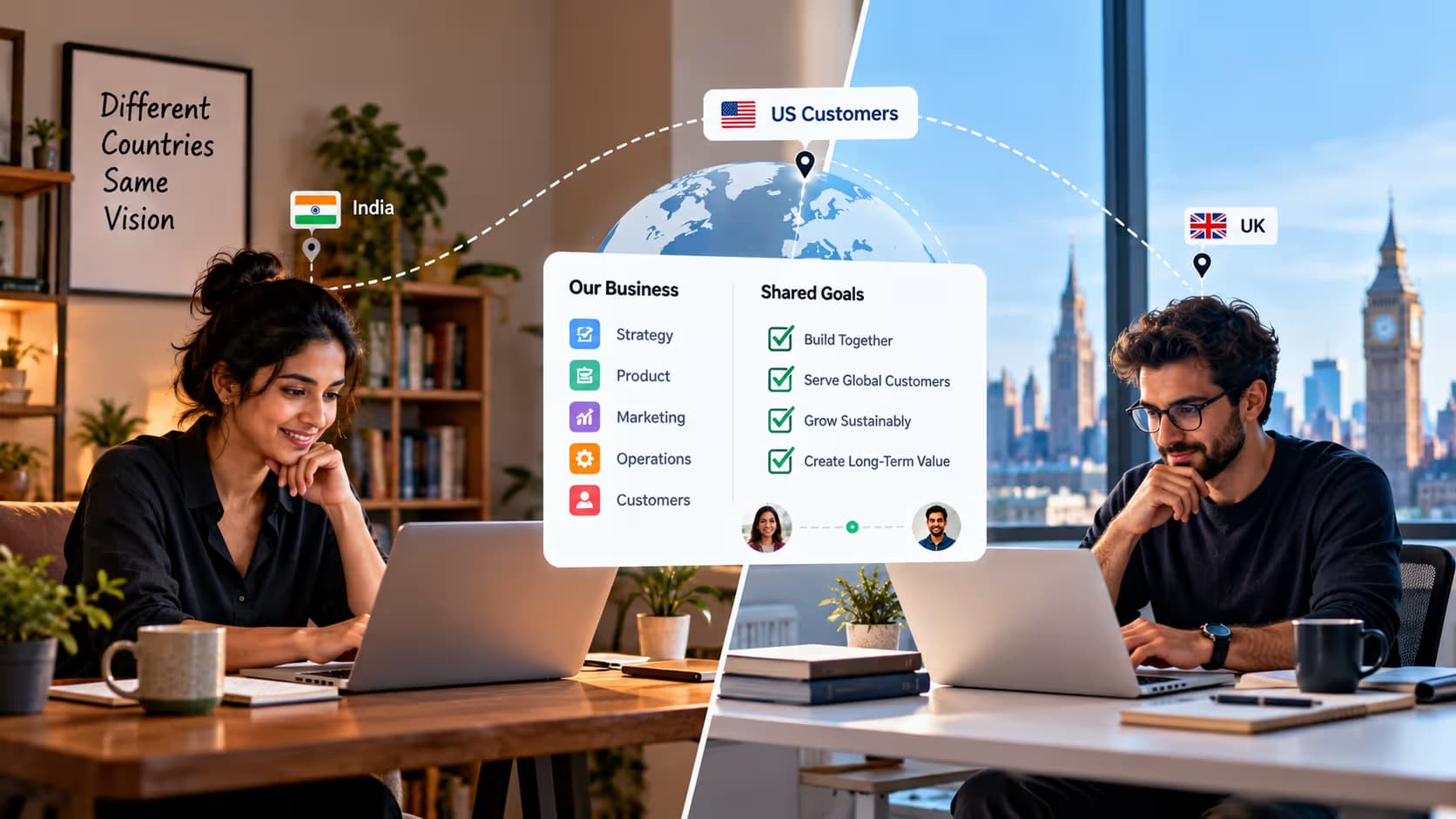
The couple may be sitting in their living room in India. Their first customer might be in their own city. The next might be in another part of the country. And then someone from America discovers them.
Suddenly, the couple realizes they aren't limited to their local market.
That is one of the biggest advantages of an online business for couples. You can build from one place while serving customers somewhere completely different.
A consultant can advise American companies. A designer can work with international brands. A software company can sell subscriptions globally. An ecommerce business can ship products across borders.
And eventually, what started at home can become an international business for couples.
International Customers Change the Business
Once customers start coming from other countries, the business becomes more complicated.
Payments need to work. Contracts need to be clear. Customer support needs to be reliable. Taxes and reporting need to be understood. If you're selling physical products, shipping, duties, and returns become important. If you're selling services, communication, contracts, and delivery become important.
The market may be global, but the business still needs solid infrastructure.
This is where I often tell founders not to confuse having international customers with having an international business. The second requires systems.
As the business grows, the couple may also need to think about the practical side of operating internationally. For example, understanding how to start a US LLC from India can become relevant when a US structure genuinely fits the business strategy.
When Does a US LLC Enter the Conversation?
Eventually, a couple serving US customers may start researching a US LLC for a family business. Or they may specifically search for a US LLC for husband and wife.
This can be a reasonable question, but it isn't one with a universal answer.
The right structure depends on where the owners live, where the business operates, what it sells, how it earns money, and what the couple wants to build.
There is also an important distinction between building the business and choosing its legal structure. A US LLC can be useful for some couples, but it shouldn't become the starting point for every decision.
That is why I would never tell a couple to choose an LLC simply because another couple chose one. Their circumstances may be completely different.
A US Company Can Be Part of the Next Stage
For some couples, the business eventually becomes large enough that a US company for a family business makes strategic sense.
Perhaps most customers are American. Perhaps the couple wants a US-focused operation. Perhaps they're working with US partners. Perhaps they're building a larger international company.
But the company should follow the business.
It shouldn't come before the business.
A US LLC for a small business can be useful in appropriate circumstances, but the registration itself doesn't create customers, solve fulfillment, or build trust. Those things still have to be earned.
If the couple eventually needs an EIN for a US business, understanding how to get an EIN without an SSN can also become part of the practical setup for a non-resident-owned business.
The Hardest Part May Not Be Business
When a husband and wife build together, the business can affect their personal relationship.
A bad sales month can follow you to dinner. A difficult customer can become a conversation at home. A disagreement about money can feel much bigger because it's no longer only about the company.
That is why boundaries matter.
Sometimes you need to stop talking about work. Sometimes you need separate responsibilities. Sometimes one person has to say, "Let's make this decision tomorrow."
Building together should not mean being at work every hour of the day.
The business should improve your life, not consume it.
From a Living Room to an International Company
I think there is something powerful about the image of two people starting in their living room. It removes the illusion that a business needs to look impressive before it becomes real.
They may have started with one product, one service, one customer, or one laptop. But if they keep learning, improving, and serving customers well, the business can grow far beyond the room where it started.
That is the real opportunity behind a family business startup. It isn't simply about building a company together. It is about building something that can eventually create more freedom, more opportunity, and perhaps a legacy for the family.
Building the Infrastructure as You Grow
As the business grows internationally, the couple may need to separate the different pieces of the operation instead of treating everything as one problem.
The company structure, banking, payments, customer operations, and compliance each serve a different purpose.
For example, once a US business structure is in place, appropriate banking may become important for receiving and managing business funds. Understanding how to open a US bank account as a non-resident LLC owner can help founders think about that part of the business separately from company formation.
The important thing is not to build all of this before there is a real business. Build the infrastructure as the business gives you a reason to need it.
The Living Room Isn't the Limitation
And that is why I like these stories.
The living room isn't the limitation. It's the starting point.
Two people can start small. They can build from home. They can find customers across borders. They can learn how to work together while the business grows around them.
Eventually, the little business they built together can become something neither of them could have imagined when they first opened the laptop.
The most important part isn't where the first office was.
It is what they built from there.
This article is for general informational purposes only and does not constitute legal, tax, or financial advice. Tousif Akram and FormLLC are not a law firm or CPA firm. Consult a licensed professional for advice specific to your situation.
Ready to Form Your US LLC?
Free 30-minute consultation with no obligation and no sales pressure.
Book Free Call