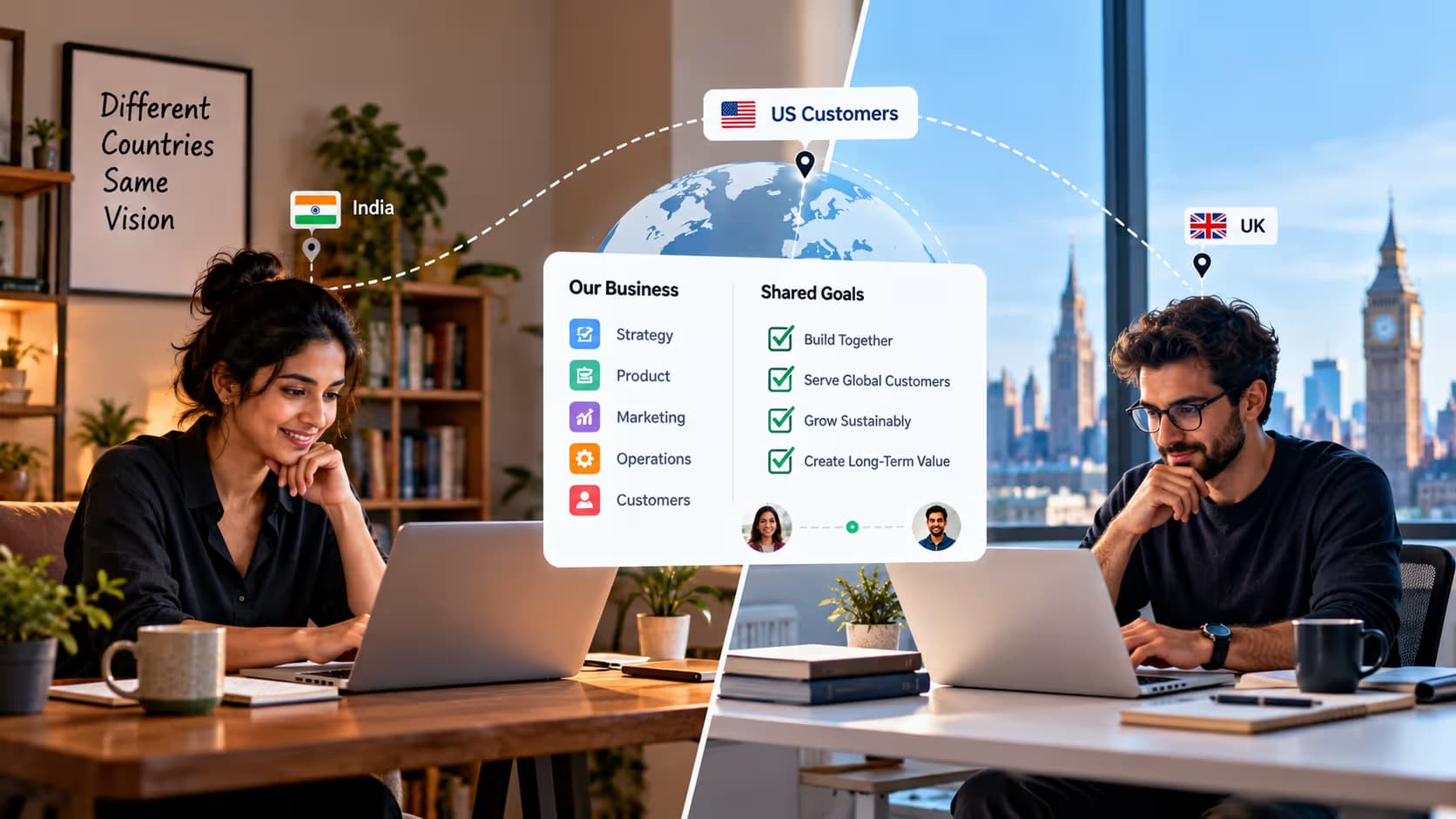
Start a Business With a Partner Abroad: Building Across Borders

Tousif Akram
IRS CAA | Founder, FormLLC
Start a Business With a Partner Abroad: They Started a Business Together From Two Different Countries
A few years ago, I spoke with two founders who wanted to start a business with a partner abroad. There was nothing unusual about their business idea. What was unusual was where the two founders lived.
They were in different countries. They had never shared an office, their day-to-day lives were completely different, and yet they wanted to build one company, serve customers internationally, and own the business together.
That conversation stayed with me because I realized how normal this is becoming. The internet has made it possible for two people to become business partners in different countries without first moving to the same city or even the same country.
But while starting a business with a partner abroad is easier than it once was, the business structure still matters. And this is where many international founders become confused.
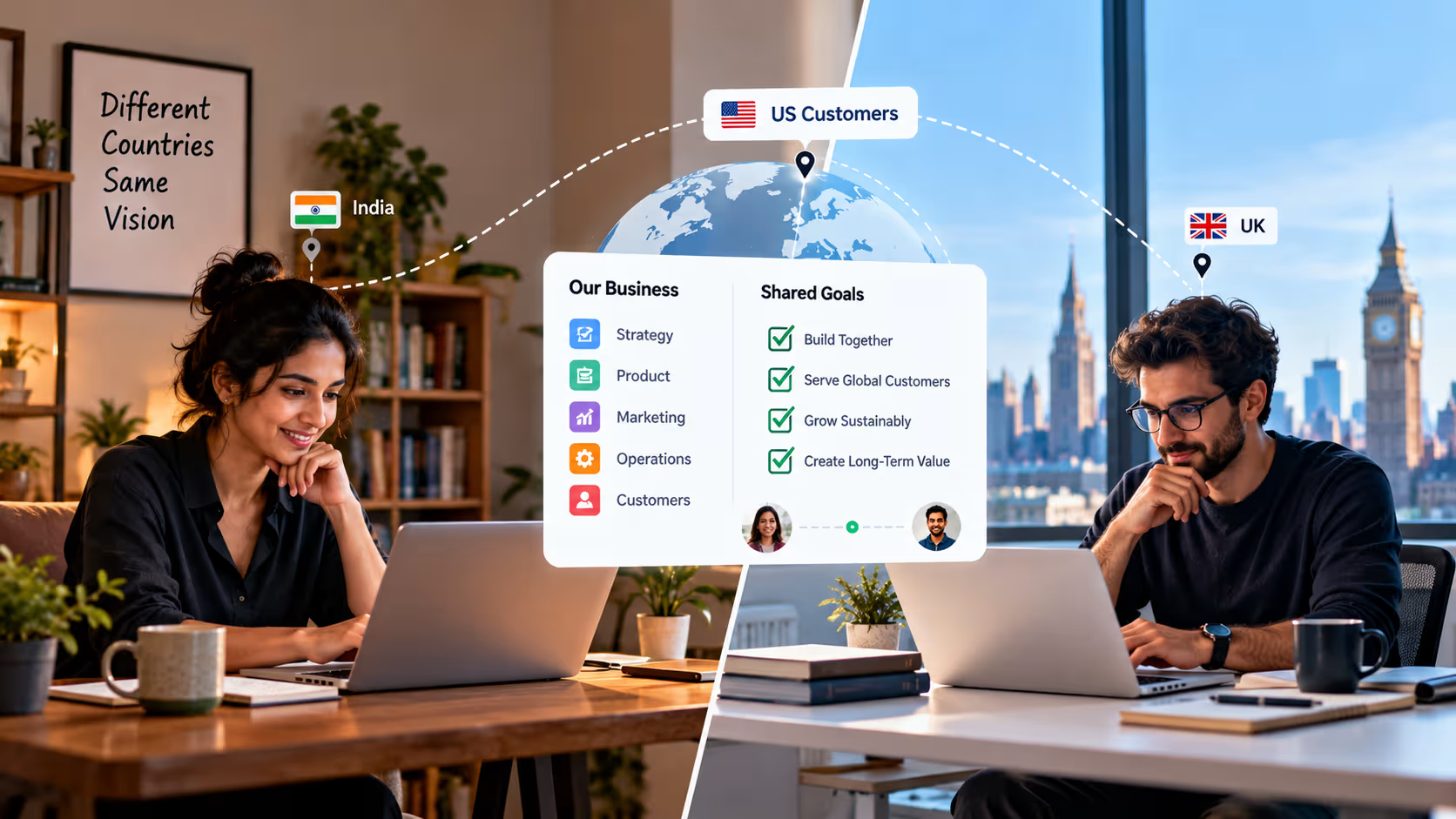
Start a Business With a Partner Abroad Without Living in the Same Country
When two people decide to start a business with a partner abroad, their first thought is often: "Can we actually own the same company?"
In many cases, international founders can build and own a business together even when they live in different countries. But the important question isn't simply whether two people can become owners.
The better question is: What structure makes sense for both founders and the business they are trying to build?
That distinction becomes especially important when the founders live in different countries. Ownership is only one part of the relationship. The founders also need to think about responsibilities, decision-making, taxes, intellectual property, banking, and how the business will actually operate.
A US LLC Can Be an Option for International Business Partners
I've seen founders from different countries consider a US LLC because they want a business structure they can operate together while serving customers internationally.
For some founders, this can make sense. A US LLC with a business partner can provide a framework for multiple owners, but forming the company is only the beginning.
The ownership structure, tax classification, source of income, where the business operates, and the countries where the founders live can all matter.
This is one reason I tell founders not to look only at the formation fee.
The easiest part can be creating the company. Understanding how the company should operate afterward is often more important.
For founders exploring international opportunities more broadly, geography and opportunity is also an important part of the conversation. Where you live can influence how you operate, but it does not necessarily determine where your customers or business partners can be.
What Happens When the Partners Live in Different Countries?
This is where an international partnership business becomes more complicated.
Imagine one founder lives in India and another lives in the United Kingdom. They decide to create a US company together.
Who owns what percentage? Who contributes the money? Who is responsible for sales? Who owns the intellectual property? Where will the founders perform their work? How will profits be divided? What happens if one founder wants to leave? What happens if they disagree?
And perhaps most importantly: What are the tax and reporting responsibilities created by having foreign owners?
These questions aren't meant to discourage founders. They are meant to encourage them to think beyond the registration certificate.
The exact tax and reporting obligations depend on the facts of the business and the founders' circumstances. That is one area where international partners should get appropriate tax and legal advice rather than relying on a generic internet checklist.
The Biggest Mistake Is Treating the LLC as the Entire Business
When people search for "US LLC for international partners" or "US company for foreign partners," they often focus on the formation itself.
They want to know how much it costs, which state they should choose, how quickly they can form it, and whether foreigners can own it. Those are reasonable questions.
But when two founders are building together from different countries, I would add another list.
Before you form anything, talk to your partner about ownership. Agree on who owns what percentage and how that ownership could change if someone contributes additional money or takes on additional responsibilities.
Then discuss responsibilities. Decide who handles product, sales, operations, finance, and customer relationships. Two founders don't need to do everything together, but they do need to know who is responsible for what.
Then discuss money. Agree on how much each person is contributing and how future expenses will be handled.
You also need to discuss decision-making. What happens if you disagree? Who has authority over a particular area? What decisions require both founders to agree?
Then there is intellectual property. Who owns the code, brand, designs, customer list, content, and other business assets?
Finally, discuss the exit. What happens if one person wants to leave the company? What happens to their ownership? Can they sell it to someone else? What happens if the relationship between the founders breaks down?
These conversations aren't particularly exciting when you're starting a business. But they become very important when the business starts making real money.
Different Countries Don't Have to Mean Different Ambitions
One thing I like about working with international founders is seeing how technology has changed the definition of a business partnership.
Twenty years ago, two founders living on opposite sides of the world would have faced much greater practical limitations. Today, they can communicate every day, manage projects online, sell to customers in multiple markets, hire remote employees, and build a company without living in the same country.
That doesn't mean borders have disappeared. They haven't.
Tax rules, immigration rules, banking requirements, local laws, and reporting obligations still exist. But the opportunity has changed.
A founder in one country can bring technical expertise. Another can bring sales experience. Someone else may understand a particular market. Another partner may have relationships with customers on the other side of the world.
The internet allows those capabilities to come together.
What I Would Do Before Starting a Business With an International Partner
If I were going to start a business with a partner abroad today, I would spend more time discussing the partnership before worrying about the registration.
I'd first make sure we agreed on the business itself. Then I'd document ownership and responsibilities. After that, I'd understand where each founder lives and where the actual business activities will take place.
Then I'd speak with the appropriate legal and tax professionals about the structure.
Only after that would I decide whether a US LLC—or another business structure—actually makes sense.
This is particularly important for US LLCs for non-residents, because "non-resident" isn't a complete description of a founder's tax situation. Two founders may both live outside the United States and still have very different circumstances depending on their countries of residence, business activities, income, and other facts.
That's why I don't like the idea of giving every international founder the same checklist.
Build the Partnership Before Building the Paperwork
The legal entity should support the relationship between the founders rather than substitute for it.
If the partners haven't agreed on ownership, responsibilities, decision-making, and what happens if one person leaves, forming an LLC doesn't solve those problems.
In fact, creating the company before having those conversations can make future disagreements more difficult because the business may already have customers, money, intellectual property, and contracts attached to it.
A written agreement between the founders can help turn assumptions into clear expectations.
For founders considering the legal side of an LLC, an operating agreement for a non-resident US LLC can also be useful to understand as part of the broader structure.
The Real Advantage Is Not the US Company
I've helped many entrepreneurs think through company formation, and one lesson has become increasingly clear to me:
Founders don't really want a company. They want what the company allows them to build.
They want customers. They want payment infrastructure. They want credibility. They want to work with a partner. They want to sell internationally. They want to turn an idea into something real.
The legal entity is simply part of the infrastructure.
I've written about why customers don't really want a US LLC, because the company itself is rarely the final objective. The real objective is usually the business that exists around it.
That's why I think the future of entrepreneurship will increasingly include cross-border business partners.
Someone in India can build with someone in Germany. Someone in the UK can build with someone in the US. Someone in Bangladesh can build with someone in Canada.
The important question isn't whether you live in the same country.
The important question is whether you can build a business together responsibly.
Building Across Borders Requires More Trust, Not Less
There is one thing I would emphasize to anyone considering international business partners:
Don't let the distance make you casual about the relationship.
If anything, being in different countries means you need more clarity.
Write things down. Discuss uncomfortable subjects early. Be clear about ownership. Understand your obligations. Don't assume that your partner understands something simply because you do.
You should also be clear about how information, money, intellectual property, customer relationships, and major business decisions will be handled.
Distance can make misunderstandings easier to create and harder to resolve. Clear communication and documented expectations can help prevent a small disagreement from becoming a major business problem.
Choose the Structure for the Business You Are Actually Building
I would never tell two international founders to choose a US LLC merely because someone online said it is the "best" structure.
Choose a structure because it fits the business you're actually trying to build.
The right question isn't simply whether two people in different countries can own the same company. The more useful question is whether the proposed structure works for their ownership, operations, customers, tax circumstances, and long-term plans.
That distinction matters because the company is only one part of a much larger business system.
Geography Matters, But It Doesn't Have to Limit the Partnership
I've come to believe that geography is becoming less important in deciding who you can build with, but it remains important when deciding how your business needs to be structured and operated.
That distinction is easy to miss.
Two founders can live thousands of miles apart and still work toward the same goal. They can combine different skills, understand different markets, and reach customers in countries neither founder lives in.
But making that work requires more than an internet connection.
It requires trust, clear responsibilities, thoughtful planning, and an appropriate business structure.
And that is what makes their story interesting.
They didn't need to live in the same country to start building the same business.
They needed to agree on what they were building, understand how they would work together, and create a structure that could support the business as it grew.
The distance was real. But it didn't have to become the limitation.
This article is for general informational purposes only and does not constitute legal, tax, or financial advice. Tousif Akram and FormLLC are not a law firm or CPA firm. Consult a licensed professional for advice specific to your situation.
Ready to Form Your US LLC?
Free 30-minute consultation with no obligation and no sales pressure.
Book Free Call