US LLC Operating Agreement for Non-Residents: Complete Guide

Tousif Akram
IRS CAA | Founder, FormLLC
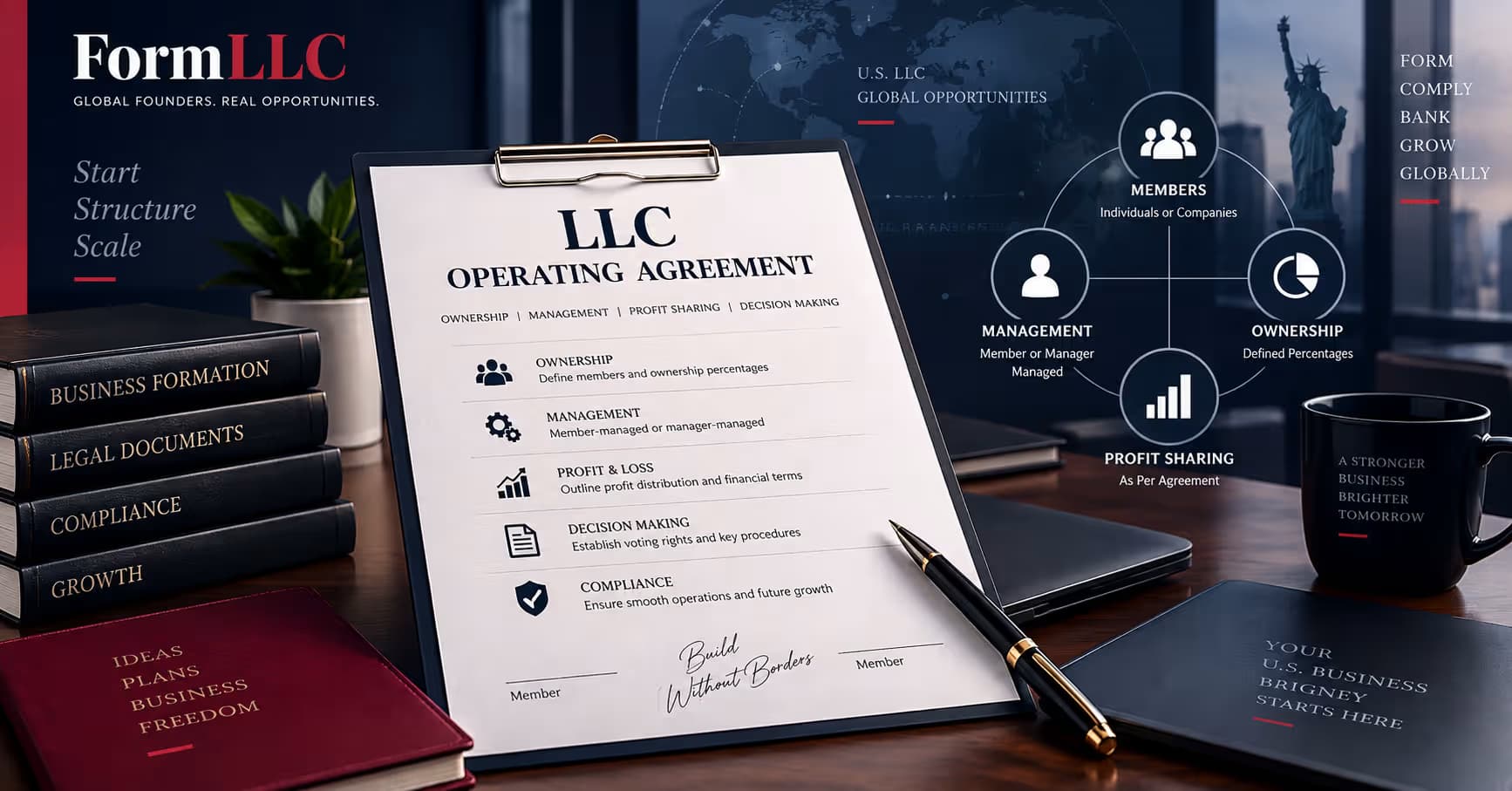
A US LLC operating agreement is an important document for non-resident entrepreneurs who own or manage a limited liability company in the United States. It explains how the company operates, who owns it, how business decisions are made, and what happens when its ownership or management changes.
Whether you are establishing a single-member LLC or building a business with international partners, understanding your operating agreement can help you document your company's internal arrangements and maintain organized business records.
In this guide, we explain what an LLC operating agreement is, what it should include, how requirements differ by state, and what international business owners should consider when preparing one.
1. What Is a US LLC Operating Agreement for Non-Residents?
A US LLC operating agreement is an internal document that establishes how a limited liability company will be managed and operated.
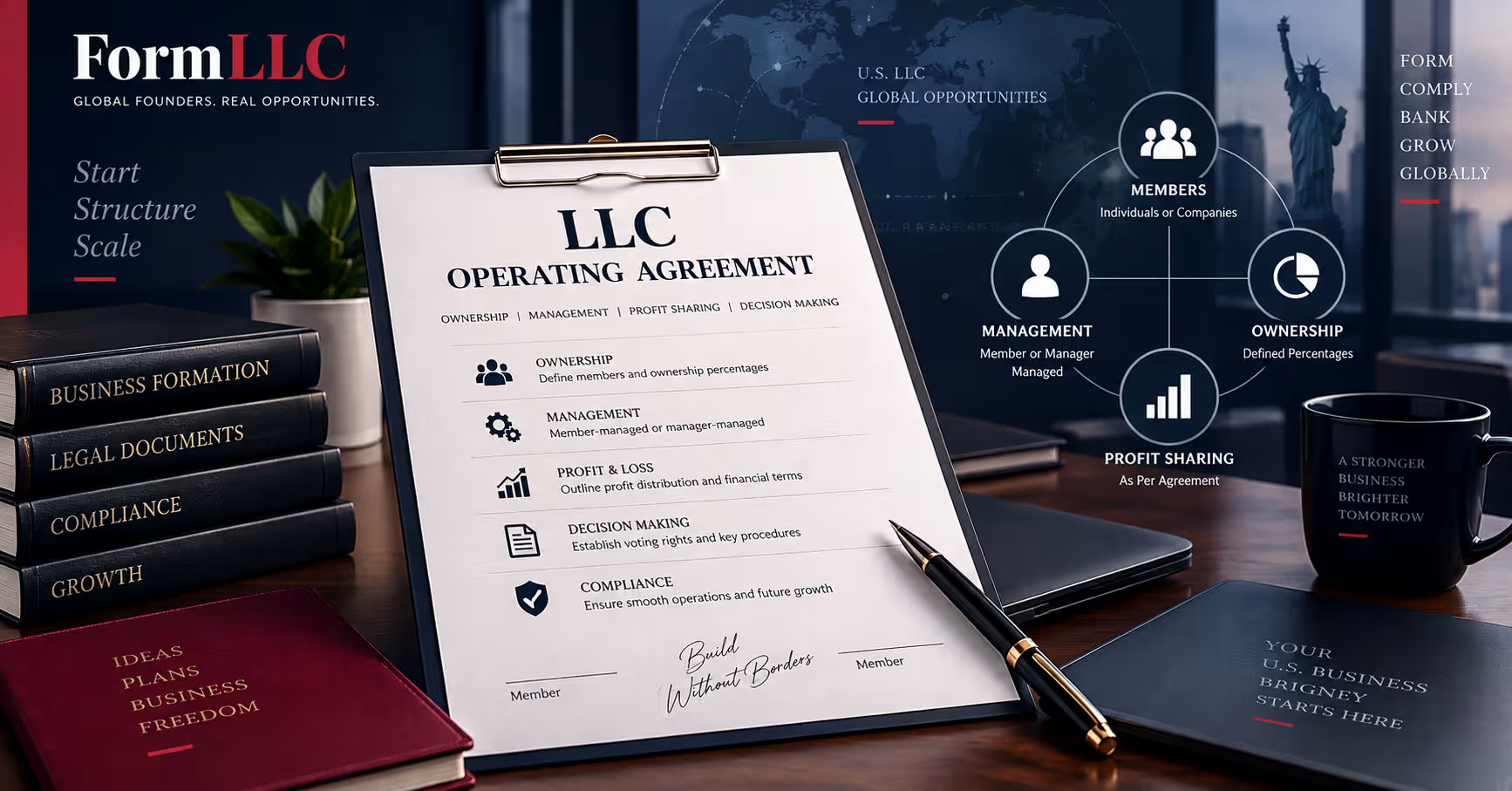
It may address ownership percentages, member contributions, management responsibilities, voting procedures, profit distributions, and procedures for admitting or removing members.
For a single-member LLC, the agreement can document the sole owner's authority and how the company will be operated.
For a multi-member LLC, it can establish the relationship between members and provide procedures for handling important business decisions.
The operating agreement is separate from the Articles of Organization or Certificate of Formation used to establish an LLC under state law.
Formation documents create the legal entity. The operating agreement establishes its internal governance arrangements.
2. Do Non-Resident LLC Owners Need an Operating Agreement?
The legal requirements for an operating agreement depend on the state where the LLC is formed.
Some states require an LLC to have an operating agreement, while others provide default statutory rules when members have not adopted one. Requirements concerning the agreement's form and contents can also differ.
An operating agreement may be useful even when a written document is not legally mandatory.
It can help non-resident owners:
- Document ownership and management authority.
- Establish how important company decisions will be made.
- Record financial contributions and distribution procedures.
- Define the rights and responsibilities of multiple members.
- Maintain consistent internal business records.
An operating agreement is not a substitute for complying with state law, tax requirements, or other applicable regulations.
Before preparing one, check the rules of your formation state or consult a qualified US business attorney.
3. What Should an LLC Operating Agreement Include?
The appropriate contents depend on the LLC's ownership structure, activities, formation state, and business requirements.
The following sections are common starting points.
Company information
Record the LLC's legal name, formation state, formation date, and principal business address.
The agreement can also identify the company's business purpose and explain how amendments to its internal records will be handled.
The information should be consistent with the company's approved formation documents.
Member ownership and contributions
Identify the LLC's members and document their ownership interests.
For a multi-member LLC, the agreement can explain each member's initial contribution and any future capital contribution requirements.
Contributions may involve money, property, or services, subject to the agreement and applicable law.
The document should also explain how ownership changes will be approved and recorded.
Management responsibilities
Specify whether the LLC will be member-managed or manager-managed.
In a member-managed structure, members generally participate in managing the company according to the agreement and applicable law.
In a manager-managed structure, designated managers are responsible for managing the company within their assigned authority.
The agreement should clearly identify who can enter contracts, authorize significant expenses, and act on behalf of the LLC.
Voting and decision-making
Explain how members will vote on company matters.
An agreement may distinguish routine operating decisions from major decisions such as admitting new members, borrowing significant amounts, selling company assets, or dissolving the LLC.
Specify the approval thresholds that apply to different decisions.
For businesses with multiple owners, clear voting procedures can reduce uncertainty when disagreements arise.
Profit distributions and financial arrangements
Document how and when the LLC may distribute available funds to its members.
The agreement should address the allocation of profits and losses where relevant and distinguish those allocations from actual cash distributions.
Financial provisions must be consistent with applicable law and the entity's tax treatment.
An operating agreement does not, by itself, determine the LLC's federal tax classification or eliminate tax-reporting obligations.
Ownership transfers and dissolution
Describe what happens if a member wants to sell or transfer an ownership interest, withdraw from the company, or transfer an interest following death.
For a multi-member LLC, the agreement may include buyout procedures and restrictions on transfers to outside parties.
It should also address the process for dissolving the company and handling its remaining assets and liabilities.
These provisions should be prepared with particular attention to the LLC's state law and the members' circumstances.
4. Single-Member vs. Multi-Member LLC Operating Agreements
A single-member LLC operating agreement is usually simpler because the company has only one owner.
It can identify the sole member, establish management authority, document the member's contribution, and explain how the company's operations and records will be maintained.
A multi-member operating agreement generally requires more detailed provisions because multiple parties have ownership and decision-making rights.
It may need to address:
- Each member's ownership interest and capital contributions.
- Management responsibilities and voting rights.
- Profit allocations and distributions.
- Procedures for admitting additional members.
- Transfer restrictions and member exits.
- Deadlock resolution and dispute procedures.
Using a generic single-member agreement for a multi-member company can leave important ownership and governance questions unanswered.
The agreement should reflect the LLC's actual structure rather than relying on a template that does not match the business.
5. How to Prepare an LLC Operating Agreement as a Non-Resident
International entrepreneurs can use the following process to organize the information required for their operating agreement.
Step 1: Confirm your LLC's formation details
Collect the LLC's approved formation documents and verify its legal name, formation state, and ownership information.
If you have not formed your company yet, read our guide to starting a US LLC from India.
Step 2: Review applicable state requirements
Check the operating agreement rules of the state where your LLC was formed.
State law may affect management authority, member rights, agreement amendments, and other important provisions.
If you are considering a Wyoming company, explore our Wyoming LLC guide for non-residents for additional information about that formation option.
Step 3: Document ownership and management
Record the members' ownership interests and establish who has authority to manage the company.
For a multi-member LLC, clarify voting arrangements and the process for making important decisions.
Step 4: Prepare the financial and governance provisions
Document contributions, distributions, financial responsibilities, and procedures for changing ownership or management.
Make sure the provisions reflect the actual arrangement between the company's owners.
Step 5: Review and adopt the agreement
Have a qualified US business attorney review the proposed agreement, particularly if the LLC has multiple members, foreign entity owners, investors, or unusual governance arrangements.
Follow the applicable state rules and the agreement's own adoption procedures.
Keep the finalized agreement with the company's important business records and provide appropriate copies to the relevant members.
6. Does an Operating Agreement Help With Business Banking?
A business bank or financial service provider may request an LLC operating agreement when reviewing a business account application.
The document can help explain the company's ownership and identify who has authority to act for the business.
However, banking requirements vary by provider.
An operating agreement does not guarantee that a non-resident founder will be approved for a US bank account.
Providers may also request formation documents, an EIN confirmation letter, identification, ownership information, address documentation, and other supporting records.
For more information, read our guide to opening a US bank account as a non-resident LLC owner.
7. Does an Operating Agreement Affect LLC Taxes?
An operating agreement and an LLC's federal tax classification are different matters.
Under the IRS default classification rules, a domestic LLC with one member is generally treated as a disregarded entity for federal income tax purposes unless it makes an applicable election.
A domestic LLC with two or more members is generally classified as a partnership unless it elects corporate treatment.
An operating agreement may document the members' intended financial and management arrangements, but it does not replace the applicable federal tax rules or required elections.
Foreign-owned LLCs may also have federal information-reporting obligations depending on their ownership, transactions, and tax classification.
Learn more in our Form 5472 guide for foreign-owned US LLCs.
For official information about LLC tax classification, consult the IRS guide to limited liability companies.
8. Common Operating Agreement Mistakes to Avoid
Several avoidable mistakes can make an operating agreement less useful.
Using an unsuitable template: An agreement written for another state or ownership structure may not address your company's requirements.
Leaving ownership arrangements unclear: Multi-member LLCs should document ownership interests, contributions, management authority, and decision-making procedures.
Confusing the agreement with formation documents: An operating agreement governs internal affairs; it does not replace the state formation filing.
Ignoring changes to the business: Adding an owner, changing management, or revising important financial arrangements may require an amendment.
Assuming the agreement solves tax or banking requirements: It does not replace tax advice, IRS filings, identity verification, or financial institution approval.
An agreement is most useful when it accurately reflects the company's current structure and operating arrangements.
9. When Should You Update Your LLC Operating Agreement?
Review the agreement whenever your company undergoes a significant ownership or governance change.
Examples include admitting a new member, transferring an ownership interest, appointing a new manager, or changing voting and financial arrangements.
A review may also be appropriate when the business expands, receives investment, or changes its operating structure.
Follow the amendment procedures established by the agreement and applicable state law.
Maintain the updated document with your company records and ensure the relevant members have access to the current version.
10. Final Checklist for Non-Resident LLC Owners
Before finalizing your operating agreement, verify that it accurately records your company's legal name, formation state, members, ownership interests, and management arrangements.
Make sure it also addresses financial decisions, voting procedures, ownership transfers, amendments, and any other provisions relevant to your business.
Review the applicable state requirements and obtain professional assistance where necessary.
A well-prepared US LLC operating agreement helps document how your company is organized and how its owners intend to manage it. It should remain consistent with the company's actual operations and applicable law.
If you need assistance establishing a US company, explore the services available through FormLLC.
Disclaimer: This article provides general educational information and is not legal, tax, banking, or financial advice. Operating agreement requirements vary by state and business structure. Consult qualified professionals before preparing or relying on an agreement for your company.
This article is for general informational purposes only and does not constitute legal, tax, or financial advice. Tousif Akram and FormLLC are not a law firm or CPA firm. Consult a licensed professional for advice specific to your situation.
Ready to Form Your US LLC?
Free 30-minute consultation with no obligation and no sales pressure.
Book Free Call