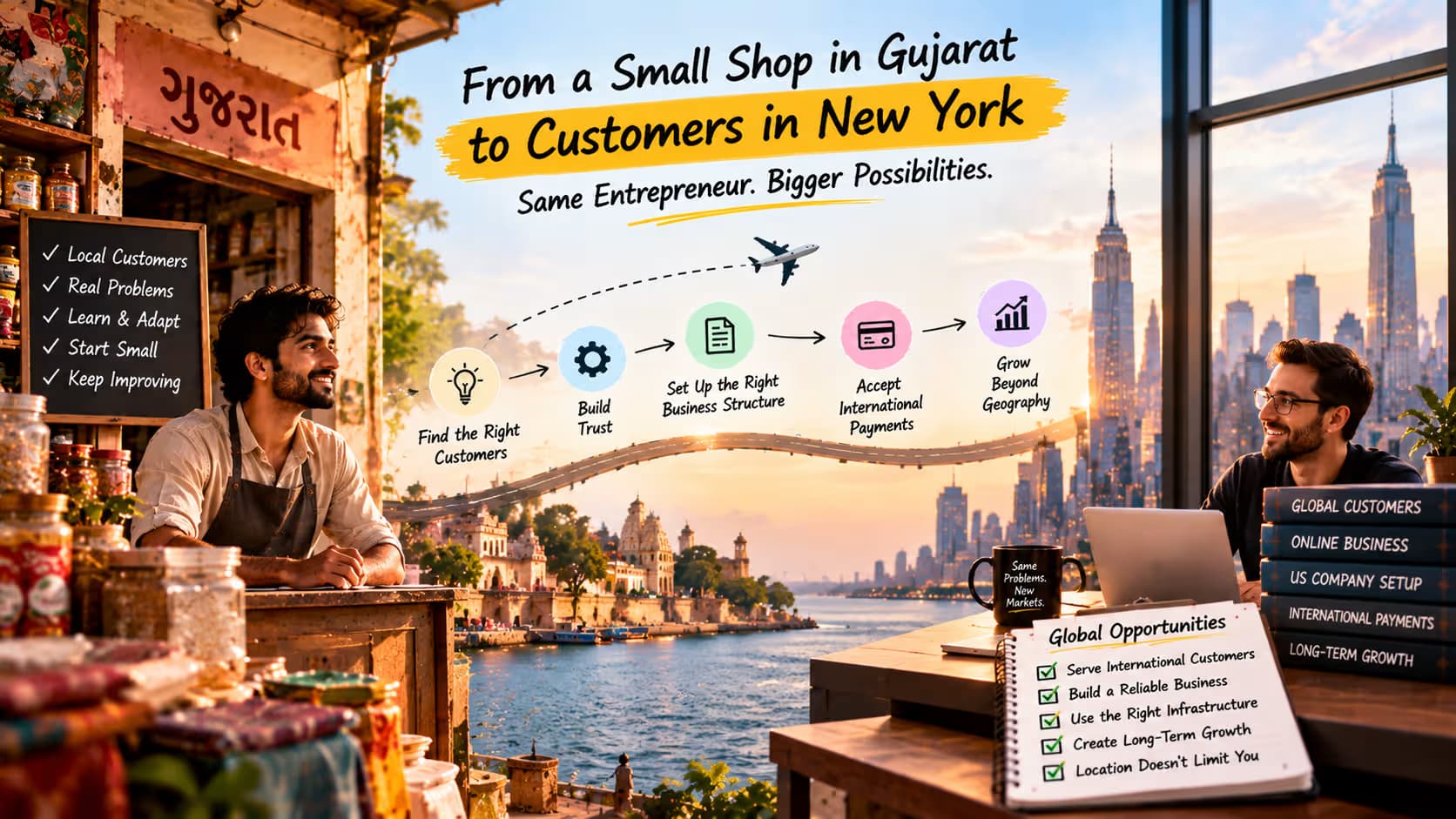
How to start US business from India: From a Small Shop in Gujarat to New York

Tousif Akram
IRS CAA | Founder, FormLLC
There is something I have learned after working with entrepreneurs from India: sometimes the distance between a small local business and an international business is much smaller than it looks. I recently thought about the journey of a founder who started with a small shop in Gujarat and eventually built a business serving customers in New York. His journey is a powerful example of what can happen when an entrepreneur starts thinking beyond geography. For Indian founders, learning how to start US business from India isn't simply about registering a company. It is about finding customers, building trust, creating the right business infrastructure, and becoming capable of serving a global market.
A US company can be useful infrastructure for some Indian entrepreneurs. But the real objective should never be simply to "own a US company." The objective is building a business that can serve customers beyond your geography. If you are considering a US LLC from India, I think that distinction is one of the most important things to understand before you begin.
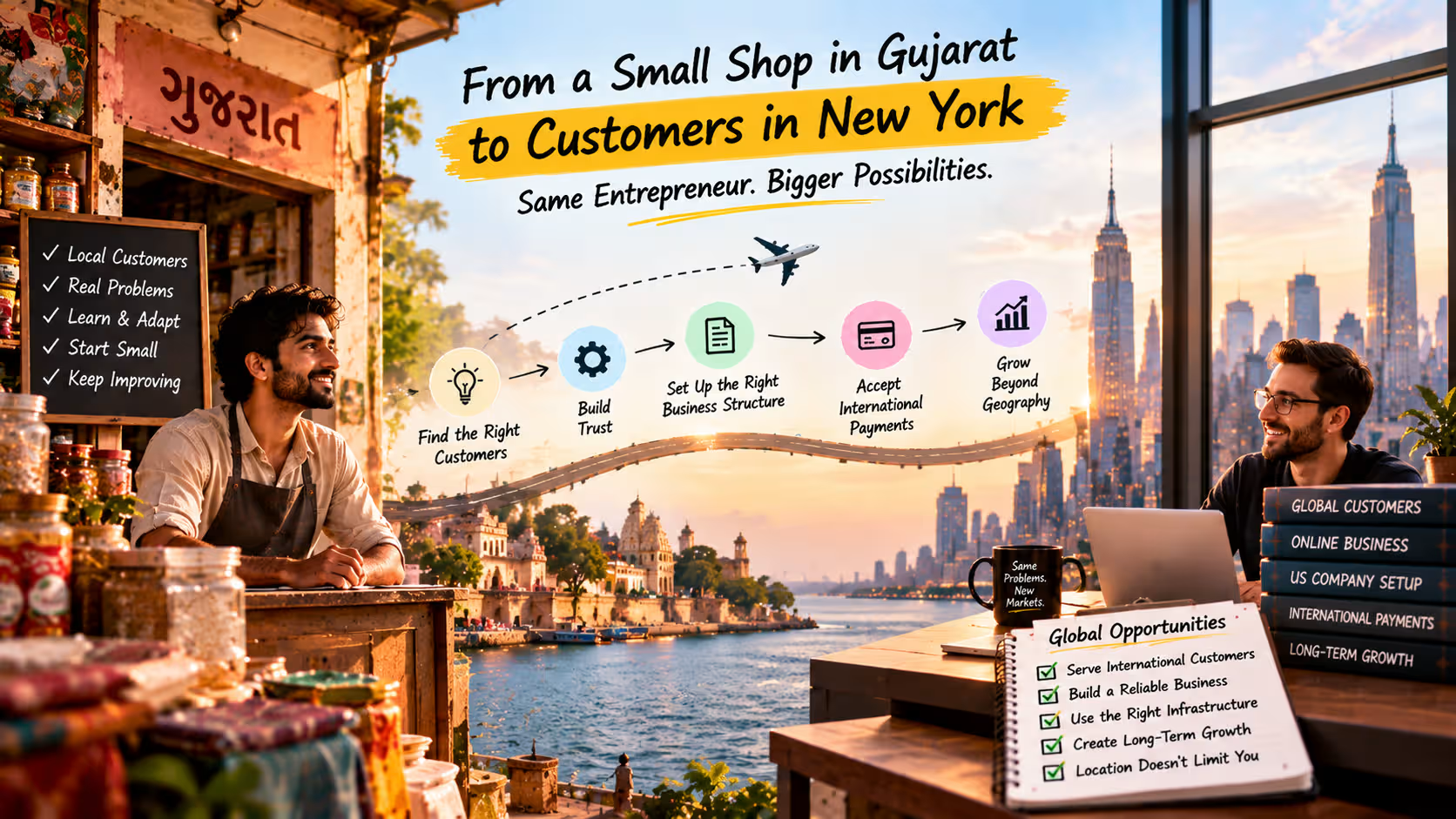
It Started With a Small Shop in Gujarat
The beginning of this story wasn't a fancy startup office, a venture capital investment, or a polished international brand. It was a small shop in Gujarat.
Like many businesses, the journey started with something much more ordinary: an entrepreneur trying to build something of his own and serve customers as well as he could. At that stage, there was no reason to assume that the business would eventually reach customers in another country. The focus was simply on building, learning, serving customers, and finding opportunities to grow.
That detail matters because when we talk about entrepreneurship today, we often begin with polished websites, startups, funding announcements, international customers, and companies that already look successful from the outside.
We forget that most businesses don't start that way.
They start small. Someone opens a shop. Someone starts freelancing. Someone sells a product. Someone takes orders through WhatsApp. Someone starts helping a few customers and slowly discovers that the market is bigger than they originally thought.
The founder in this story started locally. But eventually, the business began looking beyond the local market. And that is where things became interesting.
For me, this is one of the most important lessons for anyone thinking about how to start US business from India. You don't necessarily have to begin with an international business model. You can start with a real problem, real customers, and a real business. Then you can gradually discover that the market you can serve is much larger than the place where you started.
The Internet Changed What "Local Business" Can Mean
For a long time, your location determined a large part of your potential customer base. If you operated a shop in Gujarat, most of your customers would probably come from Gujarat or nearby areas.
That doesn't mean geography has disappeared. It hasn't. But the internet has fundamentally changed the relationship between location and opportunity.
A business can now have an operating team in India, customers in the United States, suppliers in another country, software hosted somewhere else, and payments moving across multiple financial systems.
That creates opportunities that would have been extremely difficult for a small business to pursue a few decades ago.
The founder who started with a small shop in Gujarat eventually reached customers in New York. That doesn't mean the shop suddenly became a Silicon Valley startup. It means the founder found a way to make the business relevant to someone who lived on the other side of the world.
And that is a much more important lesson.
Your starting geography does not necessarily have to become your permanent market.
That idea is one reason I believe the rise of digital entrepreneurship is particularly interesting for Indian founders. Someone can build from India while selling to customers in the US, Europe, the Middle East, or elsewhere.
The challenge is not simply reaching those customers. It is building the trust, systems, operations, and infrastructure required to serve them properly.
For an entrepreneur trying to start US business from India, that change in geography can be both an opportunity and a responsibility. Reaching a customer in another country is only the beginning. The business still has to deliver.
New York Wasn't the Destination. The Customer Was.
When people hear that an Indian business serves customers in New York, they may immediately think about the city. I think about the customer.
Why did that customer choose this business? What problem did the business solve? Why did the customer trust a company operating from India? How did the founder communicate the value of the product or service? What made the customer comfortable buying from a business thousands of kilometres away?
Those are the real questions.
International customers don't necessarily care where you were born. They care whether you can solve their problem.
Of course, trust becomes more complicated when you operate internationally. A potential customer may want to know who you are, where your business is registered, how they can pay you, whether they can sign a contract with you, what happens if something goes wrong, whether you have a professional website, and whether you are actually capable of delivering what you promise.
These questions become particularly important when an Indian entrepreneur wants to build an international business.
This is where company structure can become part of the story. A US company for Indian entrepreneurs can sometimes become part of the infrastructure supporting an international business, but the entity itself is only one piece of a much larger system.
The customer is still the centre of the business.
How to start US business from India: Think Beyond the LLC
I want to make one thing clear: not every Indian entrepreneur needs a US company.
If your customers are primarily in India, your business operates locally, and an Indian business structure already meets your needs, creating a US entity simply because it sounds international may not make sense.
But the calculation can be different when your business is genuinely international.
An Indian founder may have US customers, a SaaS business, an international software agency, an ecommerce brand, consulting clients overseas, digital products, or plans to expand into the American market. In those situations, an entrepreneur may explore whether a US company structure fits the business.
The US Small Business Administration treats business formation as more than simply registering an entity. Entrepreneurs may also need to consider the business structure, registration, tax IDs, licenses and permits, banking, and other requirements.
That broader view is important because company formation is a beginning, not the finish line.
If you are researching how to start US business from India, I would recommend thinking about the entire business model first and the legal structure second. The right structure should support what you are actually building.
For a deeper overview of the process, you can also read my guide on How to Start a US LLC From India.
What a US LLC From India Can and Cannot Do
A US LLC from India can be a useful structure for certain international businesses. But an LLC is not a magic button.
It does not automatically guarantee a bank account, payment processor approval, tax-free income, US customers, investment, or immigration rights.
Those outcomes depend on the business, ownership structure, activities, provider requirements, and applicable laws.
This distinction is important because I've seen too many conversations around international company formation reduce everything to one simple message: "Create a US LLC and everything becomes easier."
Real businesses are more complicated than that.
A founder considering a US LLC for Indian entrepreneurs should think about the entire operating model, not only the formation fee.
Where will the customers be? Where will the business operate? How will money move? What tax obligations may apply? What compliance filings are required? What banking options are available? What responsibilities remain in India?
Those questions deserve answers before the formation decision, not after it.
If you are still at the research stage, my US LLC from India guide explains the broader journey, including why formation should be treated as only one part of building an international business.
The US Company Was Not What Made This Founder Successful
This is probably the most important point in this story.
The founder did not start with a US company. He started with a small shop in Gujarat. The company structure came later, when the business had a reason to think internationally.
That distinction matters.
If someone reads this article and thinks, "I need a US company because I want customers in New York," I would tell them to reverse the order.
First, build something people in New York want.
Then, figure out the infrastructure required to serve them properly.
The legal entity should support the business. It shouldn't become a substitute for having a business.
This is also why I think the phrase US company from India can sometimes be misunderstood.
The important question isn't simply whether you can create a company in the United States while living in India. The more important question is whether that structure actually makes sense for the business you are trying to build.
For someone who wants to start US business from India, the company should be a tool that supports the business rather than the entire business strategy.
What Indian Entrepreneurs Can Learn From This Journey
The story has several lessons that I think apply far beyond this one founder. They are also lessons I have repeatedly seen while working with entrepreneurs who want to build businesses that operate beyond their home markets.
You Don't Need to Start Internationally to Become International
The founder started with a small shop in Gujarat. There was nothing wrong with starting locally.
In fact, starting locally can teach you some of the most important lessons about business: how to deal with customers, how to price something, how to manage cash flow, how to handle difficult customers, how to deliver consistently, and how to understand what people actually want.
Those skills don't become irrelevant when your customers move from Gujarat to New York. They become even more important.
A founder who learns how to serve ten customers well can eventually learn how to serve one hundred. A business that learns how to solve a real problem in one market can investigate whether that same problem exists somewhere else.
You don't have to look global on Day 1 to eventually become global.
Your Location Doesn't Have to Define Your Market
One of the most exciting things about building a business today is that your first market and your eventual market don't have to be the same.
You can start by serving customers around you. Then one customer from another city. Then another country. Then an entirely different market.
You don't have to pretend you're a global company on Day 1. You can become one by gradually proving that customers outside your geography value what you offer.
For Indian founders especially, I think this is a powerful shift in mindset.
A business can be built in India without its ambitions being limited to India.
International Business Requires Trust
If you're an Indian entrepreneur trying to serve customers in the US, ask yourself a simple question: Would someone who has never met me trust my business?
If the answer is no, registering a company won't solve the problem.
You may need a professional website, clear communication, transparent pricing, strong contracts, customer reviews, reliable delivery, professional email, clear business information, and consistent customer support.
A US company from India can be part of your business infrastructure. But credibility is built through everything around it.
This is also where your online presence matters.
Before an international customer buys from you, they may search for your company, your name, your reviews, your website, and your work.
The legal structure can contribute to credibility, but it cannot replace a trustworthy business.
Don't Confuse a US Company With a US Business
This distinction is becoming increasingly important.
A US company is a legal entity. A US business is a business that actually serves the US market. Those aren't necessarily the same thing.
You can register a US company and have no US customers. You can have US customers without immediately needing a US entity.
The right decision depends on what you're actually building.
If you're an Indian entrepreneur considering a US business from India, start with your customers and business model. Then work backwards toward the appropriate structure.
That is a much healthier way to think about internationalization than starting with a registration form.
Think Beyond the Registration Certificate
One of the things I've learned from helping entrepreneurs is that founders often spend most of their attention on formation.
They ask which state they should choose, how much an LLC costs, and how quickly they can register. Those questions matter. But they're only the first layer.
Then come the practical questions.
How do I get an EIN? How do I manage compliance? How do I handle bookkeeping? How do I receive payments? How do I work with US customers? How do I keep business and personal finances separate? How do I maintain the company?
This is why I increasingly think about company formation as Day 1 infrastructure.
The real business begins on Day 2.
If you want to understand that side of the journey, I've written more about the Day-2 problem after forming a US LLC and why formation should never be treated as the final step.
What I Would Tell an Indian Entrepreneur Thinking About Going Global
If you are sitting in Gujarat, Maharashtra, Bihar, Delhi, Karnataka, West Bengal, Tamil Nadu, or anywhere else in India and thinking about serving international customers, I wouldn't begin by asking, "Which company should I register?"
I'd begin with five different questions.
Who is my international customer?
What problem am I solving for them?
Why would they choose me instead of someone in their own country?
How will I deliver the promised result?
What business infrastructure will I need once customers start buying?
Once you can answer those questions, the conversation around company formation becomes much more useful.
You can then evaluate whether an Indian entity, a US LLC, another international structure, or a combination of structures makes sense for your situation.
If you are trying to start US business from India, this is the point where professional advice becomes valuable. Tax, foreign-exchange, and regulatory rules can affect Indian residents differently depending on their structure and circumstances.
I would strongly recommend getting advice from a qualified Indian cross-border tax professional before making a major structural decision.
The goal should not be to create a US company from India simply because someone online told you that every entrepreneur needs one.
The goal should be to build a structure that makes sense for the business you are actually trying to create.
The Real Lesson Isn't "Start a US Company"
When I look at the journey from a small shop in Gujarat to customers in New York, I don't see a story about company registration.
I see a story about expansion.
The founder started with what was available: a shop, local customers, a product or service, and a small market. Then the internet created another possibility. The market didn't have to remain local.
That is the part of entrepreneurship I find most exciting.
Someone can start with very little and gradually build access to markets that once felt impossibly far away.
Sometimes, the biggest change isn't in the business itself. It's in the founder's perception of what is possible.
A founder who once thought, "My customers are the people around me," can eventually start thinking, "Why can't someone in New York be my customer?"
That change in thinking can be the beginning of an entirely different business.
From Gujarat to New York — And What Comes Next
I don't know where this founder's journey will ultimately end. And that's another thing I like about entrepreneurship.
There is rarely a final destination.
A small shop can become a larger local business. A local business can discover an international customer. An international customer can lead to a new market.
A new market can require new infrastructure. And that infrastructure can open doors to even more customers.
This is how I think about the future of entrepreneurship in India.
I don't believe every Indian founder needs to move to America to build an American business. I don't believe every entrepreneur needs a US LLC. And I don't believe a company registration document creates success.
But I strongly believe that talented people in India should be able to build businesses that serve customers anywhere in the world.
The founder who started with a small shop in Gujarat and eventually served customers in New York is a reminder of that.
Your starting point doesn't have to be your final market.
And sometimes, the first step toward building globally isn't moving somewhere else.
It's simply realizing that the market you're capable of serving may be much bigger than the place where you started.
A Note From Me
My own journey has made this idea particularly meaningful to me.
I started by teaching students, later discovered freelancing, and eventually received my first international payment of around $20.
That small payment didn't make me successful. But it changed the way I thought about geography and opportunity.
It made me realize something that has stayed with me ever since: a person's location doesn't necessarily have to determine the size of the opportunity available to them.
Today, through my work with FormLLC, I spend a lot of time thinking about how entrepreneurs can build businesses that serve customers beyond their home markets.
I have seen founders think about US companies, international customers, payments, compliance, credibility, and all the practical problems that come after the initial decision to go global.
For me, that's the bigger story behind helping someone start US business from India.
It isn't really about the paperwork.
It's about what the entrepreneur hopes to build after the paperwork is finished.
It's about turning a local opportunity into a global one.
And sometimes, that journey can begin with something as ordinary as a small shop in Gujarat.
This article is for general informational purposes only and does not constitute legal, tax, or financial advice. Tousif Akram and FormLLC are not a law firm or CPA firm. Consult a licensed professional for advice specific to your situation.
Ready to Form Your US LLC?
Free 30-minute consultation with no obligation and no sales pressure.
Book Free Call