W-8BEN-E LLC Guide: W-8BEN or W-8BEN-E? The Form That Froze One Client's US Payments

Tousif Akram
IRS CAA | Founder, FormLLC
When founders ask me about W-8BEN-E LLC requirements, I explain that choosing the right tax form can be just as important as setting up the company correctly. I have seen payments get held up when a US client cannot validate the recipient’s tax documentation. In one situation, a client faced potential 30% withholding until the correct documentation was provided.
The problem was not simply about completing a document. It was about identifying who was receiving the income, confirming their tax status, and providing the payer with documentation it could rely on. For international founders, understanding W-8BEN vs W-8BEN-E can help prevent avoidable payment delays and unnecessary back-and-forth with US clients.
W-8BEN vs W-8BEN-E: What Is the Difference?
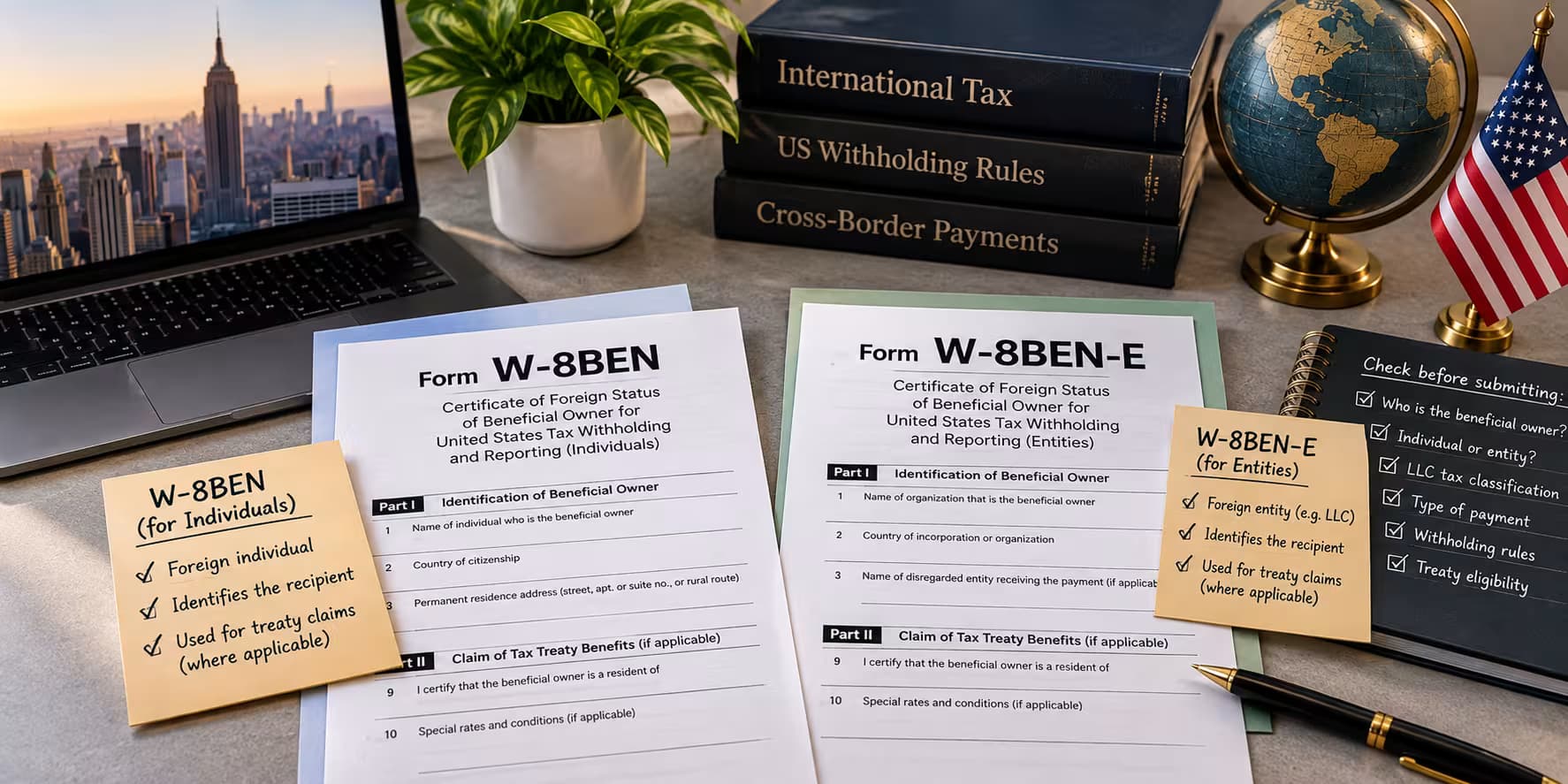
The main difference is who the form identifies. Form W-8BEN is generally used by foreign individuals, while Form W-8BEN-E is generally used by foreign entities. Both forms help a US payer or other withholding agent document foreign status and, where applicable, determine whether a reduced withholding rate or treaty benefit may apply.
Form W-8BEN may be relevant when an individual outside the United States receives income directly or is the beneficial owner of income paid through a disregarded entity. Form W-8BEN-E is generally used when a foreign entity is the beneficial owner of the relevant income and the form is appropriate for that payment.
This distinction matters because submitting the wrong form can leave the payer unable to verify the recipient’s tax status or apply the withholding treatment being claimed. Before completing either form, review the official IRS instructions for Form W-8BEN and Form W-8BEN-E.

W-8BEN-E LLC Requirements: Which Form Does Your LLC Need?
The phrase W-8BEN-E LLC can create confusion because an LLC is a legal business structure, but its federal tax classification determines how it is treated for many US tax purposes. You should not assume that every LLC must submit Form W-8BEN-E simply because it is a business.
Understanding w-8ben-e llc requirements starts with confirming who owns the income and how the LLC is classified for US tax purposes. These details help determine which tax form the payer may need.
If you own a foreign-owned, single-member US LLC that is treated as a disregarded entity for federal tax purposes, the appropriate documentation generally depends on the owner’s status. The foreign individual owner may need to provide Form W-8BEN, while a foreign entity owner may need Form W-8BEN-E, depending on the facts and applicable IRS instructions. If the relevant recipient is a US person, Form W-9 may instead be appropriate.
An LLC that has elected corporate tax treatment or has multiple owners may require a different analysis. If the income is effectively connected with a US trade or business, Form W-8ECI may be relevant in certain circumstances. The correct documentation depends on the beneficial owner, the LLC’s tax classification, the nature of the income, and the applicable withholding rules.
My advice is to confirm the tax treatment before sending a form to a client. A company name, an EIN, or a US registration certificate alone does not determine which W-8 form is correct. If you are still working through your business setup, read my guide on forming a US LLC as a non-resident to understand the wider formation process.
What Should You Check Before Choosing a Form?
Before completing a W-8 form, identify the beneficial owner of the income and confirm whether that owner is an individual or an entity. Then establish how the LLC is classified for US federal tax purposes and identify the type of payment involved. These details help determine which form may be appropriate and whether a treaty claim or another withholding position can be supported.
Why Can a US Client Withhold 30%?
US withholding rules can require a payer to withhold 30% from certain US-source payments to foreign persons unless valid documentation supports an exemption or a reduced rate. Depending on the circumstances, covered income may include dividends, interest, rents, royalties, and other categories subject to the applicable rules.
That does not mean every invoice sent to a US customer automatically faces 30% withholding. The type and source of income, where services are performed, the recipient’s tax status, and the relevant withholding rules all matter. If a payment is subject to withholding and the payer lacks valid documentation, withholding may apply or payment processing may be delayed.
This is why I take payment documentation seriously. If a US client requests a W-8 form, I encourage founders to clarify what the client needs before completing it. The objective is to provide a valid form that accurately reflects the recipient’s status, not to select whichever form appears easiest or offers the most favourable result.
Does a W-8 Form Automatically Eliminate US Withholding?
No. A W-8 form documents relevant information about a foreign recipient and may support a particular withholding treatment when the requirements are met. It does not automatically eliminate withholding on every payment. Any exemption or treaty benefit must be supported by the recipient’s circumstances and the applicable rules.
What I Tell Founders Before They Submit a W-8 Form
First, identify the beneficial owner of the income. Next, confirm whether that owner is an individual or an entity and determine how the LLC is treated for US tax purposes. Then review the payment type and establish whether the form is being used to document foreign status, claim treaty benefits, or support another withholding position.
If you are claiming tax treaty benefits, confirm that you qualify and that the form supports the specific claim. Do not select a treaty exemption simply because your business is registered outside the United States. Treaty eligibility depends on the relevant rules and the facts of your situation.
One more important detail is that W-8 forms are generally provided to the requesting payer or withholding agent rather than sent directly to the IRS. The payer uses the documentation to determine the appropriate withholding and reporting treatment. Follow the payer’s submission instructions and ensure that the information you provide is accurate and current.
Before submitting a form, review the w-8ben-e llc requirements against the IRS instructions and the payer’s request. Choosing the appropriate form helps document your tax status accurately and may prevent avoidable payment delays.
My broader lesson is simple: setting up a US LLC is only one part of doing business internationally. Payment onboarding, tax documentation, and ongoing compliance matter too. If you are reviewing your business identification requirements, my guide to getting an EIN without an SSN as a non-resident explains another important part of the process. You can also read my guide to non-resident US LLC tax filing to understand why ongoing compliance matters after formation.
A few minutes spent checking the details can help avoid unnecessary back-and-forth when you are waiting to get paid. Before submitting Form W-8BEN or W-8BEN-E, confirm that the form fits your actual situation and that any withholding or treaty position you claim is properly supported.
Frequently Asked Questions
Is Form W-8BEN-E required for every US LLC?
No. An LLC does not automatically need Form W-8BEN-E simply because it is registered in the United States. The appropriate form depends on the LLC’s tax classification, the beneficial owner, the type of payment, and the applicable IRS rules.
What is the difference between W-8BEN and W-8BEN-E for a foreign-owned LLC?
Form W-8BEN is generally used by foreign individuals, while Form W-8BEN-E is generally used by foreign entities. For a disregarded single-member LLC, the owner’s status may determine which form is appropriate. Check the current IRS instructions before submitting either form.
Can a US client withhold 30% if I do not provide a W-8 form?
Certain US-source payments to foreign persons may be subject to 30% withholding when valid documentation supporting a different treatment is missing. However, withholding does not apply automatically to every payment or invoice. The applicable rules depend on the income and the recipient’s circumstances.
Do I send Form W-8BEN-E directly to the IRS?
Generally, no. You normally provide the completed form to the requesting payer or withholding agent, following its submission instructions. The payer uses it to document foreign status and determine the appropriate withholding treatment.
Can I claim tax treaty benefits using a W-8 form?
Potentially, if you qualify under the applicable treaty and IRS requirements. You should not claim a reduced withholding rate or exemption unless your circumstances support it and the form is completed correctly.
Does having an EIN mean my LLC should submit Form W-8BEN-E?
No. An EIN identifies a business or other eligible entity for federal tax purposes, but it does not by itself determine which W-8 form is appropriate. You must also consider the beneficial owner, the LLC’s tax classification, and the type of income.
Final Thoughts
Choosing between Form W-8BEN and Form W-8BEN-E is not just an administrative detail. The correct documentation can help a US payer verify a foreign recipient’s status and determine the appropriate withholding treatment. The wrong form or an unsupported treaty claim can lead to delays, additional questions, or incorrect withholding.
Before submitting your paperwork, confirm who owns the income, how your LLC is classified for US tax purposes, and what type of payment you receive. Review the official IRS instructions and seek qualified tax advice if your situation is unclear.
The goal is not simply to complete a W-8 form. It is to provide accurate tax documentation so your international business can work with US clients with fewer avoidable payment and compliance problems.
*This article is for general educational purposes only and is not individualized tax or legal advice. The appropriate form depends on the recipient, the LLC’s tax classification, the type of income, and the applicable withholding rules. Consult a qualified tax professional if you are unsure.*)
W-8BEN-E LLC Requirements: Which Form Does Your LLC Need?
The phrase W-8BEN-E LLC can create confusion because an LLC is a legal business structure, but its federal tax classification determines how it is treated for many US tax purposes. You should not assume that every LLC must submit Form W-8BEN-E simply because it is a business.
Understanding w-8ben-e llc requirements starts with confirming who owns the income and how the LLC is classified for US tax purposes. These details help determine which tax form the payer may need.
If you own a foreign-owned, single-member US LLC that is treated as a disregarded entity for federal tax purposes, the appropriate documentation generally depends on the owner’s status. The foreign individual owner may need to provide Form W-8BEN, while a foreign entity owner may need Form W-8BEN-E, depending on the facts and applicable IRS instructions. If the relevant recipient is a US person, Form W-9 may instead be appropriate.
An LLC that has elected corporate tax treatment or has multiple owners may require a different analysis. If the income is effectively connected with a US trade or business, Form W-8ECI may be relevant in certain circumstances. The correct documentation depends on the beneficial owner, the LLC’s tax classification, the nature of the income, and the applicable withholding rules.
My advice is to confirm the tax treatment before sending a form to a client. A company name, an EIN, or a US registration certificate alone does not determine which W-8 form is correct. If you are still working through your business setup, read my guide on forming a US LLC as a non-resident to understand the wider formation process.
What Should You Check Before Choosing a Form?
Before completing a W-8 form, identify the beneficial owner of the income and confirm whether that owner is an individual or an entity. Then establish how the LLC is classified for US federal tax purposes and identify the type of payment involved. These details help determine which form may be appropriate and whether a treaty claim or another withholding position can be supported.
Why Can a US Client Withhold 30%?
US withholding rules can require a payer to withhold 30% from certain US-source payments to foreign persons unless valid documentation supports an exemption or a reduced rate. Depending on the circumstances, covered income may include dividends, interest, rents, royalties, and other categories subject to the applicable rules.
That does not mean every invoice sent to a US customer automatically faces 30% withholding. The type and source of income, where services are performed, the recipient’s tax status, and the relevant withholding rules all matter. If a payment is subject to withholding and the payer lacks valid documentation, withholding may apply or payment processing may be delayed.
This is why I take payment documentation seriously. If a US client requests a W-8 form, I encourage founders to clarify what the client needs before completing it. The objective is to provide a valid form that accurately reflects the recipient’s status, not to select whichever form appears easiest or offers the most favourable result.
Does a W-8 Form Automatically Eliminate US Withholding?
No. A W-8 form documents relevant information about a foreign recipient and may support a particular withholding treatment when the requirements are met. It does not automatically eliminate withholding on every payment. Any exemption or treaty benefit must be supported by the recipient’s circumstances and the applicable rules.
What I Tell Founders Before They Submit a W-8 Form
First, identify the beneficial owner of the income. Next, confirm whether that owner is an individual or an entity and determine how the LLC is treated for US tax purposes. Then review the payment type and establish whether the form is being used to document foreign status, claim treaty benefits, or support another withholding position.
If you are claiming tax treaty benefits, confirm that you qualify and that the form supports the specific claim. Do not select a treaty exemption simply because your business is registered outside the United States. Treaty eligibility depends on the relevant rules and the facts of your situation.
One more important detail is that W-8 forms are generally provided to the requesting payer or withholding agent rather than sent directly to the IRS. The payer uses the documentation to determine the appropriate withholding and reporting treatment. Follow the payer’s submission instructions and ensure that the information you provide is accurate and current.
Before submitting a form, review the w-8ben-e llc requirements against the IRS instructions and the payer’s request. Choosing the appropriate form helps document your tax status accurately and may prevent avoidable payment delays.
My broader lesson is simple: setting up a US LLC is only one part of doing business internationally. Payment onboarding, tax documentation, and ongoing compliance matter too. If you are reviewing your business identification requirements, my guide to getting an EIN without an SSN as a non-resident explains another important part of the process. You can also read my guide to non-resident US LLC tax filing to understand why ongoing compliance matters after formation.
A few minutes spent checking the details can help avoid unnecessary back-and-forth when you are waiting to get paid. Before submitting Form W-8BEN or W-8BEN-E, confirm that the form fits your actual situation and that any withholding or treaty position you claim is properly supported.
This article is for general informational purposes only and does not constitute legal, tax, or financial advice. Tousif Akram and FormLLC are not a law firm or CPA firm. Consult a licensed professional for advice specific to your situation.
Ready to Form Your US LLC?
Free 30-minute consultation with no obligation and no sales pressure.
Book Free Call