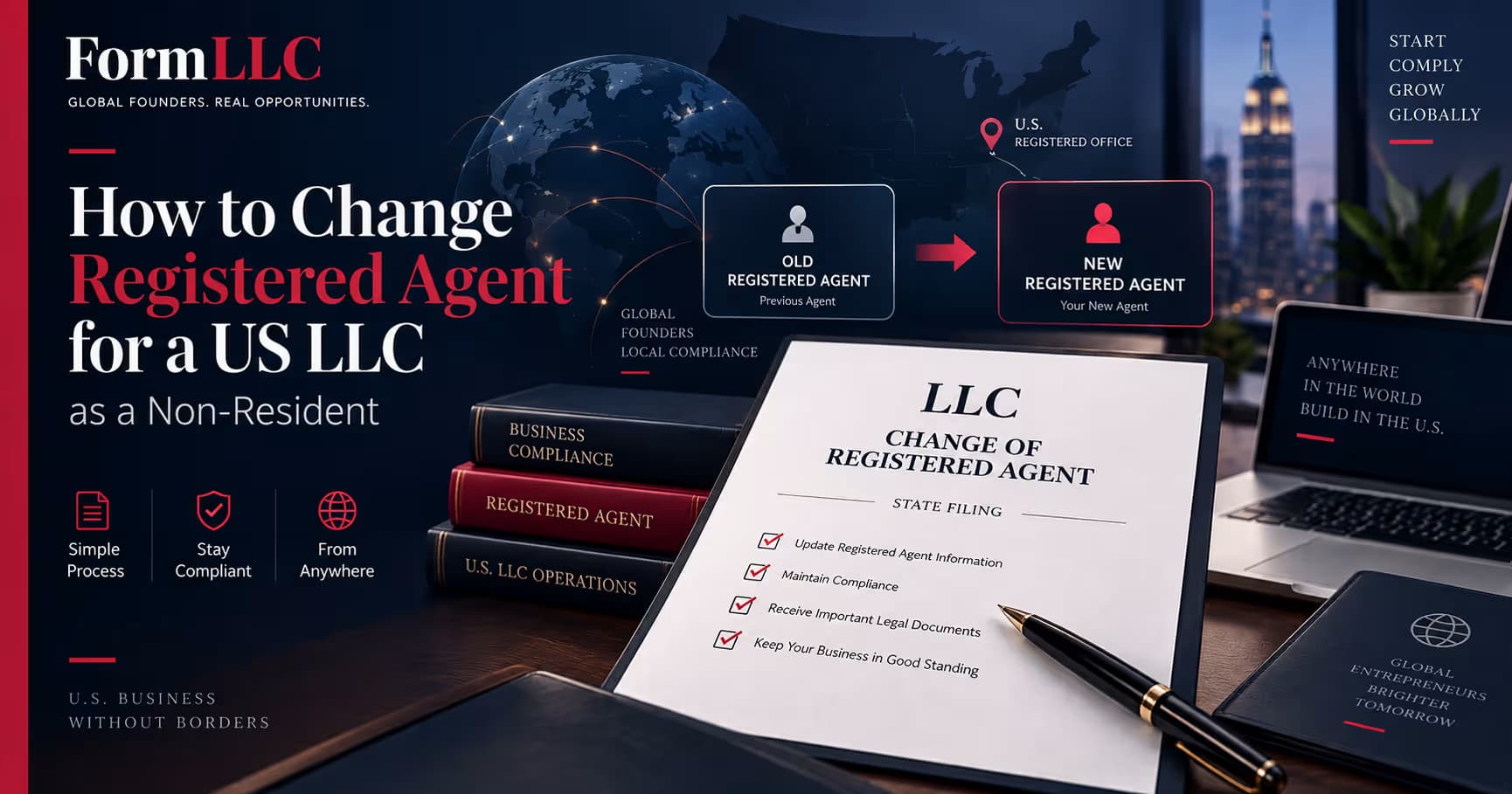
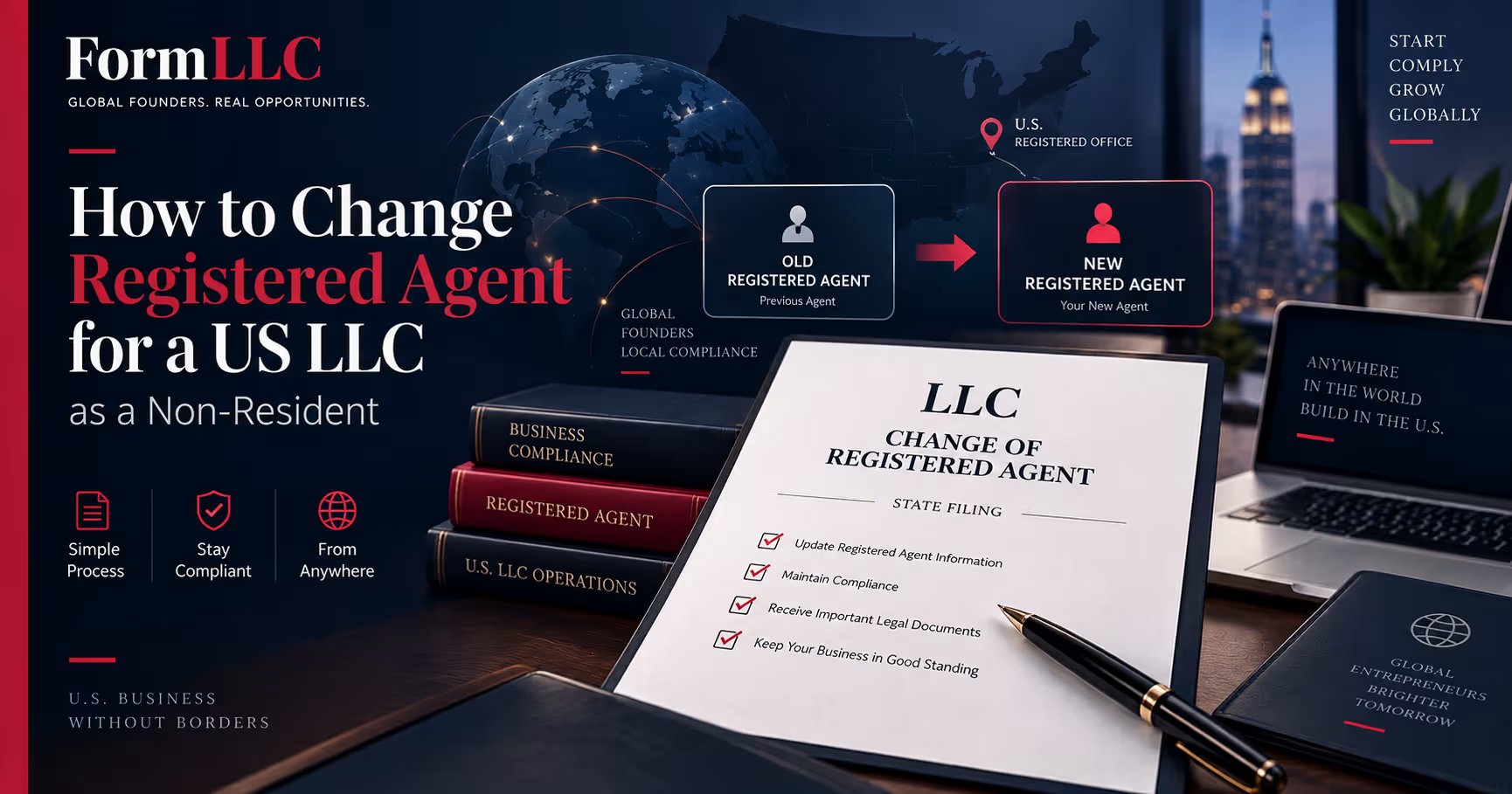
How to Change Registered Agent for a US LLC as a Non-Resident

Tousif Akram
IRS CAA | Founder, FormLLC
A registered-agent change is a normal part of maintaining a US LLC. If you need to change registered agent information, you generally do so through the state where your LLC is registered.
For a non-resident owner, the process can feel unfamiliar. You may be unsure which form to file or whether you need to visit the United States.
Changing your registered agent generally does not require forming a new LLC. However, the filing process, fee, effective date, and consent requirements depend on the state.
This guide explains how to change registered agent information, choose an eligible replacement, file the appropriate document, and verify the result.
What Is a Registered Agent?
A registered agent is a person or business designated to receive service of process and certain official documents on behalf of an LLC.
An LLC generally needs an eligible registered agent in each state where it is required to maintain one. The agent must meet that state's eligibility and registered-office requirements.
For a non-resident owner, a professional registered-agent service can be useful. The owner may not have a physical presence in the United States.
A registered agent is not necessarily the same as a business mailing address or virtual mailbox. An accountant or attorney also serves a different role, unless separately appointed as the registered agent.
For an overview, see the US Small Business Administration's business registration guidance.
Why Would You Change Your Registered Agent?
An LLC may need to replace its registered agent for several reasons:
- The existing provider has increased its fees.
- Official documents are not forwarded promptly.
- Communication with the provider has become unreliable.
- The provider is discontinuing its service.
- The current agent no longer meets state requirements.
- The owner prefers another registered-agent company.
- The LLC needs different document-handling services.
When you change registered agent information, the immediate goal is to appoint an eligible replacement. You must also update the applicable state record.
Replacing the registered agent does not, by itself, transfer ownership or create a new LLC.
Can a Non-Resident Change a US LLC's Registered Agent?
Yes. Living outside the United States does not, by itself, prevent an LLC owner from arranging a registered-agent change.
The replacement must meet the requirements of the state where the LLC is registered. You must also use a filing method that the state accepts.
Some states permit online filing. Others may require a signed form submitted by mail or another approved method.
A foreign residential address cannot replace an in-state registered-office address when state law requires a qualifying local address.
If you are still researching business formation, read our US LLC formation guide for non-resident founders.
How to Change Registered Agent for a US LLC: Step by Step
The exact procedure differs by state. The following steps provide a practical starting point.
Step 1: Choose a new registered agent
Select a replacement before cancelling your current service.
Confirm that the new agent:
- Meets your LLC state's eligibility requirements.
- Has an acceptable registered-office address.
- Has agreed to accept the appointment.
- Can receive service of process.
- Can receive other relevant official documents.
- Has a reliable document-forwarding process.
- Can communicate with you while you live abroad.
Ask whether document scanning and mail forwarding are included. Check the fees for compliance reminders and annual-report assistance, if offered.
Confirm who will submit the change-of-agent filing. Some providers handle the filing, while others expect the LLC to do it.
Step 2: Check your LLC's official state record
Find your LLC using the state's official business-entity search.
Confirm its exact legal name and entity number. Check the current registered agent, registered-office address, and entity status.
Use those details when preparing the filing.
If your LLC is registered in another state as well, check that state's record separately. Updating the formation state's record does not automatically update every other registration.
Step 3: Coordinate the transition
Purchasing a new registered-agent subscription does not necessarily update the state record. Cancelling the old subscription does not complete the state filing either.
Arrange the replacement before ending the existing service.
Review your current provider's cancellation terms. Ask whether it holds any outstanding legal papers or government correspondence for your LLC.
The objective is to avoid a gap in registered-agent coverage.
Step 4: Find the correct state filing
The document used to change registered agent information depends on the jurisdiction.
Its name may include:
- Statement of Change
- Change of Registered Agent
- Change of Registered Office or Agent
- Certificate of Change of Agent
- Appointment of New Registered Agent and Office
Some states have separate procedures for an agent's resignation. Others provide a different process for an existing agent to update its address.
Those procedures may not be suitable when an LLC appoints a replacement.
Use your state's current official instructions. Do not submit a form intended for another jurisdiction.
The SBA's state registration lookup can help you locate the relevant state office.
Step 5: Prepare the required information
Before filing, collect the information requested by your state.
- LLC legal name: Use the exact name shown in the state record.
- Entity or file number: Find it in the state record or formation documents.
- Current registered agent: Check the agent currently listed by the state.
- New registered agent: Use the replacement agent's approved legal name.
- Registered-office address: Use an address that meets state requirements.
- Agent consent: Obtain any consent required by the state.
- Authorized signature: Follow the state's signature instructions.
- Filing fee: Confirm the current amount with the state office.
The required details and documents vary by state. Follow the instructions for your LLC's specific filing.
Do not name a replacement agent before obtaining its authorization.
Step 6: Submit the change-of-agent filing
Complete the correct filing. Submit it using a method accepted by the relevant state.
Follow the official instructions for payment and signatures. Include any required supporting documents.
Keep a copy of the submitted filing and its acknowledgment.
A submission receipt does not necessarily mean the state has accepted the change. Check the final filing status before treating the appointment as complete.
Step 7: Confirm the new agent's consent
Some states require the replacement registered agent to consent to the appointment.
The form and submission requirements differ by jurisdiction.
Wyoming publishes a consent-to-appointment form with its registered-agent materials.
Texas requires the designated agent's consent. Its guidance explains that the consent generally does not need to accompany Form 401.
Check your LLC state's current requirements. Keep any required consent with your business records.
Step 8: Verify the updated state record
After the state processes your filing, search the LLC's official record again.
Confirm that:
- The replacement agent is listed correctly.
- The registered-office address is accurate.
- The change has been accepted.
- The change is effective.
- The former agent is no longer listed, where applicable.
Save the accepted filing and state confirmation. Keep the new provider's appointment details as well.
Once the replacement is effective, terminate the previous service under its contract. Request any outstanding documents held by the former agent.
State-Specific Examples: Wyoming, Texas, and Delaware
There is no single nationwide form or fee for changing a registered agent.
The following examples show why you should check the appropriate state office before filing.
Wyoming LLC
Wyoming provides an Appointment of New Registered Agent and Office form. Its published guidance lists a $5 filing fee for the change.
The form also asks whether the LLC's mailing or principal address should change. These are separate details.
Do not automatically change other business addresses because you have appointed a new registered agent.
Check the Wyoming Secretary of State's registered-agent guidance and current forms before filing.
If your company is registered in Wyoming, read our Wyoming LLC guide for non-residents.
Texas LLC
Texas uses Form 401 — Statement of Change of Registered Office/Agent.
Its published filing fee is generally $15 for an LLC.
Texas requires the proposed agent to consent to the appointment. The consent generally does not need to accompany Form 401.
Check the Texas Secretary of State's business forms and Form 401 instructions before filing.
Delaware LLC
Delaware provides a Certificate of Change of Agent for a Delaware LLC.
The Delaware Division of Corporations' published LLC change-of-agent form lists a $200 filing fee.
Delaware law also specifies a $50 fee for a qualifying certificate of amendment that changes only the registered office or registered agent.
That amendment has specific requirements. Do not assume the lower fee applies to every filing.
Check the Delaware Division of Corporations' change-of-agent forms. Confirm the appropriate filing route and current fee before submitting your documents.
These examples do not replace the current rules of your LLC's state.
What Documents Do You Need to Change a Registered Agent?
The required documents depend on the state.
Prepare your LLC's legal name and state entity number. Collect the current agent's details and the proposed agent's approved name and address.
You may also need written consent or an authorized signature.
Check whether the filing asks for a separate registered-office address or other company information.
Use the state's current instructions to determine which documents are required.
How Much Does It Cost to Change a Registered Agent?
There is no nationwide government fee to change registered agent information.
Your total cost may include:
- The applicable state filing fee.
- The replacement provider's service fee.
- A separate fee for preparing or submitting the filing.
- Optional expedited-processing or document-delivery charges.
Wyoming's published appointment-of-new-agent filing fee is $5. Texas generally lists $15 for an LLC's Form 401 filing.
Delaware's published LLC Certificate of Change of Agent lists $200. A separate $50 fee may apply to a qualifying amendment that changes only the agent or registered office.
These amounts concern different state procedures. Confirm the correct fee and filing route before paying.
A registered-agent subscription does not necessarily include the government filing fee.
Do You Need a New EIN After Changing Your Registered Agent?
Changing only your registered agent does not ordinarily require a new Employer Identification Number (EIN).
The registered agent is part of your LLC's state registration arrangements. An EIN is the company's federal tax identification number.
The IRS explains that certain ownership or structural changes can require a new EIN. A routine registered-agent replacement is different.
Replacing your agent does not, by itself, create a new LLC or change its federal tax classification.
See the IRS guidance on when a new EIN is required.
Registered Agent vs. IRS Responsible Party
Your registered agent and the responsible party recorded with the IRS are not necessarily the same person.
The IRS responsible party is generally the individual who ultimately owns or controls the entity under the applicable IRS rules.
Replacing a third-party registered-agent company does not automatically change your IRS responsible party.
Review the information on your federal records. Do not assume that every state filing requires an IRS update.
When Form 8822-B May Apply
The IRS uses Form 8822-B to report changes to a business mailing address, business location, or responsible party.
If other IRS-recorded information actually changes during the agent transition, review whether this form applies.
The IRS states that a responsible-party change must be reported within 60 days.
That is not a general 60-day deadline for every registered-agent replacement.
See the IRS guidance for Form 8822-B.
Does Changing the Registered Agent Change LLC Ownership?
No. Replacing a registered agent does not, by itself, transfer LLC ownership.
A routine registered-agent change also does not automatically change:
- The LLC's members or ownership percentages.
- Its managers or management structure.
- Its operating agreement.
- Its EIN.
- Its existing contracts.
- Its business bank accounts.
If you are also changing ownership or management, assess those changes separately.
Review the LLC's operating agreement, applicable state law, and relevant tax requirements.
For more information, read our US LLC Operating Agreement guide for non-residents.
Do You Need to Update Your Business Bank Account?
Changing a registered agent does not automatically require you to close or reopen your company's bank account.
However, check the information held by your bank and payment providers.
Your previous registered-agent provider may also have supplied a mailing address or virtual mailbox. Ending those services could affect information recorded with your financial providers.
Update details that have actually changed. Follow each provider's applicable procedures.
For additional guidance, read our US bank account guide for non-resident LLC owners.
What About Tax and Compliance Records?
A registered-agent change does not cancel or restart your LLC's existing compliance obligations.
Continue tracking any applicable:
- State annual or periodic reports.
- State taxes and franchise taxes.
- Federal tax returns and information returns.
- Business licenses and permits.
- Registrations in additional states.
- Registered-agent service renewals.
- Required updates to company contact information.
If your LLC is registered in more than one state, review each relevant registration.
Keep the accepted change-of-agent filing with your business records. It can help document when the new appointment took effect.
Common Mistakes to Avoid
Cancelling the old agent too early
Arrange the replacement before terminating your current service.
Confirm when the state change becomes effective. The goal is to avoid a gap in registered-agent coverage.
Using an ineligible address
The registered office must meet the applicable state's requirements.
A foreign address, P.O. box, or certain mailbox services may not qualify. Check the rules before submitting the change.
Using the wrong state form
A form used in Wyoming may not be appropriate in Texas, Delaware, or another state.
Use the current form or approved online procedure from the relevant state agency.
Forgetting to check the registered office
Some states record both the agent's identity and the registered-office address.
When you change registered agent information, review both details for accuracy.
Assuming the state automatically updates the IRS
State business-registration records and IRS records are separate.
Review Form 8822-B if the underlying IRS-recorded business address, location, or responsible party has actually changed.
Ignoring documents held by the former agent
Ask the previous provider whether it holds any outstanding legal papers or government notices.
Confirm how the replacement agent will notify you when future documents arrive.
Failing to verify the filing
Keep the state's acceptance confirmation. Check the updated public business record.
Submitting a form does not necessarily mean the state has processed and accepted it.
Registered-Agent Change Checklist for Non-Resident LLC Owners
Use the following checklist before treating the process as complete.
Before filing
- [ ] Confirm the replacement agent is eligible in the relevant state.
- [ ] Obtain the new agent's agreement to serve.
- [ ] Verify that the registered office meets state requirements.
- [ ] Check the LLC's exact legal name and state entity number.
- [ ] Identify the correct filing and submission method.
- [ ] Verify the current government filing fee.
- [ ] Obtain any required consent and signatures.
After submitting the filing
- [ ] Keep the submission receipt or acknowledgment.
- [ ] Confirm that the state accepted the change.
- [ ] Check the updated public business record.
- [ ] Save the accepted filing with the LLC's records.
After the appointment becomes effective
- [ ] Request outstanding correspondence from the previous agent.
- [ ] Terminate the previous service at the appropriate time.
- [ ] Review any separately affected business or mailing addresses.
- [ ] Check IRS records if the underlying IRS information changed.
- [ ] Review bank and payment-provider records where necessary.
- [ ] Check registrations in any other relevant state.
Final Takeaway
A non-resident owner can generally arrange a registered-agent change without creating a new US LLC.
Choose an eligible replacement and obtain any required consent. File the correct state document and confirm that the new agent appears in the official record.
The filing method, fee, and effective date depend on the jurisdiction. Check your state's current instructions before submitting anything.
Changing a registered agent does not, by itself, transfer ownership or require a new EIN.
Review other company records only where the underlying information has actually changed.
For founders seeking help with US LLC formation and ongoing administration, FormLLC offers business formation and related services.
Disclaimer: This article provides general educational information, not legal, tax, banking, or financial advice.
Requirements, fees, procedures, and deadlines vary by state and may change over time.
Verify the current rules with the relevant government agency. Consult qualified professionals for advice specific to your circumstances.
This article is for general informational purposes only and does not constitute legal, tax, or financial advice. Tousif Akram and FormLLC are not a law firm or CPA firm. Consult a licensed professional for advice specific to your situation.
Ready to Form Your US LLC?
Free 30-minute consultation with no obligation and no sales pressure.
Book Free Call