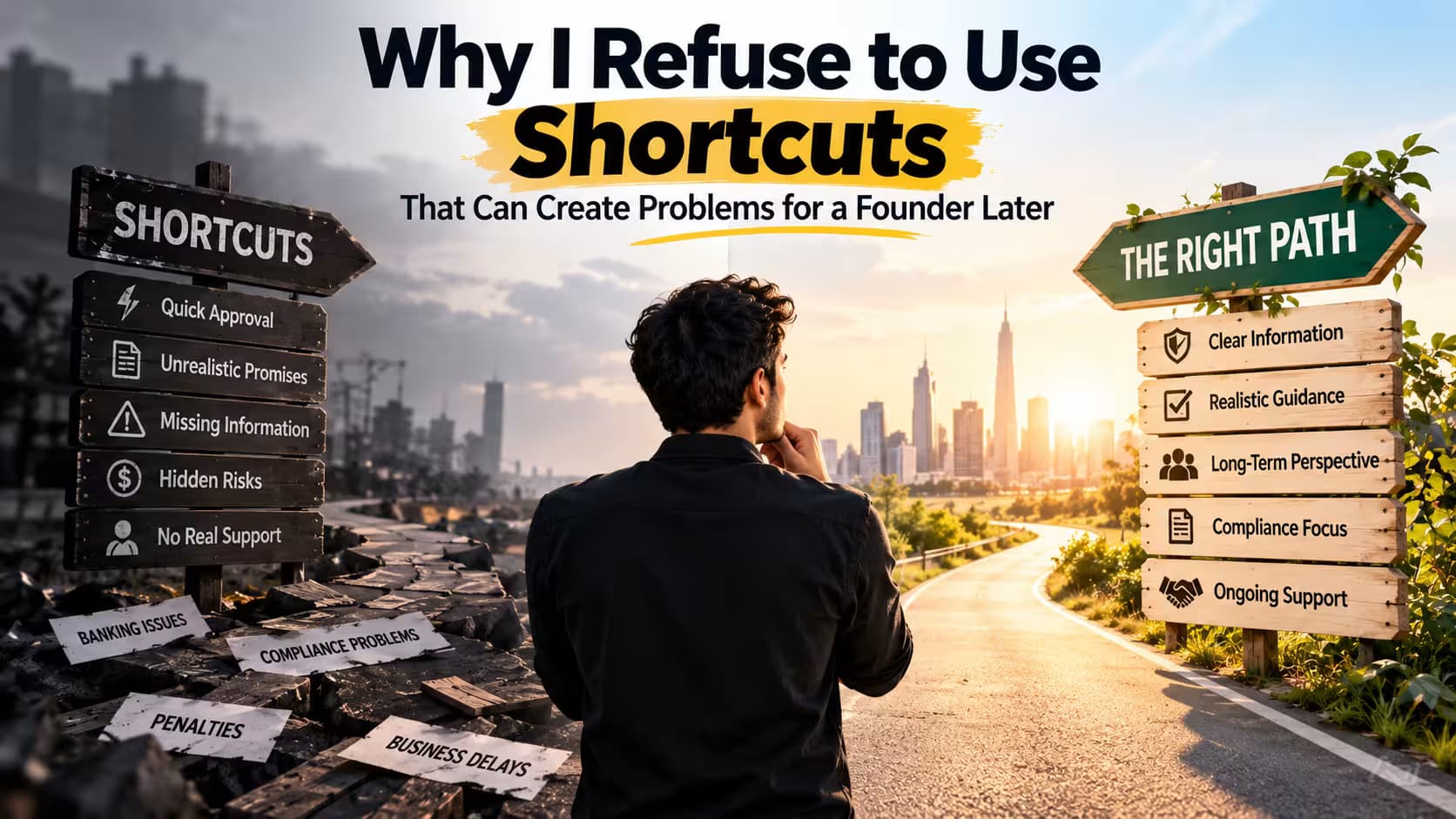
Why I Refuse Shortcuts in Company Formation

Tousif Akram
IRS CAA | Founder, FormLLC
Why I Refuse Shortcuts in Company Formation That Can Hurt Founders Later
Company formation can look simple from the outside. Choose a state, submit some information, pay a fee, and receive your documents. But after years of working with entrepreneurs, I have learned that the easiest-looking path is not always the one I want to recommend.
Shortcuts can make a process faster, make an offer look cheaper, or make it easier to tell a customer exactly what they want to hear. The problem is that a shortcut can sometimes move the problem instead of solving it.
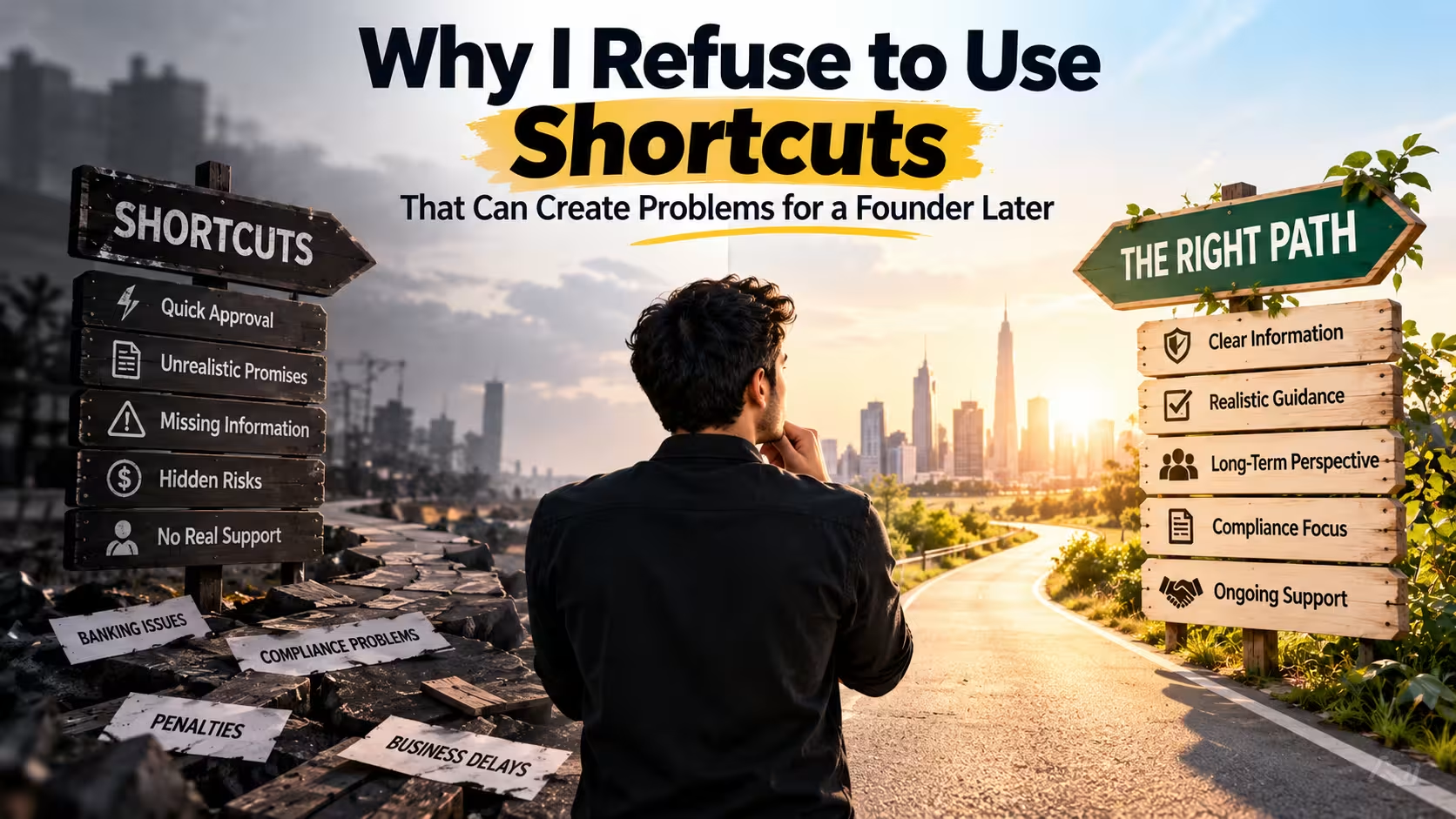
I have seen founders come to us after forming a US company with questions they did not know they needed to ask. Sometimes they were dealing with documentation issues. Sometimes they discovered additional filing or compliance responsibilities. Other times, they had been given expectations about banking, taxes, or other services that depended on circumstances outside the formation provider's control.
Those experiences changed the way I think about company formation.
What Company Formation Should Really Accomplish
When a founder forms a company, they are not simply buying a set of documents. They are creating a structure that they expect to use for an actual business.
That is why I think the formation process should help a founder understand what comes next, not just help them get through the initial paperwork.
For international founders, this can be especially important. Someone forming a US LLC from another country may be dealing with an unfamiliar business and tax system for the first time. They may be trying to understand an LLC, EIN, business banking, payment processing, state requirements, and federal reporting at the same time.
The IRS explains that an LLC's federal tax treatment can depend on the number of members and any tax elections made by the company. In other words, an LLC is a legal structure, but its federal tax treatment is a separate question.
That is exactly the kind of distinction I want founders to understand instead of making the process sound simpler than it is.
I Would Rather Explain a Complication Than Hide It
One of the biggest lessons I have learned is that telling a founder something simply because it helps close a sale is not the same as helping them.
If I tell someone, “This will be easy,” and six months later they discover responsibilities they did not know about, I have not really solved their problem.
I made the sale. I did not solve the problem.
That is why I would rather explain a complication when it matters. If something depends on the IRS, a bank, a payment provider, a state authority, or another professional, I want the founder to understand that dependency.
Sometimes the honest answer is, “This depends on your situation.”
Sometimes it is, “You should speak with a tax professional.”
And sometimes it is simply, “Here is what you need to do next.”
I think those answers are much more useful than making every situation sound identical.
An LLC Does Not Automatically Answer Every Tax Question
This is particularly important because founders can easily assume that forming an LLC answers their tax questions.
It does not.
The IRS states that a domestic LLC can be treated as a disregarded entity, partnership, or corporation for federal income tax purposes depending on the circumstances and elections made.
For certain foreign-owned US disregarded entities, there are also specific information-reporting rules. The IRS says that a foreign-owned US disregarded entity covered by these rules may need to file Form 5472 attached to a pro forma Form 1120.
I do not think a founder needs to become a tax expert before forming a company. But I do think founders should know that formation is not the same thing as understanding every obligation that may follow.
If you are an international founder, our US LLC guide for non-resident founders is a useful starting point before you make formation decisions.
Fast Is Good When It Does Not Mean Skipping Important Steps
I have nothing against speed.
If we can complete something correctly in one day instead of three days, that is a good thing. Founders have businesses to build, customers to serve, and decisions to make.
But fast and careless are not the same as fast and efficient.
I do not want to make something artificially fast by skipping information that could matter later. There is a difference between removing unnecessary friction and removing an important step.
That distinction matters in company formation because the consequences of misunderstanding something may appear much later, when the original transaction is already finished.
My goal is not to make every process feel complicated. It is to make the process as simple as it can responsibly be.
The Cheapest Option Is Not Always the Lowest-Cost Decision
The same principle applies to price.
I understand why founders look for the cheapest option. I was a founder before I became a service provider, and I know what it feels like to watch every dollar when you are starting.
But the initial price is only one part of the calculation.
A founder should also consider what happens after formation, including services they may need, state requirements, tax and information-reporting responsibilities that apply to their situation, registered-agent requirements, bookkeeping, and professional advice when necessary.
That does not mean an expensive provider is automatically better. It simply means formation price should not be the only question.
The better question is: What am I actually getting, what remains my responsibility, and what happens after the company is formed?
Banking Is Another Area Where I Refuse to Make Promises I Cannot Control
Banking is a good example of why I avoid shortcuts and guarantees.
A founder may think that forming a US LLC and obtaining an EIN automatically means a bank or financial provider will approve the account.
I would never want to present it that way.
Banks and financial providers make their own decisions, and the information they request can vary. The Consumer Financial Protection Bureau also notes that customers should understand the information and options involved when opening bank or credit-union accounts.
A company's ownership, business activity, expected transactions, documentation, and other factors can matter depending on the provider.
That is why I would rather explain the process honestly than promise an outcome that I do not control.
For founders preparing for this step, our guide on opening a US bank account as a non-resident LLC owner covers the broader process.
Sometimes “I Don't Know” Is the Most Responsible Answer
This philosophy has also made me more comfortable saying “I don't know” when I genuinely do not know something.
That may sound strange for a company that is supposed to help founders.
But I think pretending to know everything is much worse.
If a question requires a CPA, tax attorney, immigration professional, bank, or another specialist, I would rather tell the founder that than give them an answer outside our expertise.
There is nothing wrong with knowing where your expertise ends.
In fact, I think knowing when to refer someone to the right professional is part of responsible customer service.
Trust Is Not Built by Saying Yes to Everything
Over the years, customers have taught me that trust is built differently from what many businesses think.
Trust is not built by saying yes to everything.
Sometimes trust is built by saying, “No, I don't think you should do that.”
Sometimes it is built by explaining a cost the customer did not expect.
Sometimes it is built by telling someone that a cheaper option may not fit their particular situation.
And sometimes it is built by refusing to make a promise that we cannot control.
Those conversations may not always be the easiest ones to have, but I would rather have an honest conversation today than a difficult conversation six months later.
The Business I Want to Build
This philosophy has shaped the way I want to build FormLLC.
I do not want FormLLC to be known for finding the fastest shortcut. I want it to be known for helping founders understand the path they are taking.
That means explaining what we know, being clear about what we do not control, identifying when another professional may be needed, and helping founders understand what happens after the formation documents are delivered.
For founders who are still deciding whether a US company makes sense for their situation, our guide to getting an EIN without an SSN can help explain another part of the process.
The Shortcut I Refuse to Take
After years of working with founders, I have become comfortable with the fact that the right process is not always the shortest one.
Sometimes it requires another explanation. Sometimes it requires an additional step. Sometimes it requires waiting for an outside provider to make a decision. And sometimes it means telling a founder that we are not the right person to answer a particular question.
I am okay with that.
Because a founder does not just remember what you promised when they bought from you.
They remember what happened after they bought.
For me, that is where the real test of a business begins.
This article is for general informational purposes only and does not constitute legal, tax, or financial advice. Tousif Akram and FormLLC are not a law firm or CPA firm. Consult a licensed professional for advice specific to your situation.
Ready to Form Your US LLC?
Free 30-minute consultation with no obligation and no sales pressure.
Book Free Call