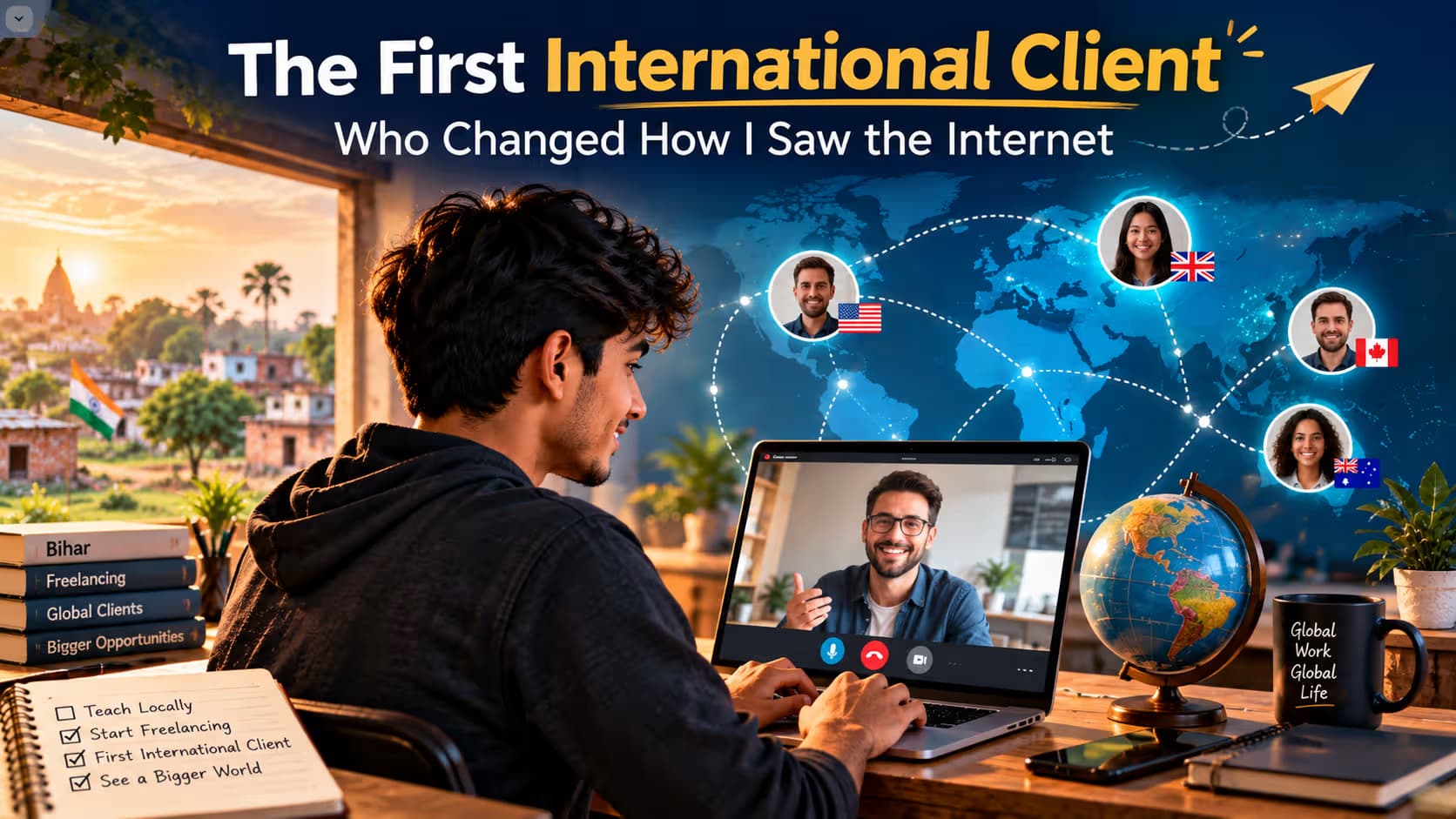
The First International Client Who Changed How I Saw the Internet

Tousif Akram
IRS CAA | Founder, FormLLC
The First International Client Who Changed How I Saw the Internet
I don't remember every detail about my first international client, but I remember what the experience made me realize. Until then, most of the people I knew, worked with, or taught were connected to the same geographical environment I was. I grew up in a small village in Bihar, India, and my early understanding of work was naturally shaped by what I could see around me. People worked with local businesses, taught students, ran shops, prepared for jobs, or built careers that were largely connected to their immediate surroundings.
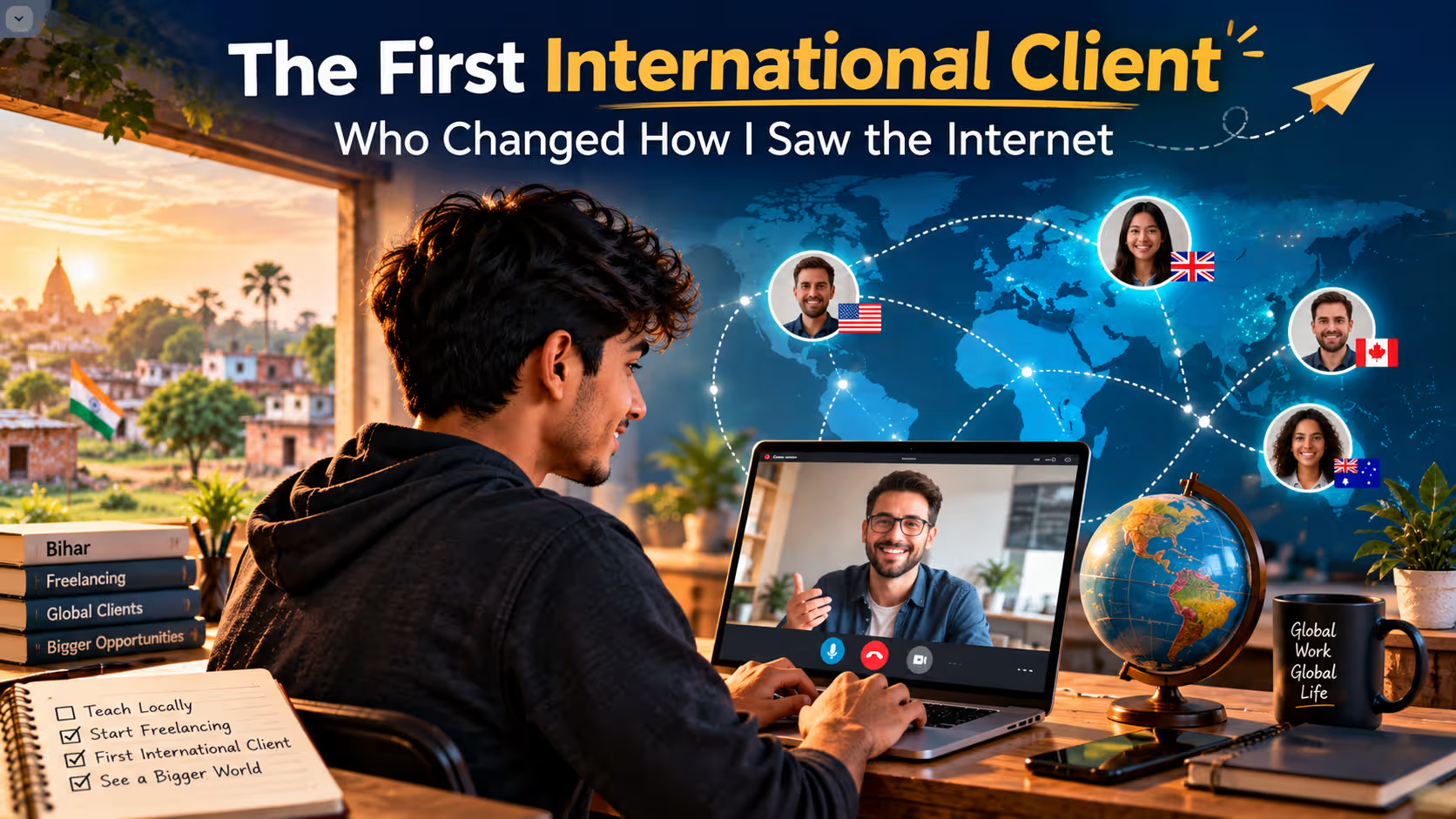
Then I started freelancing. Suddenly, the person on the other side of the conversation didn't have to live anywhere near me. They could be thousands of kilometres away, have a completely different background, speak differently, use a different currency, and still have a reason to work with me. That was a much bigger realization than I understood at the time.
My First Experience With a Client From Another Country
Before freelancing, I had already started teaching students while I was young. Teaching eventually led me to understand something that became useful in every business I built later: knowing something isn't enough. You have to understand the person you're helping.
When I started working with international clients through Fiverr, that lesson became even more important. An international client couldn't simply walk into my office and explain what they needed. Most of the relationship happened through messages, files, instructions, and online communication. I had to understand what the person wanted, ask the right questions, and make sure the final work matched their expectations.
That sounds normal today because remote work has become so common. But for me, it was one of the first times I experienced the internet as something much bigger than a place to consume information. The internet could become a place where I could actually build a livelihood.
I Realized the Client Didn't Care Where I Was
This was probably the most important lesson. The client wasn't hiring me because I lived in a particular city. They weren't interested in whether I had an office in a major business district. They didn't know the people I knew or the local reputation I had. They had a problem, and I believed I could help solve it. That was enough to start a business relationship.
Of course, location can still matter. There are industries where physical presence is essential, and international business comes with legal, tax, payment, and regulatory considerations. But freelancing showed me that geography wasn't necessarily a hard limit on what I could offer. That changed the way I looked at my own circumstances.
I started thinking less about the opportunities immediately around me and more about the opportunities I could reach through the internet. That shift eventually became an important part of my entrepreneurship journey, because I began to see my location as the place where I started rather than the limit of where I could go.
The First Client Taught Me Something About Trust
Working with someone in another country also taught me that international business isn't really about having an impressive story. It's about trust. A client needs to believe that you understand the assignment, that you'll communicate properly, and that you'll deliver what you promised.
I learned this through very small projects. Sometimes the work itself wasn't particularly complicated. The challenge was understanding exactly what the client expected and making sure there were no surprises. I became increasingly focused on communication. If something wasn't clear, I asked. If I could improve something, I tried to improve it. If there was a problem, I wanted to explain it rather than disappear.
Looking back, I think those habits were more valuable than any particular freelancing technique I learned. They later became important when I started building a company and working with founders from many different countries.
I Didn't Think of Myself as a Global Entrepreneur
One thing I want to clarify is that I didn't wake up one morning and decide that I was going to become a global entrepreneur. It happened gradually.
First, I wanted to earn. Then I wanted to become better at what I was doing. Then I wanted to work with better clients. Then I became interested in building something bigger. Only much later did I look back and realize that my work had gradually crossed geographical boundaries.
That's something I think people sometimes misunderstand about entrepreneurship. We see the finished company and assume there was always a master plan behind it. Usually, there wasn't. There were small decisions: one client, one project, one skill, one mistake, and one opportunity. Then another.
My first international client was one of those small moments that changed the direction of the next few decisions. Looking back, it became one of the most meaningful experiences in my entrepreneurship journey because it changed what I believed was possible. That experience also influenced how I later approached building a global business from India.
What International Clients Taught Me About Value
One of the best things about working with people from different countries is that it forces you to think about value differently. You quickly realize that the person buying from you doesn't necessarily care how hard you worked. They care about whether you solved the problem.
That distinction became very important to me. I could spend ten hours on something, but if I didn't understand what the customer actually needed, those ten hours didn't necessarily create much value. On the other hand, sometimes a relatively small amount of work could make a significant difference to someone if it solved the right problem.
This changed how I approached my work. I stopped thinking only in terms of tasks and started thinking more about outcomes. What is the customer trying to accomplish? What is preventing them from getting there? What information are they missing? What would make their life easier?
Those questions eventually became extremely relevant to the work we do today at FormLLC. They also influenced the way I think about international business and company formation, because founders often need more than a service—they need someone who understands the problem behind the service.
Years Later, I Started Seeing the Same Problem From the Other Side
After working with international clients myself, I eventually began helping other entrepreneurs who wanted to operate internationally. That gave me an interesting perspective.
Earlier, I had been the person sitting in India trying to figure out how to serve someone abroad. Later, I started talking to founders who were facing a different version of the same problem. They might have been developers, freelancers, agency owners, ecommerce sellers, or consultants. Many had the skills to serve international customers, but they didn't always know how to build the infrastructure around that business.
Should they form a company? Which jurisdiction makes sense? How do they handle an EIN? What happens after formation? How should they think about banking and compliance?
For founders who are exploring the process, I also wrote a practical guide to US LLC formation for non-resident founders and another guide explaining how non-residents can get an EIN without an SSN.
The questions were different from my first freelancing questions, but the underlying ambition was familiar. They wanted access to a market beyond the place where they lived.
That connection is one of the reasons I eventually became so interested in helping non-US founders establish US businesses.
A Global Business Doesn't Start With a Company
This is something I believe much more strongly today. A company registration document doesn't magically turn someone into an international entrepreneur. The business has to start somewhere else.
It might start with a skill. It might start with a customer. It might start with a product. It might start with someone solving a problem better than the alternatives.
For me, it started with teaching and eventually freelancing. The company came later.
This is why I don't think every person who wants to work internationally needs to immediately create a US LLC or another foreign company. First understand what you're building. Understand who your customer is. Figure out whether people are actually willing to pay for what you offer. Then think about the legal and operational structure that makes sense for the business.
The structure should support the business. It shouldn't become the business.
The Internet Didn't Remove Every Barrier
I don't want to romanticize the story and pretend the internet solved everything. It didn't.
Working internationally still creates challenges. Payments can be complicated. Trust can take time. Tax and compliance requirements can be confusing. Banking isn't guaranteed. Different countries have different rules. And building a reputation online takes consistency.
But the internet changed something fundamental. It allowed the first conversation to happen. A person in one country could discover someone in another country and decide, “This person can solve my problem.”
That possibility didn't require us to live in the same city. For someone from a small village in Bihar, that was a powerful thing to experience personally.
What I Would Tell Someone Trying to Get Their First International Client
If you're reading this because you want to work with international customers, I wouldn't start by worrying about looking like a large company. Start by becoming useful. Find a problem you understand. Learn how to explain your solution clearly. Create a simple way for people to understand what you do. Build proof through your work.
Respond professionally. Don't promise what you cannot deliver. And when someone gives you a chance, take that opportunity seriously.
Your first international client might not be worth thousands of dollars. Mine wasn't. But your first client can teach you something that money can't measure. It can show you that someone outside your immediate environment sees value in what you know how to do.
That realization can change the way you think about yourself. For me, it became an important part of my entrepreneurship journey, because I stopped seeing international work as something that belonged only to people living in major cities or established business centers.
The Client Wasn't Just a Customer
Looking back now, I don't think my first international client was important because of the size of the project or the amount of money involved. The important part was what the experience unlocked in my mind.
Before that, my world of opportunity was largely defined by what I could see around me. Afterward, I started looking further. I realized that the person I could help didn't necessarily have to live nearby.
That one realization influenced the way I approached freelancing, consulting, entrepreneurship, and eventually FormLLC. Today, when I speak with founders from different countries, I sometimes think about how strange the journey would have sounded to my younger self.
Someone sitting in Bihar can work with someone on the other side of the world. That person can eventually build a team. That team can help other entrepreneurs. And those entrepreneurs can go on to serve customers in countries they may never have visited.
That's what the internet changed for me. It didn't just give me access to information. It gave me access to people, customers, and possibilities that geography would otherwise have kept far away.
And sometimes, one international client is enough to make you realize that your market is much bigger than the place you call home.
*I'm Tousif Akram, founder of FormLLC. I write about entrepreneurship, international business, company formation, and what I've learned from helping founders build businesses across borders.*
This article is for general informational purposes only and does not constitute legal, tax, or financial advice. Tousif Akram and FormLLC are not a law firm or CPA firm. Consult a licensed professional for advice specific to your situation.
Ready to Form Your US LLC?
Free 30-minute consultation with no obligation and no sales pressure.
Book Free Call