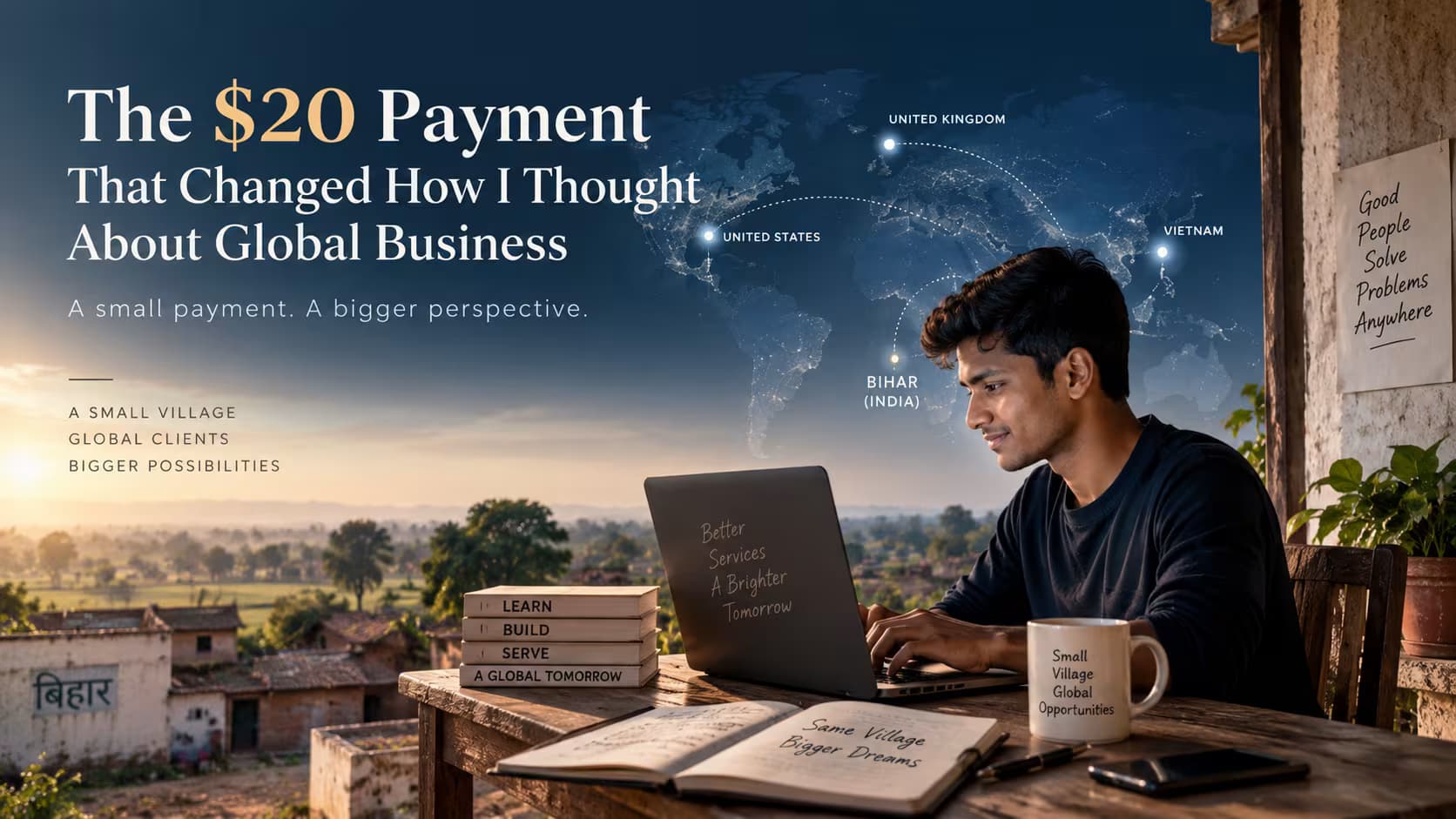
Global Business from India: The $20 Payment That Changed How I Thought About Business

Tousif Akram
IRS CAA | Founder, FormLLC
Global Business from India: The $20 Payment That Changed My Perspective
My journey toward building a global business from India started with an online payment of around $20.
It came through Fiverr, a freelancing platform that connected me with a client from another part of the world. For someone living in a small village in Bihar, India, that payment meant much more than the amount I had earned.
I had already started working and making money by teaching students. But earning from an international client was a different experience.
Someone who had never met me, who lived in another country, was willing to pay me for my knowledge and the work I could deliver. I didn't need to move to a big city. I didn't need to travel abroad to meet the client. I didn't need an impressive office or a prestigious degree.
I needed to understand what the client wanted, communicate properly, and deliver what I had promised.
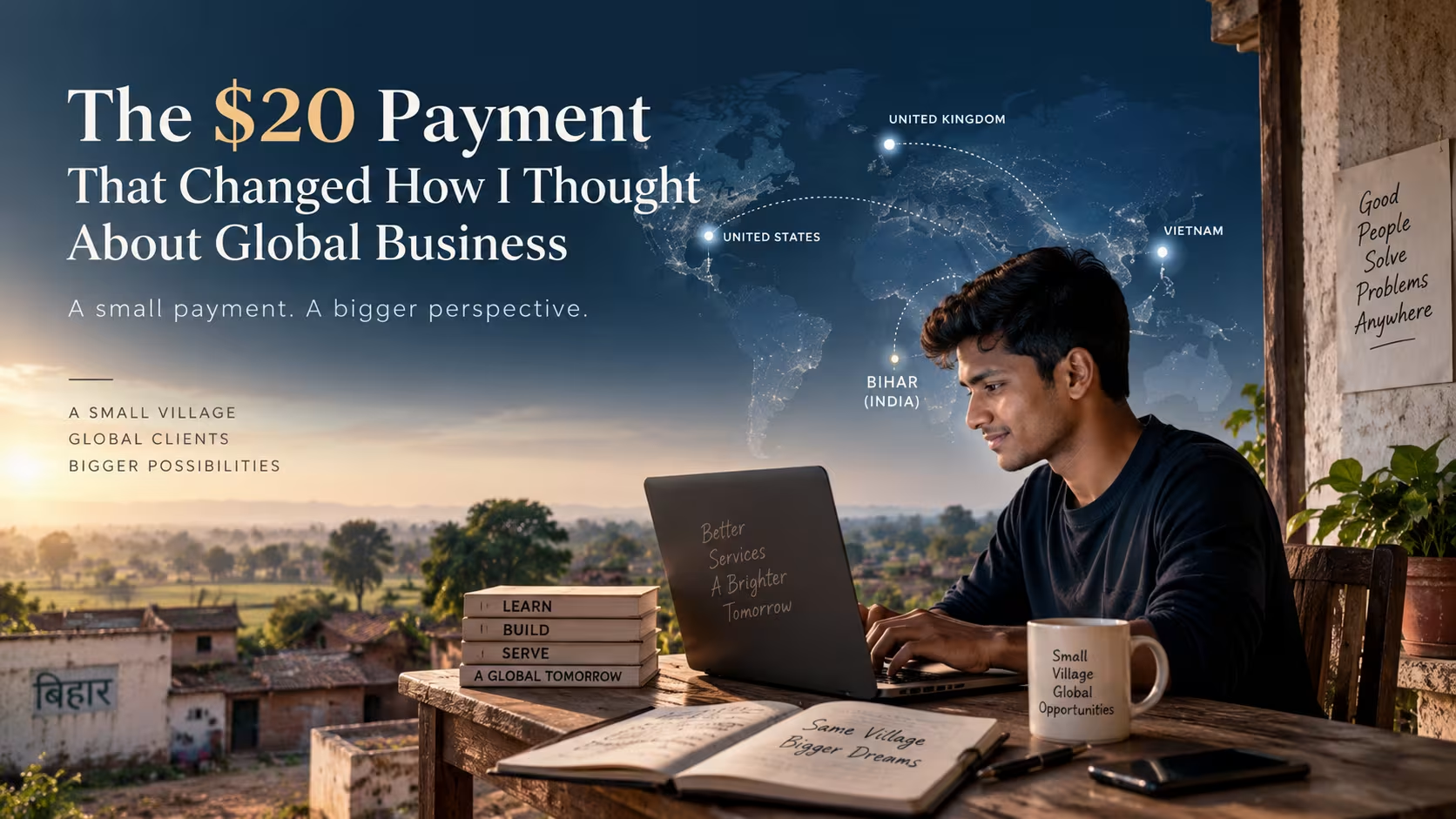
That first payment changed the way I thought about where business could happen and who could participate in it.
I didn't know at the time that this experience would eventually influence my decision to build FormLLC, a company focused on helping entrepreneurs establish and maintain businesses in the United States.
I was simply enjoying the opportunity to work with people beyond my immediate surroundings.
But looking back, that $20 payment was one of the experiences that shaped how I think about entrepreneurship today.
My entrepreneurial journey started in a small village in Bihar
Before I started serving international clients, I was teaching students.
I began teaching while I was in Class 11 and eventually started a small coaching centre where I taught other students.
At around 18, I was already finding ways to work, earn money, and manage my own expenses. My situation was different from someone growing up with an established business network or substantial financial support.
I had to learn how to manage things myself. In my village, the career options people commonly discussed were relatively traditional. Completing a degree, finding a job, or learning a trade seemed like the natural paths to earning a living.
I don't think there is anything wrong with those choices. But I wanted to explore something different.
I was interested in working with clients, understanding their problems, and finding ways to solve them. Even before I understood entrepreneurship in a formal sense, teaching students had shown me something important.
If I could help someone solve a problem, I could create value for that person.
That lesson stayed with me when I started exploring freelancing.
How Fiverr introduced me to international clients
When I discovered freelancing platforms such as Fiverr, I began to see an opportunity that wasn't limited to my village or even my country.
I could offer services online. A client could find me, explain what they needed, and pay me for the work. It sounds ordinary today. Millions of people work remotely and sell services internationally. But when you're starting with limited resources and little exposure to international business, the first time it happens to you is different.
My first online payment was approximately $20. I don't remember every detail of that first transaction. I believe one of my earliest international clients was from Vietnam or the United Kingdom. What I remember clearly is how much I enjoyed the experience.
I enjoyed talking to the client, understanding the requirements, and figuring out how I could help. I wasn't thinking only about completing the minimum work required to receive payment.
I wanted the client to be satisfied. I often tried to do more than what had originally been discussed because I genuinely enjoyed solving the problem. There were times when I felt I would have enjoyed helping someone even without charging them. Of course, getting paid mattered. I needed to support myself and build my future.
But the work itself was what motivated me to continue. When my first payment eventually became available through Fiverr, it reinforced something I was beginning to understand.
I could work with people I had never met, deliver value from where I lived, and earn money from an international market.
That realization was worth much more to me than the $20.
The most important thing I learned wasn't about earning in dollars
People often talk about freelancing in terms of money. They discuss hourly rates, high-paying clients, international currencies, and the possibility of earning more than they might earn locally.
Those are understandable motivations.
Coming from a small village in Bihar, earning even a modest amount in US dollars was meaningful to me. But the bigger lesson was about opportunity. Before freelancing, my work and opportunities were largely connected to the people and businesses I could reach locally.
Through the internet, that began to change. A client didn't have to live in the same city as me. I didn't have to know someone personally before offering my services.
The client could judge me by my communication, the quality of my work, and whether I delivered what I promised. That doesn't mean geography had suddenly stopped mattering. Where you live can still influence your internet access, education, payment options, legal requirements, and the opportunities available to you.
But my experience showed me that where I lived didn't have to determine the limits of every opportunity I pursued.
For someone who had grown up with a relatively narrow view of the careers available around him, that was an important change in perspective.
Why I started treating every client relationship seriously
As I continued freelancing, I learned that getting an international client was only the beginning. The more important question was whether the client would trust me enough to continue working with me or recommend me to someone else.
I tried to approach every project with a simple principle:
Deliver what I promised, and whenever reasonably possible, do a little more.
I wasn't perfect. Not every project went exactly as planned. Platform-related issues, holidays, and circumstances outside my control sometimes created difficulties.
But I never wanted a client to receive poor work because I hadn't made a sincere effort. Over time, I received approximately 1,000 reviews on Fiverr, with only a small number of negative experiences.
What mattered most to me was not simply the review count.
It was the response I received from clients. Some thanked me personally. Some appreciated the additional effort. Some gave tips even after they had already paid for the agreed service.
Those experiences taught me that an international client relationship wasn't fundamentally different from a local one.
People wanted to be understood. They wanted honest communication. They wanted someone who would take their work seriously.
And they wanted to receive the value they had been promised.
Trust could travel across borders when I gave people a reason to trust me.
That principle eventually became an important part of how I approached building a company.
The internet made international work possible, but I started noticing another problem
As I gained more experience working with clients, I became increasingly interested in how entrepreneurs could build businesses that served international markets.
Freelancing was a starting point.
But what happened when someone wanted to move beyond individual projects and build a global business from India?
What if a freelancer wanted to establish an agency? What if a developer wanted to launch a SaaS product? What if someone wanted to sell products to customers in the United States? What if a small team wanted to build a recognizable international brand?
In many situations, delivering the service or building the product was only one part of the challenge.
Founders also needed to think about business registration, payment collection, banking, customer trust, taxes, compliance, and maintaining a professional online presence.
I began to understand that having the skills to serve international customers and having the infrastructure to operate an international business were two different things.
A talented person might be capable of delivering excellent work while still struggling with the administrative and financial requirements of running a business across borders.
That gap interested me.
I had experienced what it felt like to discover opportunities outside my immediate surroundings. I wanted other entrepreneurs to have an easier path to exploring those opportunities.
How my freelancing experience influenced the idea behind FormLLC
When I became more involved in company formation and business consulting, I noticed that entrepreneurs often struggled to find affordable, understandable guidance.
Some agencies charged significant consultation fees before a founder could even understand the basic requirements.
I found that frustrating because I genuinely enjoyed discussing business problems and helping people understand their options.
But I also started recognizing that company registration wasn't simply about submitting paperwork.
Customers wanted to know whether the service provider would remain available after their company was formed.
They wanted to understand what came next.
Could they apply for a business bank account?
For founders exploring this question, our US bank account guide for non-resident LLC owners explains the banking side of setting up a US business.
What would they need to know about payment gateways? When would their tax filings be due? What ongoing responsibilities would they have? How could they build a professional website and establish credibility with international customers?
These questions reminded me of my own early experience. When I received that first Fiverr payment, I didn't need someone to convince me that an international opportunity existed. I had experienced it myself.
But someone trying to build a larger business often needed more than motivation. They needed practical guidance and reliable infrastructure. That became central to my thinking as I built FormLLC.
For entrepreneurs considering a US company, our US LLC formation guide for non-resident founders explains the basic formation process and considerations.
My goal wasn't simply to help someone receive a company registration document.
I wanted to help entrepreneurs understand what it takes to establish a business and maintain it responsibly.
A US company may be useful for some founders, depending on their business activities, customers, ownership structure, and legal and tax circumstances. But it isn't automatically necessary for everyone who wants to work internationally.
My own journey began with freelancing, not with forming a US company.
That distinction matters: you can begin exploring international opportunities before you have built every part of your future business infrastructure.
And when you're ready to establish a company, the right structure should support your actual business needs.
What building a company taught me about that first $20
Today, my work is very different from the early days of teaching students and taking freelance projects.
Through FormLLC, my team and I have helped entrepreneurs from different countries with company formation and related business requirements. Based on our internal estimates, we have supported approximately 5,000 entrepreneurs across around 50 countries.
Our customers include developers, freelancers, marketing agencies, ecommerce sellers, consultants, and first-time founders.
Their businesses are different, but many of the questions they ask are familiar to me.
How do I start? How can I work with international clients? What do I need to receive payments?
For founders setting up a US business, our guide on getting an EIN without an SSN explains an important part of the setup process for eligible non-residents.
How do I make customers trust my business? What should I do after registration? How do I avoid expensive mistakes?
I don't see these questions only as a service provider. I remember what it was like to start without having all the answers.
I also remember that earning my first $20 was meaningful partly because I was doing something I enjoyed.
As the business grew, I started hiring employees. That changed my perspective again. Building a company was no longer only about creating opportunities for myself. The business could also provide work for other people and contribute to their families.
That realization gave me another reason to take the responsibility seriously.
I had started by trying to manage my own expenses. Now I was working with a team to help other people build businesses of their own.
The scale had changed, but the principle behind the work remained familiar.
Understand the problem. Make a reasonable promise. Do the work properly. Keep learning.
Five things I would tell someone who wants to start working internationally
If you're living in a small town or village and want to work with international clients, there are a few things I would encourage you to think about.
These aren't lessons I learned from a single book or business course. They're lessons that developed through my own experience as a freelancer and entrepreneur.
1. Start with a problem you can solve
You don't need to begin with a company that offers ten different services.
Think about one thing you can do that someone else finds valuable. It might be development, design, marketing, consulting, writing, accounting, or something completely different.
When I started, I enjoyed speaking with clients and helping them solve problems. That interest kept me engaged even when individual projects were relatively small. Start with the value you can deliver, not just the amount you want to earn.
2. Take small clients seriously
Your first customer may not give you a large project.
That doesn't make the opportunity unimportant.
A small project can help you understand what clients expect, how to communicate professionally, and how to deliver work consistently. My first online payment was around $20. I couldn't have built a large company with that amount. But the experience helped me develop confidence in my ability to work internationally. Don't underestimate what you can learn from your first few clients.
3. Build trust through your work
A professional profile and website can help people understand what you offer.
But they cannot replace the quality of your work. Be clear about what you can deliver. Communicate when something is delayed. Avoid making promises just to win a project. And make sure the client knows what to expect. Some of my most important early business lessons came from clients who appreciated the effort I put into their projects. Trust is easier to maintain when your actions support your words.
4. Learn the business requirements as you grow
You don't need to form a foreign company simply because you want your first international client.
Your initial priorities may be developing a marketable skill, finding customers, understanding your local legal and tax obligations, and arranging a legitimate way to receive payments.
As your business grows, you may need a more formal structure, contracts, professional accounting, a business bank account, or additional compliance support.
If you decide to establish a US company or another foreign entity, understand the continuing obligations as well as the initial formation cost.
For example, foreign-owned US LLCs may have separate federal reporting requirements. Our Form 5472 filing guide for foreign-owned US LLCs explains one of those requirements.
The right setup depends on your circumstances.
A business structure should solve a real problem for your business, not become an expense you take on only because someone told you that every international entrepreneur needs one.
5. Don't wait until everything is perfect
You may not have a large office, an expensive website, a big team, or all the technology you eventually want.
That doesn't necessarily prevent you from starting with a service you can deliver responsibly.
My early work began with teaching students and later taking freelance projects. I didn't start with the company I operate today.
I started with the opportunities I could reach, then learned from them.
You can take the same approach.
Begin with a realistic opportunity, deliver value, learn from the experience, and make the next decision based on what your business actually needs.
Building a Global Business from India
One of the reasons I care about international entrepreneurship is that I know how limited your options can appear when you grow up in a place where most people haven't had the opportunity to build businesses beyond their local market.
I don't believe every person needs to become an entrepreneur. I don't believe every entrepreneur needs a US company. And I don't believe that earning in dollars automatically makes a business successful.
But I do believe people should have the opportunity to explore markets beyond the place where they were born.
A developer in Bihar should be able to work with a customer in London.
A designer in Bangladesh should be able to serve a business in the United States.
A small agency in Nepal should be able to build relationships with customers in different countries.
The internet has made many of these connections possible.
There are still challenges involving access to education, reliable internet, banking, payments, regulation, and trust.
But those challenges are also why I believe practical guidance and accessible business services matter.
My work with FormLLC is one way I contribute to that larger idea.
I want founders to spend more time building their businesses and less time being confused by requirements they don't fully understand.
I want them to receive clear information about what they need, what they don't need, and what responsibilities come with the decisions they make.
And I want people from smaller places to understand that international business isn't reserved for people who grew up surrounded by international opportunities.
The $20 wasn't the destination. It changed what I thought was possible.
Sometimes I think about how different my perspective was when I first started teaching students.
I was trying to manage my own expenses and find opportunities through the work I could do.
I wasn't thinking about serving entrepreneurs in dozens of countries or building a company with a team.
When I received that first international payment, I didn't suddenly have all the knowledge, resources, or infrastructure required to build a global business.
I had simply completed work for someone who lived elsewhere and received payment for it.
But that experience was enough to change the questions I was asking myself.
Instead of thinking only about what I could do in my immediate surroundings, I started thinking about who else I could help.
What other problems could I solve? What could I learn from people in different countries? How could I build something that wasn't limited to the place where I lived?
Those questions eventually influenced the direction of my career and the businesses I chose to build.
I still have a great deal to learn. FormLLC is an ongoing journey, not the end of the story. But whenever I think about why I started, I return to a simple idea:
You don't always need a large opportunity to change your future. Sometimes a small opportunity changes what you believe you're capable of doing next.
For me, that opportunity was worth around $20.
And it came from someone on the other side of the world.
I'm Tousif Akram, founder of FormLLC. I write about entrepreneurship, building businesses from smaller places, international company formation, and the lessons I learn from working with founders around the world.
If you're exploring how to establish a business in the United States, you can learn more about our company-formation and compliance services at FormLLC. If you're just starting your first business, I hope this story encourages you to begin with the skills, resources, and opportunities already available to you.
This article is for general informational purposes only and does not constitute legal, tax, or financial advice. Tousif Akram and FormLLC are not a law firm or CPA firm. Consult a licensed professional for advice specific to your situation.
Ready to Form Your US LLC?
Free 30-minute consultation with no obligation and no sales pressure.
Book Free Call