Non Resident LLC US Bank Account: 6 Rejection Reasons

Tousif Akram
IRS CAA | Founder, FormLLC
Non Resident LLC US Bank Account: Why Applications Get Rejected
When applying for a non resident LLC US bank account, international founders may face address verification issues, document mismatches, or eligibility checks. After helping non-US founders navigate these processes through FormLLC, I've learned an important lesson: forming a company is one process; getting that company verified by a bank, payment provider, or the IRS is another.
When I review an application problem, I don't immediately assume the founder chose the wrong state or that a provider doesn't accept international owners. I look at the specific requirement that wasn't satisfied. Here are the main issues I investigate when a non-resident LLC banking application or related business setup runs into trouble.
1. Why a Non Resident LLC US Bank Account Application Can Be Rejected
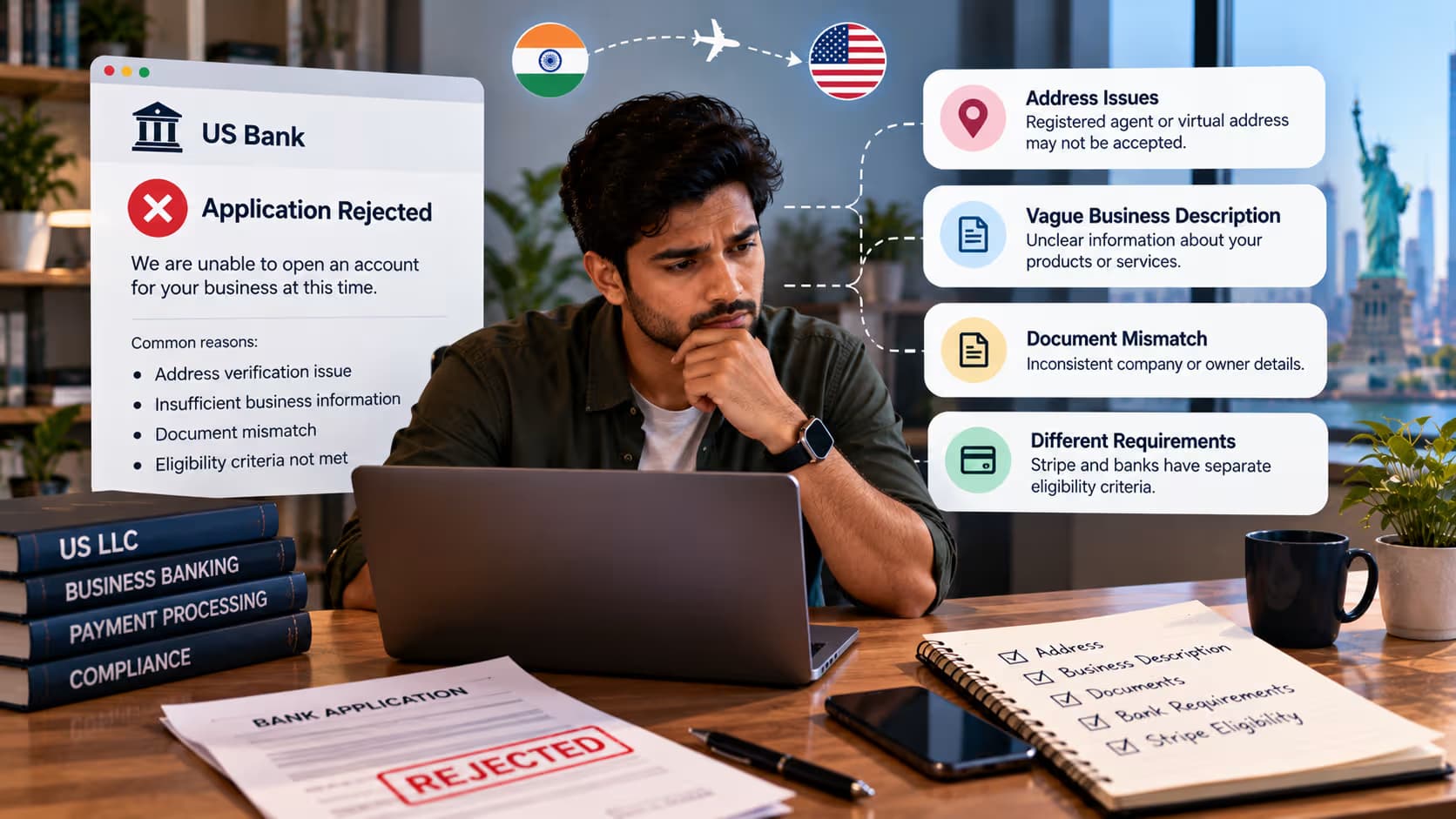
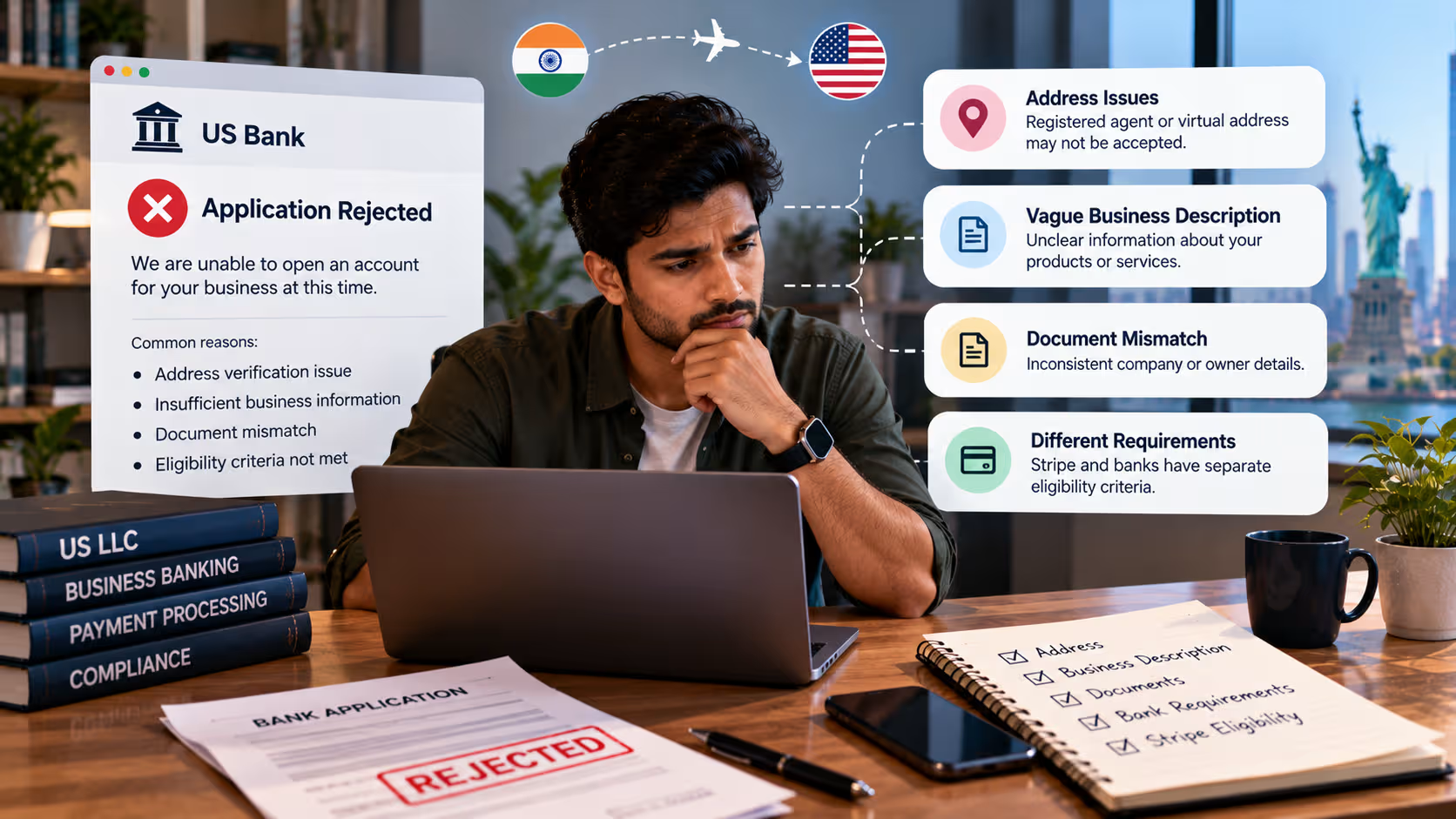
Address problems are one of the first things I check. A founder may have a registered-agent address for the LLC and a virtual mailbox for business correspondence, then enter one of those addresses as the physical operating address.
These addresses serve different purposes. A registered agent receives official legal documents, while a virtual mailbox generally handles business correspondence. Neither automatically proves where a company actually operates. Some financial providers require a verifiable operating address and may not accept registered-agent addresses, PO boxes, or virtual addresses for that purpose. They may also ask for the actual residential address of each beneficial owner.
How to Avoid Address Verification Problems
The solution is not to find a more convincing US address. It is to understand which address the application asks for and provide accurate, verifiable information. Before applying, check the provider's current address requirements and ensure that your legal, mailing, residential, and operating addresses are entered in the correct fields.
If your address information does not meet a provider's requirements, ask what documentation or alternative arrangements it accepts rather than submitting an address that misrepresents your operations.
2. Why a Vague Business Description Can Lead to Rejection
A company description such as “consulting,” “online business,” or “ecommerce” may not fully explain what the business does. A bank or payment provider may need to understand what you sell, who your customers are, how you earn revenue, where payments originate, and what connection your business has to the United States.
When reviewing an application, I would make sure the description reflects the real business model. A software company should explain its product and customers, while a consultant should describe the services provided. An ecommerce business should be able to explain what it sells and how orders are fulfilled.
Explain Your Business Clearly and Accurately
Before submitting an application, prepare a concise explanation of your products or services, target customers, revenue model, and current or planned operations. Make sure your answers are consistent with your company documents and supporting records.
Do not exaggerate your US operations or claim customers you do not have. The goal is to help the provider understand your actual business, not to make the company appear more established than it is.
3. How Inconsistent Documents Create Verification Problems
A bank may ask for the LLC's formation documents, EIN confirmation, and identity documents for its owners. If the legal company name, EIN, ownership details, or addresses differ across the documents, the provider may request clarification or additional evidence.
A document mismatch does not automatically mean the business is ineligible. However, it can create questions that take time to resolve, especially when the application contains information that is difficult to verify.
Check Your LLC and EIN Documents Before Applying
Before submitting an application, compare the information across your formation records, EIN confirmation, ownership documents, and application forms. If something genuinely changed, identify which record needs updating instead of changing information arbitrarily to make the application appear consistent.
International founders who still need to complete their EIN process can review our guide to getting an EIN without an SSN as a non-resident. Accurate company details from the beginning can help reduce avoidable inconsistencies later.
4. Why Stripe Requirements Differ From Bank Requirements
This is where founders can waste time. They may assume that because their US LLC qualifies to apply for a bank account, it will automatically qualify for Stripe.
However, banking eligibility and payment processing eligibility are separate decisions. A payment provider may assess the registered business, the owner's information, the physical location where business activity takes place, and the documents needed to verify the account. Requirements can also vary by product and account type.
A US LLC and EIN therefore do not guarantee approval for Stripe. Even when a business is eligible to apply, the provider may request more information or decline the application after reviewing the details.
Check Payment Processing Requirements Before Forming Your LLC
If your main reason for establishing a US company is to use a particular payment service, review its eligibility requirements before spending money on formation. Confirm the rules for your business type, owner residence, business address, verification documents, and payout arrangements.
Do not confuse eligibility for standard payment processing with the requirements for other financial products. A provider may apply different rules to different services, so make sure you are checking the requirements for the exact product you intend to use.
5. Why an Otherwise Valid LLC May Not Meet a Provider's Eligibility Rules
Sometimes the documents are accurate, but the business still doesn't qualify. Financial providers assess factors such as business activity, owner residence, operating locations, and risk. Their eligibility policies may exclude certain industries, countries, or business arrangements.
This is why I recommend checking eligibility before paying for formation or submitting repeated applications. An LLC can be legally valid while still being ineligible for a particular bank account or payment service.
Review Eligibility Before Reapplying
Read the provider's current eligibility rules and compare them with your actual circumstances. If your business does not meet a requirement, determine whether the provider offers an eligible alternative or whether another service better matches your business model.
Do not assume that changing the state of formation will solve an eligibility issue. The underlying problem may relate to the business activity, owner's residence, operating address, or the provider's risk policies rather than the state where the LLC was registered.
Founders who are still deciding how to structure their companies can begin with our US LLC formation guide for non-residents and assess their requirements before applying for financial services.
6. Why an EIN Application May Be Delayed or Returned
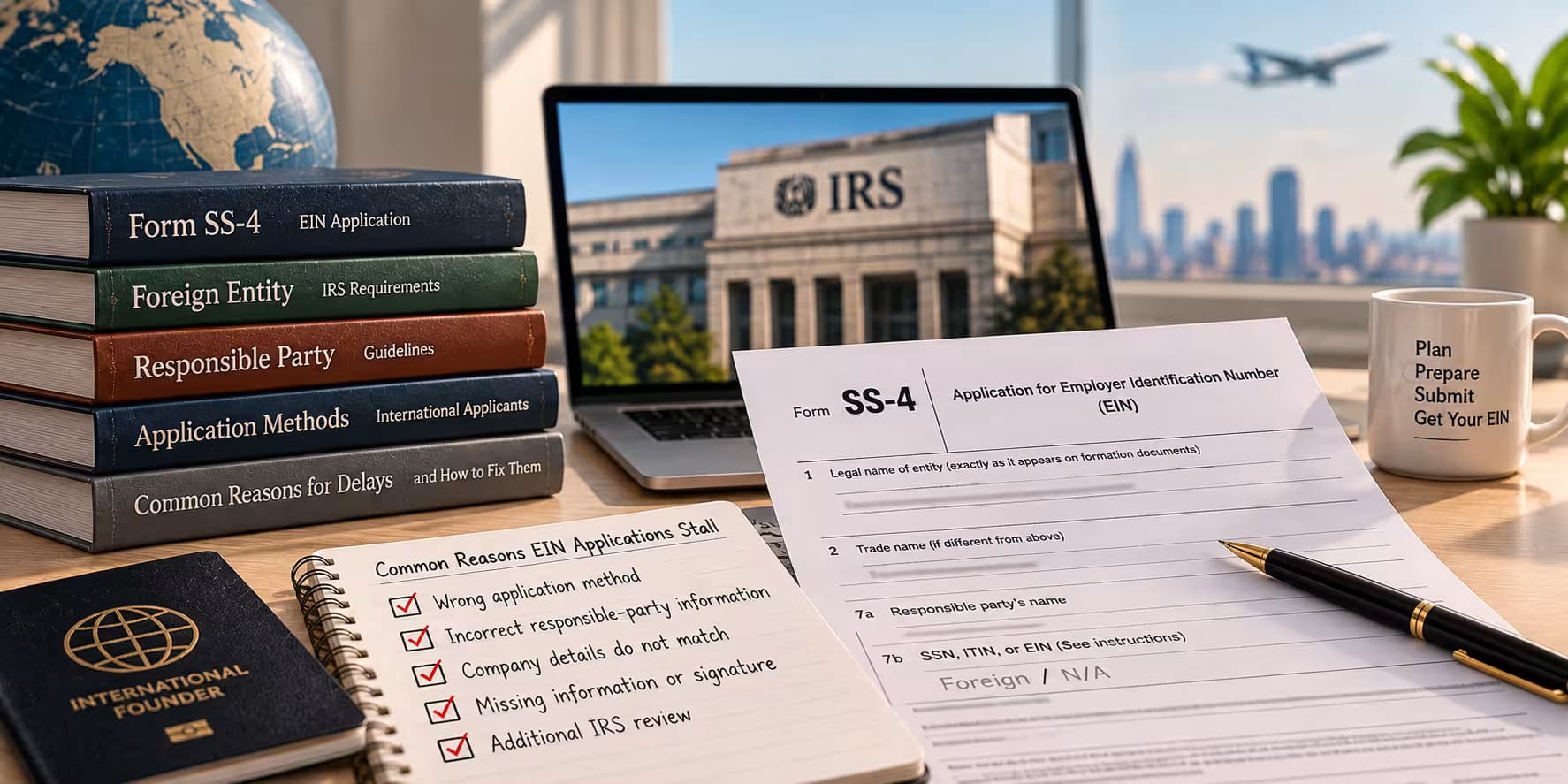
An EIN application is a separate process from opening a bank account. International applicants who have no legal residence, principal place of business, or principal office in the United States generally cannot use the IRS's standard online EIN application. Other application routes may be available under the current IRS instructions.
If an application is delayed or returned, review the Form SS-4 details and the submission method before sending another application. Make sure the responsible-party information and company details are accurate, and follow the applicable IRS instructions.
Understand the Difference Between a Delay and a Rejection
A delay is not necessarily a rejection, and neither should be treated as proof that the LLC itself is invalid. Before submitting another application, determine whether the IRS needs corrected information, additional clarification, or simply more time to process the request.
Keep copies of the submitted form and relevant correspondence so you can identify what has already been provided. If the reason for the delay is unclear, follow the appropriate IRS procedure to clarify the status instead of submitting duplicate applications without understanding the issue.
What Our Rejection Log Taught Me About US LLC Banking
The useful lesson from reviewing these problems isn't that one bank or payment provider is always difficult. It's that each institution is answering a different question.
The state checks formation requirements. The IRS issues EINs and administers federal tax reporting. A bank evaluates whether it can open and maintain an account for the business. A payment provider assesses whether the business meets the requirements for its services. One approval does not guarantee another, and one rejection does not necessarily mean the founder needs to form a new LLC.
My approach is to identify the exact reason, compare it against the provider's current requirements, correct genuine errors, and submit accurate supporting information. If a provider declines an application, ask what additional information it is permitted to accept and whether reapplying is appropriate. Approval is never guaranteed.
For founders looking for a non resident LLC US bank account, the goal should not be to find a workaround. It should be to build a legitimate, consistent setup that meets the provider's requirements. Our guide on opening a US bank account as a non-resident LLC owner can help founders prepare for the banking process.
That's the practical value of keeping a rejection log: not blaming the founder, the bank, or the paperwork automatically, but learning which requirement needs attention before the next application.
The most useful lesson is simple: understand the requirement, correct the actual problem, and make sure every detail you submit reflects your real business.
This article is for general informational purposes only and does not constitute legal, tax, or financial advice. Tousif Akram and FormLLC are not a law firm or CPA firm. Consult a licensed professional for advice specific to your situation.
Ready to Form Your US LLC?
Free 30-minute consultation with no obligation and no sales pressure.
Book Free Call