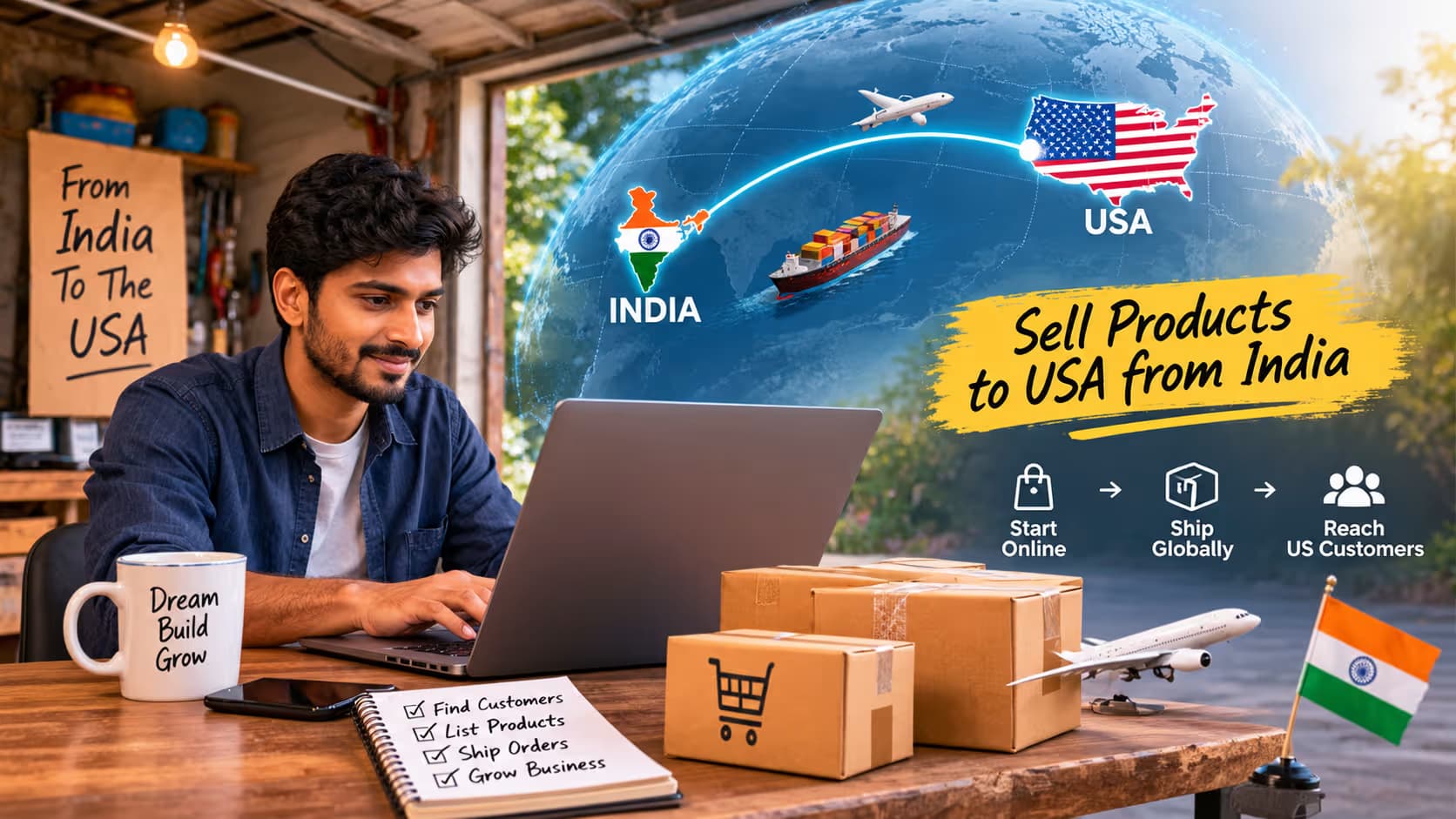
Sell Products to USA From India: How to Start an Ecommerce Business

Tousif Akram
IRS CAA | Founder, FormLLC
He Started in His Family Garage. His Customers Were 8,000 Miles Away.
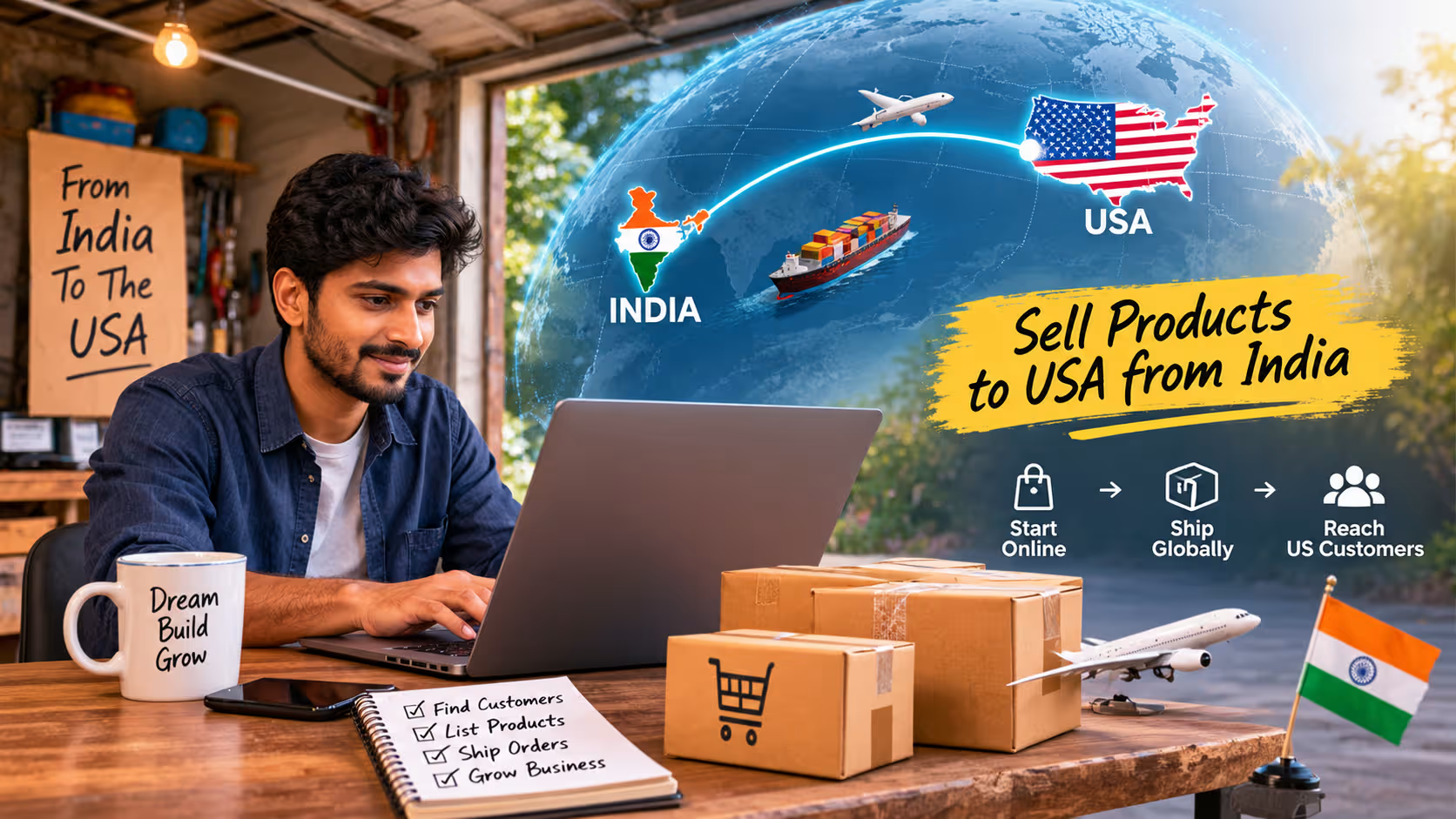
There is a particular kind of entrepreneur I have always found interesting: someone who starts with almost nothing that looks impressive from the outside. If you're wondering how to get US clients from India or how to sell products to USA from India, you don't necessarily need to move your business to America to begin. A product, a laptop, a family garage, and the belief that somebody somewhere will buy what you're building can be enough to start.
I remember speaking with founders like this and realizing how dramatically ecommerce has changed the meaning of a “small business.” A business can start in a family garage in India and have customers sitting thousands of miles away in the United States.
The garage may be local. The ambition doesn't have to be.
You Don't Need to Be in America to Sell to America
One of the questions I hear from Indian entrepreneurs is surprisingly simple: Can I sell products to USA from India?
The answer is yes. Indian businesses can sell to US customers through marketplaces such as Amazon or through their own ecommerce stores, subject to applicable marketplace rules, taxes, customs, product-safety requirements, and other regulations.
For entrepreneurs learning how to get US clients from India, the important point is that reaching American customers and creating a US company are not automatically the same thing.
Amazon has programs for India-based sellers expanding into the US, while cross-border ecommerce platforms such as Shopify also support businesses selling into international markets without necessarily requiring the seller to establish a local entity in every country.
That distinction is important.
Selling to the United States and creating a US company are two different decisions.
You can start exploring the US market before deciding whether you actually need a US entity.
How to Sell Products to USA From India
Start With the Customer Before the Company
If you want to sell products to USA from India, the first question shouldn't necessarily be, “Which company should I register?”
Start with the product and the customer.
Who are you selling to? Where are those customers located? What problem does your product solve? Why would an American customer choose your product instead of an alternative?
These questions matter whether you're an ecommerce seller, an Indian agency, a freelancer, or a founder building a larger international business.
What Changes When Your Customers Are 8,000 Miles Away?
The first few orders can feel simple. Someone discovers your product, places an order, you ship it, and they receive it.
But as sales grow, the questions become more complicated.
How will you handle fulfillment? Where will inventory sit? How will customers pay? How will returns work? What happens with customs and duties? What product regulations apply? How will you manage US taxes and your obligations in India? What happens when you start doing enough business to need a more formal structure?
This is where many founders discover that international ecommerce from India isn't simply about putting a product online.
The internet may make the customer easy to reach.
It doesn't make the underlying business infrastructure disappear.
Why Getting US Customers Is Different From Building a US Company
The US LLC Question Usually Comes Later
Suppose you're building an ecommerce business from India to USA.
You start small. Maybe you're making products yourself. Maybe you're sourcing products from Indian manufacturers. Maybe you have a Shopify store. Maybe you're selling on Amazon. Maybe you're shipping every order directly from India.
Eventually, the business starts becoming more serious.
At that point, you may start researching a US LLC for Indian ecommerce.
And this is where I think founders need to slow down.
A US LLC for ecommerce can be useful in certain situations, but it isn't automatically required simply because your customers are American.
If you're considering a US entity, you can learn more about the broader process in this US LLC guide for non-residents.
Don't form a company because somebody on social media told you that every Indian ecommerce seller needs one.
Understand why you need it.
When a US Company Can Become Part of the Conversation
There are situations where an entrepreneur may decide that having a US company for ecommerce fits the way their business is developing.
Perhaps they are building a US-focused brand. Perhaps their operations are becoming more connected to the US market. Perhaps they need a particular business structure for partners or investors. Perhaps they want to establish a separate US business operation as they expand.
But the decision should be made alongside an understanding of taxes, compliance, banking, fulfillment, ownership, and the founder's existing business in India.
A company registration certificate doesn't solve all of those problems.
And this is one of the lessons I've learned from working with entrepreneurs.
The formation is often the easiest part.
The harder question is whether the structure continues to make sense after the first sale.
What I Would Tell an Indian Founder Who Wants US Customers
If someone came to me today and said, “I want to sell products to US customers from India. Where should I start?”
I wouldn't immediately tell them to register an LLC.
I'd ask what they're selling. Where is it manufactured? Where is the inventory? Who is the customer? How will the product reach them? What marketplace or website will they use? What is the expected order volume? What happens if the product is returned? And what does the business look like if sales become 10 times larger?
Only after understanding those questions would I start thinking seriously about the appropriate business structure.
Because how to sell products in USA from India is not one question.
It's a collection of decisions. The product has to work. The economics have to work. The logistics have to work. The customer experience has to work.
And eventually, the legal and financial infrastructure has to support the business.
How to Get US Clients From India Through a Strong Customer Experience
Your First US Customer Can Teach You More Than a Business Plan
For entrepreneurs asking how to get US clients from India, the first customer can be one of the most valuable learning experiences.
You discover how customers in the American market communicate. You learn what they expect from a business. You learn how they evaluate products, delivery, customer support, pricing, and reliability.
The first sale proves that someone outside your local market is willing to buy.
The next challenge is creating a system that makes the second, tenth, and hundredth sale easier.
Trust Matters When You Work Across Borders
An American customer may have questions about buying from an Indian business.
Will communication be easy? Will delivery happen on time? Can the business handle customer support? What happens if something goes wrong?
These concerns are normal when buying across borders.
The strongest way to address them is professionalism.
Clear product information, transparent policies, reliable communication, customer support, reviews, and consistent delivery can reduce uncertainty.
If you want to get US clients from India, don't focus only on reaching American customers. Focus on giving them a reason to trust your business.
The Garage Is Actually the Least Interesting Part
What stays with me about the garage story isn't the garage.
It's what happens next.
A founder starts with a few products.
Someone in another country discovers them.
The first international order arrives.
Then another.
Then the founder realizes that the market is much larger than the city or country where the business began.
That is the moment the definition of a small business starts changing.
An Indian business selling to USA customers may still have only three employees. It may still operate from a family property. The founder may still personally pack some orders.
But the market is global.
That is what makes modern ecommerce so interesting.
A small team can have a global customer base without first becoming a large company.
Don't Confuse Access With Readiness
This is probably the biggest lesson I would share with someone building an Indian ecommerce business for US customers.
Getting access to the US market is one thing.
Being ready for the US market is another.
You need to understand your product category. You need to understand the platform you're using. You need to understand shipping and fulfillment. You need to understand applicable taxes, customs, and regulations. You need to understand customer expectations.
And if you decide to establish a US entity, you need to understand the ongoing responsibilities that come with it.
That's why I don't like the simplistic version of the story:
Start an LLC → open a bank account → start selling.
Real businesses rarely work that neatly.
Build Infrastructure as the Business Grows
The right infrastructure should support the business you are actually building.
If you're just testing demand, focus on the product, customer, pricing, and fulfillment model.
If you're receiving more international revenue, you may need to think more carefully about payment systems and banking. Our guide to US bank accounts for non-residents covers one part of that broader business infrastructure question.
If you're considering a US entity, understand the formation and ongoing responsibilities before making the decision.
The goal isn't to create complexity.
The goal is to build enough infrastructure to support the opportunity you've already proven.
The Opportunity Is Still Enormous
Despite all those complications, I remain very optimistic about entrepreneurs who want to sell products to USA from India.
The reason is simple.
The distance between the entrepreneur and the customer has changed.
Twenty years ago, reaching customers in another country could require distributors, physical offices, local partners, or substantial capital.
Today, a founder can test demand online before building a large physical operation.
That doesn't make international business easy.
It makes it possible.
And once you understand the difference, you can build the infrastructure gradually.
Start with the product.
Find the customer.
Validate demand.
Understand the economics.
Then build the business structure around the reality you've created.
Not the other way around.
What That Garage Founder Taught Me
The founder who starts in a garage doesn't need to look like a multinational corporation on the first day.
He needs to solve a real problem for a real customer.
If those customers happen to be 8,000 miles away, that's no longer the impossible part.
The harder part is building a business that can responsibly serve them as the opportunity grows.
That is where I think company formation becomes interesting.
A US LLC for Indian ecommerce may eventually be the right structure for some founders. For others, their existing Indian entity may be sufficient for the stage they're at. The answer depends on the actual business.
What matters is making the decision for the right reason.
I've learned this repeatedly while working with entrepreneurs:
Don't start with the paperwork. Start with the business.
Then let the infrastructure grow around it.
Because the next great international ecommerce brand may not start in a Silicon Valley office.
It may start in someone's family garage in India.
And its first customer may be sitting 8,000 miles away.
Frequently Asked Questions
Can I Sell Products to USA From India?
Yes. Indian businesses can sell products to US customers through appropriate marketplaces, ecommerce stores, and other sales channels, subject to applicable taxes, customs, product regulations, marketplace requirements, and other obligations.
The important distinction is that selling products to USA from India does not automatically mean you need to form a US company.
How to Get US Clients From India?
If you're wondering how to get US clients from India, start by identifying a specific American customer and understanding the problem your product or service solves.
Build trust through a professional website or storefront, strong product information, testimonials, reliable communication, clear pricing, and consistent delivery. The first goal is to prove that American customers want what you're offering.
How to Get American Clients From India?
Learning how to get American clients from India starts with identifying the right audience rather than trying to reach every American customer.
Research your target market, understand its needs, create a relevant offer, and use appropriate sales channels to reach potential customers.
Can an Indian Business Sell to US Customers Without a US LLC?
Yes, an Indian business may be able to sell to US customers without automatically forming a US LLC, depending on its business model and circumstances.
Selling internationally and establishing a US company are separate decisions. If you are considering a US entity, understand the tax, compliance, banking, ownership, and operational implications before proceeding.
Is a US LLC Required for Indian Ecommerce?
A US LLC is not automatically required simply because an Indian ecommerce business has American customers.
A US LLC for ecommerce may make sense in some circumstances, but the decision should be based on the actual business model and long-term requirements.
How Can I Sell Services to US Clients From India?
Indian freelancers and agencies can provide many professional services to American customers remotely.
To sell services to US clients, focus on a clear offer, a defined target market, strong communication, professional proposals, reliable delivery, and a customer experience that builds trust.
Can Indian Freelancers Work With US Clients?
Yes. Indian freelancers can work remotely with US customers across many industries, including software development, design, marketing, content, consulting, and other professional services.
The specific tax, payment, contractual, and business requirements depend on the freelancer's circumstances.
Does an Indian Freelancer Need an EIN to Work With US Clients?
Not every Indian freelancer working with US customers automatically needs an EIN.
Whether an EIN is relevant depends on the business structure and circumstances. If you establish a US business entity, however, an EIN becomes an important part of the company's administration.
You can learn more about this in the EIN without SSN guide for non-residents.
Should I Form a US Company Before Selling to US Customers?
Not necessarily.
The better approach is usually to understand your product, customer, sales channel, fulfillment model, expected volume, and long-term plans first.
Once you understand how the business actually works, you can evaluate whether a US company would provide a meaningful advantage.
What Should I Consider Before Selling Products to the US?
Consider your target customers, product category, pricing, fulfillment, shipping, returns, payment methods, customs, taxes, product regulations, marketplace requirements, and customer support.
If your business grows, you may also need to consider company structure, banking, accounting, and ongoing compliance.
The Future of Indian Businesses Selling to the USA
Talent Is Already Global
I often return to one simple thought: the next successful global company doesn't have to come from a major business hub.
It could emerge from a small town, a developing economy, or a founder without access to a traditional entrepreneurial network.
The world isn't short of talented people. There are people with ideas, ambition, and the willingness to build something meaningful.
What we need to keep improving is the infrastructure that helps them turn those ideas into sustainable businesses.
For an Indian entrepreneur, learning how to get US clients from India or figuring out how to sell products to USA from India can be the beginning of something much larger than a single transaction.
A first American customer can lead to a stronger portfolio. A stronger portfolio can lead to more customers. More customers can lead to an agency, product, team, or international company.
Your Location Is Only the Starting Point
I don't believe every Indian entrepreneur needs to create a US company. I don't believe every freelancer needs to target American customers. And I don't believe international growth is automatically the right strategy for every business. But I do believe geography should not unnecessarily limit ambition.
If you have a valuable product, a strong service, or a solution to a real business problem, there are customers somewhere in the world who may need it.
The opportunity is to build the capability, find those customers, earn their trust, and create the infrastructure that allows the relationship to grow.
That's what makes international entrepreneurship so exciting to me. Talent is already everywhere.
The opportunity should be too.
This article is for general informational purposes only and does not constitute legal, tax, or financial advice. Tousif Akram and FormLLC are not a law firm or CPA firm. Consult a licensed professional for advice specific to your situation.
Ready to Form Your US LLC?
Free 30-minute consultation with no obligation and no sales pressure.
Book Free Call