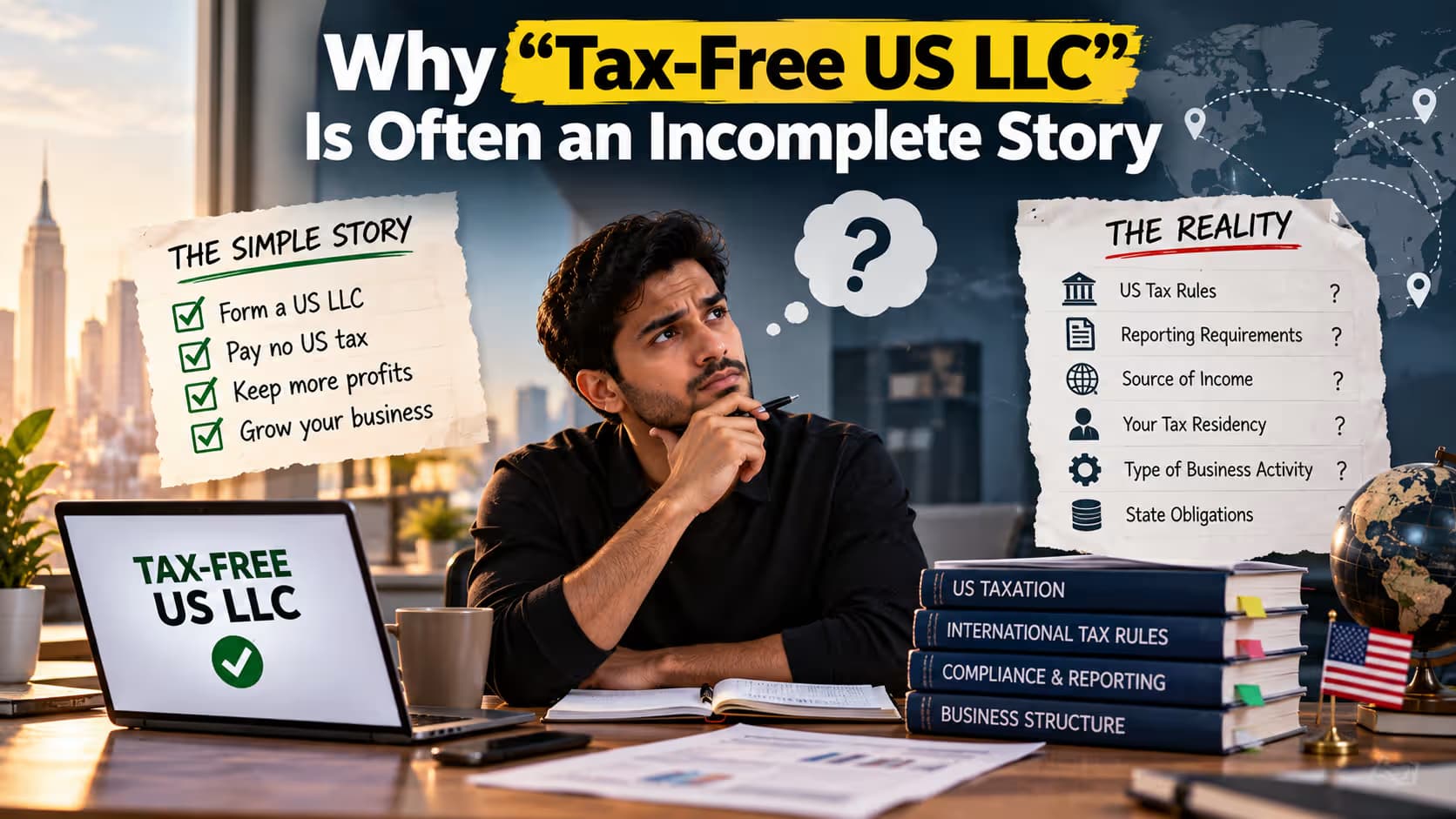
Why “Tax-Free US LLC” Is Often an Incomplete Story

Tousif Akram
IRS CAA | Founder, FormLLC
Why “Tax-Free US LLC” Is Often an Incomplete Story
“Tax-free US LLC” is one of those phrases that immediately gets the attention of international founders. I understand why. If you live outside the United States and someone tells you that you can form a US LLC and pay zero US tax, it sounds like a very attractive opportunity.
But after working with international founders for years, I have learned that the phrase is usually too simple to describe a complicated tax situation.
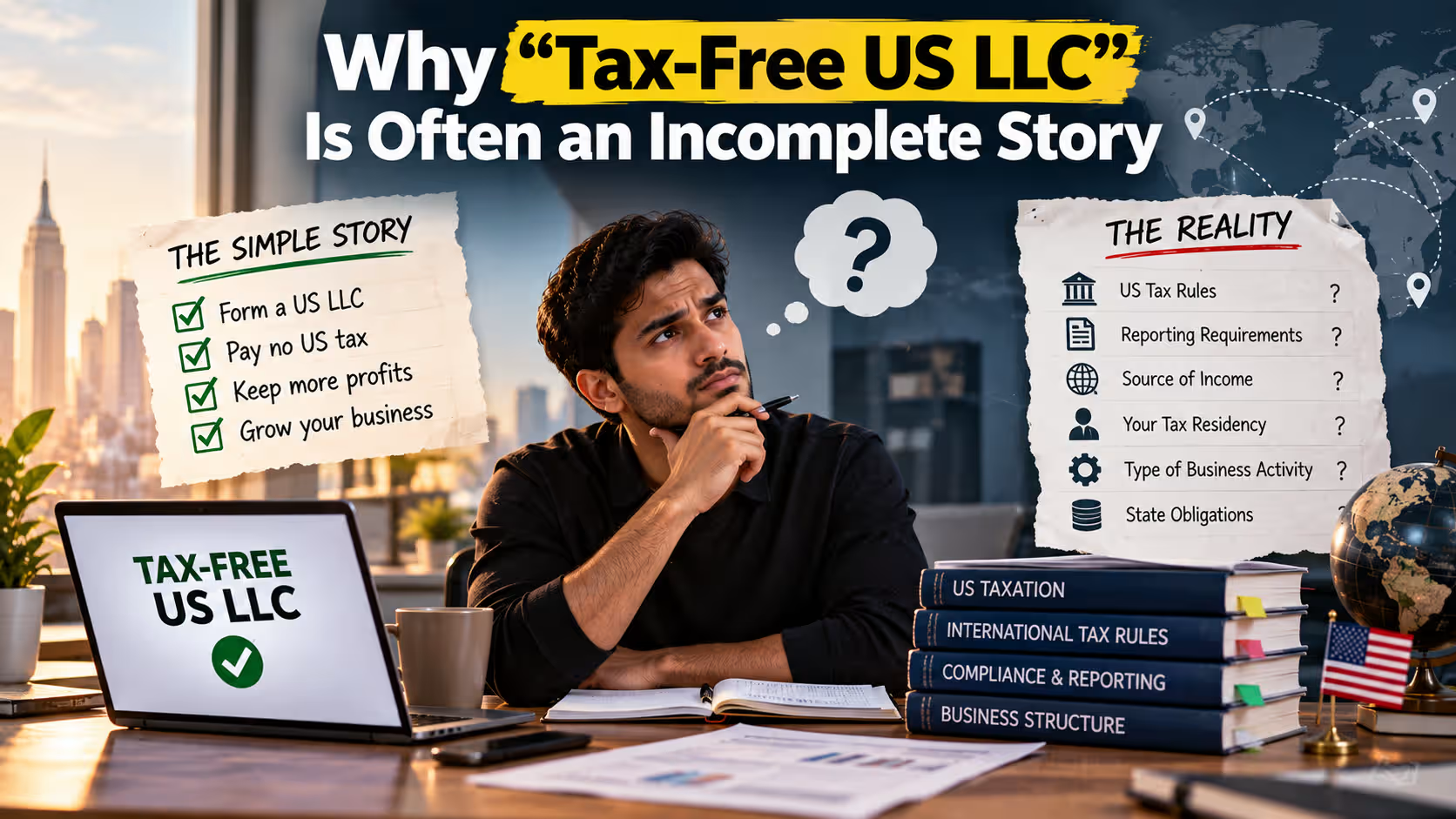
Whether a founder or business owes US tax depends on the facts. The entity's tax classification, the type and source of income, where business activities take place, whether the business is engaged in a US trade or business, the owner's tax status, and potentially tax treaties can all matter. The IRS specifically distinguishes between effectively connected income and other categories of income when explaining how nonresident aliens and foreign persons are taxed.
That is why I am careful about using the phrase “tax-free US LLC” as though it were a guaranteed outcome.
A US LLC Is Not Automatically a Tax-Free Company
I have seen founders come to us with the expectation that living outside the United States automatically means everything their US LLC earns is outside the US tax system.
I would not make that assumption.
A US LLC is a legal entity, but its federal tax treatment is a separate question. The actual tax result depends on how the entity is classified and what the business and owner are doing.
For example, the IRS explains that income effectively connected with a US trade or business can be subject to US taxation. For a foreign person engaged in a US trade or business, US-source income connected with that business is generally treated as effectively connected income, subject to the applicable rules and deductions.
That does not mean every international founder with a US LLC automatically owes US income tax.
It means the opposite: you need to understand the facts before reaching a conclusion.
“No US Income Tax” Does Not Mean “No Tax or Reporting”
This is one of the biggest distinctions I think founders need to understand.
Tax and reporting are not always the same thing.
A founder may hear that their particular situation does not result in US income tax and conclude that there is nothing left to do. That can be a dangerous assumption.
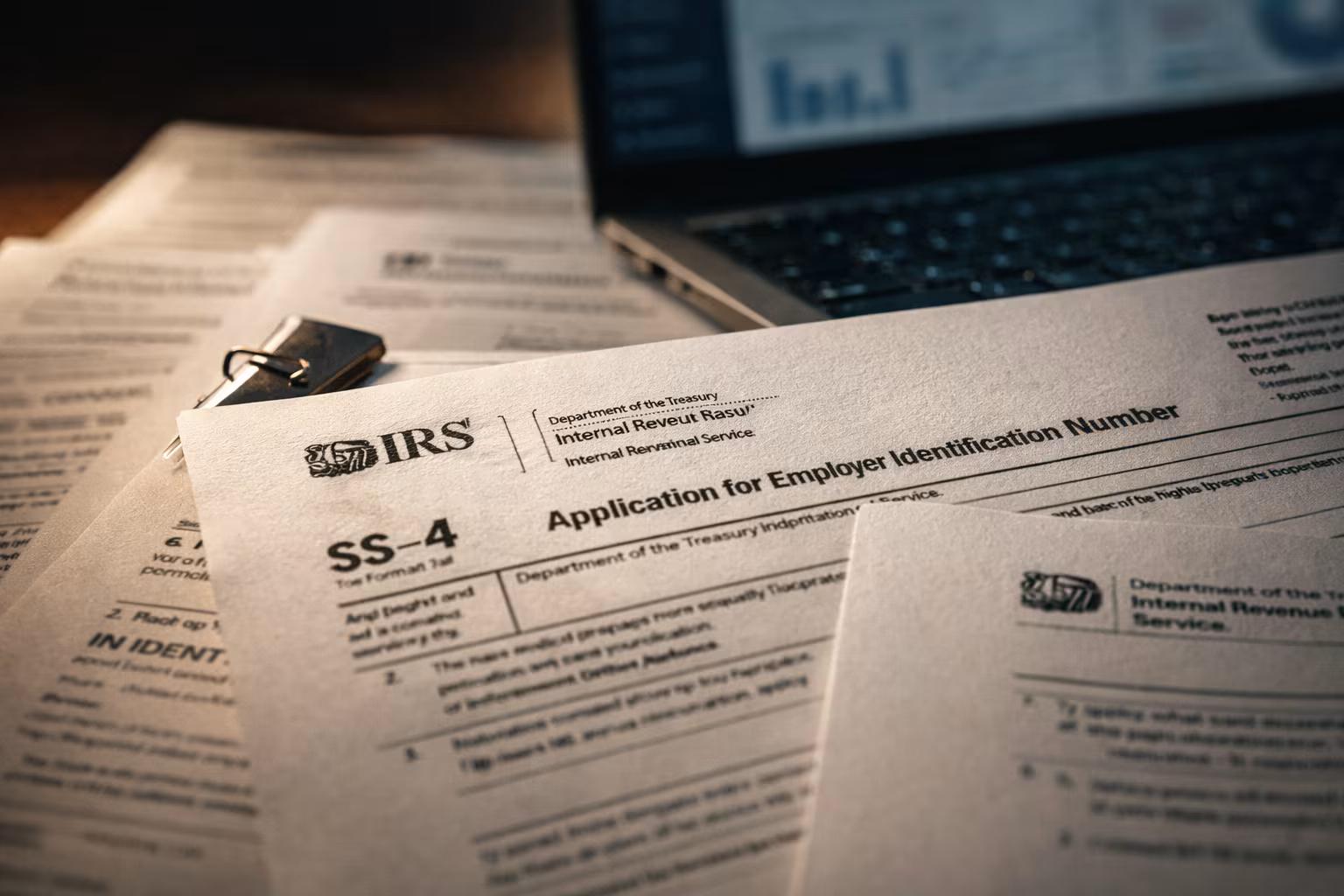
For certain foreign-owned US disregarded entities, the IRS has specific information-reporting requirements. A qualifying foreign-owned US disregarded entity may need to file Form 5472 with a pro forma Form 1120, even though the entity does not have a regular federal income tax return requirement in the same way as a corporation.
That is an important distinction.
A filing requirement does not automatically mean the company owes income tax.
And the absence of income tax in a particular situation does not automatically mean there are no filing or reporting responsibilities.
If you are a foreign owner of a US LLC, our guide on Form 5472 for foreign-owned US LLCs explains why this area deserves careful attention.
Where You Actually Conduct Business Can Matter
Another reason I dislike broad “tax-free LLC” promises is that founders sometimes focus almost entirely on where the company was formed.
They may say, “My LLC is in Wyoming,” or “My company is registered in Delaware,” as though the state of formation answers the tax question.
It does not.
Where the company is registered is only one part of the overall picture. Where the founder works, where services are performed, where business activities occur, what type of income the business earns, and whether there is a US trade or business can all be relevant.
The IRS notes, for example, that a foreign person generally may be engaged in a US trade or business when they perform personal services in the United States, subject to the applicable rules.
That is why I would never tell a founder that simply choosing a particular state makes their entire tax situation “tax-free.”
International Founders Have More Than One Tax Question
This becomes even more important when you live outside the United States.
You might be based in India, Bangladesh, Pakistan, the UAE, the UK, Europe, or another country while owning a US company. In that situation, there may be two separate tax systems to think about: the United States and the country where you personally live or where other relevant business activities take place.
Your personal tax residency can matter. The location of your work can matter. The nature of your income can matter. Your entity's classification can matter. Tax treaties can also affect certain situations.
That means the question should not simply be:
“Is my US LLC tax-free?”
A much better question is:
“What are my US tax and reporting obligations, and what obligations may apply where I live?”
That question is much harder to answer in one sentence, but it is also much more useful.
An EIN Does Not Decide Your Tax Liability
I also see founders sometimes connect the EIN with the tax question.
Getting an EIN is an important administrative step for many US businesses, but an EIN does not determine whether your business is tax-free.
It is a federal tax identification number used for certain business and tax purposes. The underlying tax treatment depends on the entity and circumstances.
If you are a non-US founder who needs an EIN, our guide on how to get an EIN without an SSN explains the process and why international founders often encounter additional questions.
Banking, Payments, and Taxes Are Different Questions
Another mistake I see is treating the US company as one package where everything automatically follows from formation.
A founder may think:
“I form the LLC, get the EIN, open the bank account, receive payments, and therefore everything is sorted.”
But these are different parts of running a company.
Company formation does not guarantee banking approval. An EIN does not guarantee payment processor approval. And opening a business account does not determine your tax liability.
Banks and payment providers make their own decisions based on their requirements and the information they request.
If banking is part of your plan, our guide on opening a US bank account as a non-resident LLC owner can help you understand that process separately from the tax question.
“Tax-Free” Can Distract Founders From the Bigger Business Decision
I also think founders sometimes focus so heavily on avoiding tax that they forget to ask whether the structure actually makes sense for their business.
Tax matters.
But it is not the only consideration.
You also need to think about banking, payments, compliance, bookkeeping, contracts, customers, operating costs, reporting, and where you actually conduct the business.
A structure that looks attractive from a tax perspective may not necessarily be the best fit for every founder or business.
Sometimes a US LLC can be useful for an international entrepreneur. Sometimes another structure may make more sense. And sometimes a founder may not need a US company at all.
The right answer depends on the business.
If you are still evaluating whether a US LLC makes sense, our US LLC guide for non-resident founders is a good place to start before focusing only on the tax question.
Why I Avoid Promising a “Tax-Free LLC”
After working with international founders, my view has become straightforward.
I do not want to sell the dream of a “tax-free company.” I want to help founders understand the structure they are actually creating.
There may be situations where a foreign founder does not owe US federal income tax on particular business income under the applicable rules. There may also be reporting obligations, state-level considerations, foreign-country tax obligations, or other issues that need to be evaluated.
That is very different from promising someone, “Your US LLC will pay zero tax.”
I would rather explain the uncertainty than give a simple answer that may turn out to be wrong for that founder.
The Better Question Is “Why?”
When someone asks me whether a US LLC is tax-free, I think the most useful response starts with another question:
Why do you believe it is tax-free, and what facts are we relying on?
Where do you live? Where do you perform your work? What does the business sell? Where are the customers? Where does the business operate? How is the LLC classified for US tax purposes? Are there US activities? Are there reporting requirements? What does your home country require?
Those questions help move the conversation away from internet slogans and toward the actual business.
That is the approach I prefer because international taxation is based on facts, not marketing phrases.
The Real Lesson Behind “Tax-Free US LLC”
After seeing founders ask these questions repeatedly, I understand why the phrase remains popular. Nobody wants to pay more tax than they legally owe, and good tax planning is a legitimate part of running a business.
But “zero tax” is not a strategy by itself.
Understanding why a particular income may or may not be taxable, which reporting requirements apply, where the business operates, and what obligations exist in the countries involved is the real work.
You do not need to become a tax expert before forming a company.
But you should be careful about anyone who makes international taxation sound like a one-line promise.
A US LLC may be tax-efficient in a particular situation. That does not make every US LLC “tax-free.”
And that distinction is something I believe every international founder should understand before forming a company.
This article is for general informational purposes only and does not constitute legal, tax, or financial advice. Tousif Akram and FormLLC are not a law firm or CPA firm. Consult a licensed professional for advice specific to your situation.
Ready to Form Your US LLC?
Free 30-minute consultation with no obligation and no sales pressure.
Book Free Call