Start Business as a Student: He Started Selling to America

Tousif Akram
IRS CAA | Founder, FormLLC
Start Business as a Student: He Was Still a Student When He Started Selling to America
Most students are thinking about exams, internships, their first job, and what they will do after graduation. Some are thinking about something completely different. They are trying to start business as a student and find their first customer while they are still in college.
I have always found these young founders interesting because they don't necessarily wait for permission to become entrepreneurs. They start with whatever they already have: a skill, a laptop, an idea, a small amount of money, and a lot of curiosity.
Sometimes the first customer is local. Sometimes, surprisingly, the first serious customer is thousands of miles away.
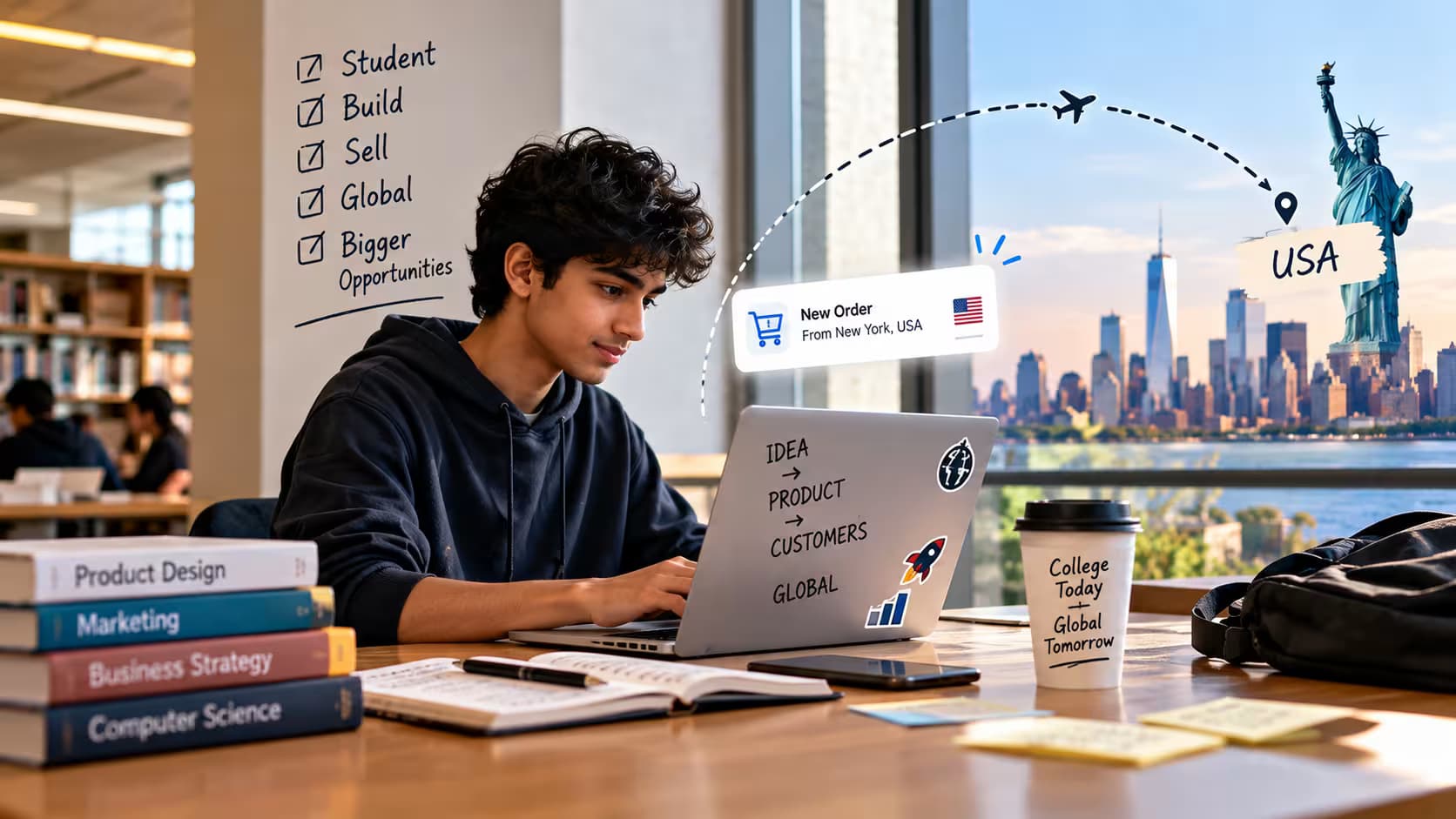
That is what makes the story of a student selling to America so interesting. He wasn't waiting to graduate before becoming an entrepreneur. He was learning by building.
Start Business as a Student Without Waiting for Graduation
When people search for how to start business as a student, they often imagine that they need a perfect business idea first. I don't think that's necessary.
Your first business can begin with a skill. Writing, design, programming, marketing, video editing, research, tutoring, or even finding a problem that other students or businesses are willing to pay you to solve can all become starting points.
The important thing is to start small enough that you can actually learn from the experience. You don't need to build a large company immediately. You need to find something valuable enough that someone is willing to pay for it.
A Student Business Can Be Global From Day One
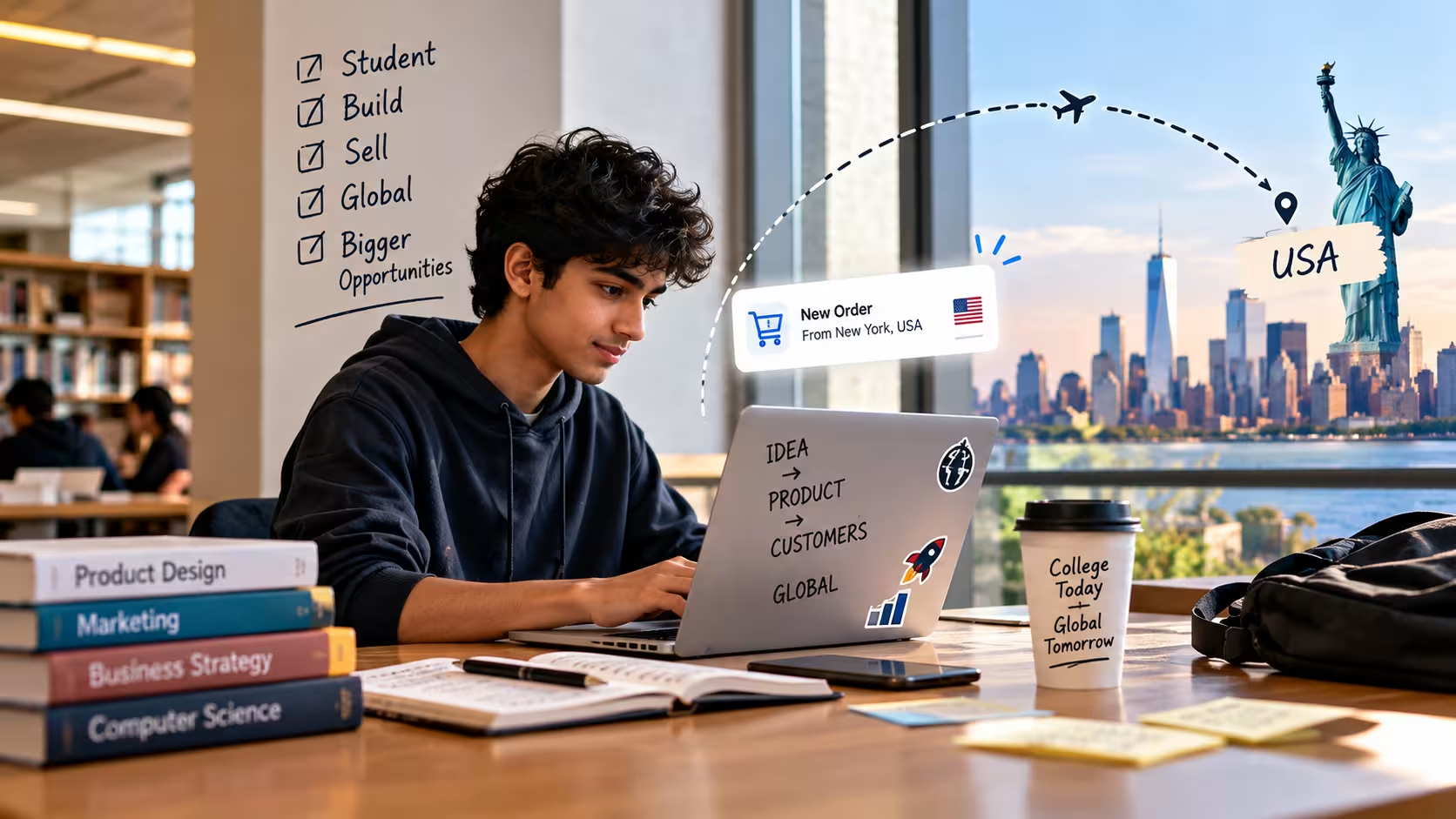
The internet has changed what it means to be a student entrepreneur. A student sitting in India doesn't necessarily have to find their first customer in India.
A designer can work with an American startup. A developer can build software for an American company. A student with an ecommerce idea can sell internationally. A writer can create content for a global audience.
This is one reason I believe the modern student startup is different from what entrepreneurship looked like for previous generations. The market can be global even when the founder is still sitting in a college bedroom.
I've seen this same idea play out through my own journey and through the founders I work with. My experience with global business from India showed me how a small international opportunity can completely change the way someone thinks about where business can happen.
Start With a Skill Before You Start With a Company
If I were advising a student who wanted to start business as a student, I wouldn't immediately tell them to register a company. I'd tell them to find something they can sell.
Get one customer. Do the work. Ask what the customer liked. Ask what they didn't like. Then find another customer.
That process teaches something a business textbook cannot fully teach you. It teaches you what people will actually pay for.
And that first payment can change your confidence completely. Suddenly, entrepreneurship stops being an idea. It becomes real.
Your First Business Is Also an Education
A student business can teach you how to communicate with customers, price your work, handle feedback, meet deadlines, negotiate, and take responsibility for the outcome.
Those lessons become useful regardless of what you eventually build. You might start as a freelancer and later become an agency owner. You might start by selling a service and eventually create software around the problem. Or you might discover that your first idea isn't the right one and move in a completely different direction.
The important thing is that each customer gives you information about what to do next.
The First International Customer Can Change Your Ambition
There is something different about receiving your first payment from another country. You realize that your location doesn't necessarily determine the value of your work.
A student sitting in India can solve a problem for someone in America. That person may never visit India. They may never meet the student. But they are willing to pay because the work is valuable.
That is the beginning of what I would call student entrepreneur international business.
The founder starts thinking beyond a local market. Instead of asking, "Who can I sell to around me?" the question becomes:
"Who has this problem anywhere in the world?"
That is a much bigger question.
What Are Good Student Business Ideas?
I don't think students need to search endlessly for a magical list of student business ideas. The better approach is to look at what you already know.
What do classmates struggle with? What do small businesses struggle with? What can you do faster than someone else? What can you learn quickly? Can you turn a skill into a service? Can you turn a service into a product? Can you build software around a repeated problem?
The first business doesn't have to become your lifelong company. It can simply teach you how business works. And that education can be incredibly valuable.
When a US Company Enters the Conversation
Eventually, a young founder may start getting enough customers to think about formal business structure. That's when questions about a US LLC for young entrepreneurs or a US LLC for startup may appear.
But I would separate two things: first, building the business; second, deciding where and how the business should be structured.
A US LLC can be appropriate for certain businesses, but it isn't automatically necessary because your customers are American. The company should support the business rather than become the business itself.
I've written about customers don't really want a US LLC because the company itself is rarely the ultimate goal. Founders usually want the infrastructure that allows them to operate professionally and serve customers.
For a student with two customers, the priorities may be completely different from those of a startup with employees, investors, and significant revenue. The company structure should grow with the business.
Can a Student Start a US Business?
This is where I think young founders need to be particularly careful.
If someone wants to start business as a student in the United States, they need to distinguish between owning or forming a company and being authorized to work in the United States. Those are not the same question.
For students physically studying in the US on an F-1 or other student status, employment and work authorization can have specific restrictions. If you're an international student physically in the US, don't assume that forming an LLC automatically gives you permission to operate or work in the United States.
Immigration status is a separate issue and deserves qualified advice.
Forming a Company and Working in the US Are Different Questions
This distinction is especially important for international students. A business entity is a legal structure, while immigration status determines what activities you may be authorized to perform in the United States.
So before making a decision based on something you read online, understand your particular situation and get appropriate professional guidance when necessary.
The same principle applies to taxes, contracts, and other legal requirements. Being young does not remove the responsibility to understand the rules that apply to your business.
The Advantage of Being Young
There is one thing students have that they often don't appreciate enough: time to experiment.
You can try something. It doesn't work. You learn. You try something else.
You don't necessarily need your first business to become a million-dollar company. You need your first business to teach you how to find customers, sell, deliver, communicate, negotiate, and solve problems.
That experience compounds.
A student who learns those lessons at 20 may approach business very differently at 25. And at 30, they may already have a decade of experience that no classroom could provide.
Don't Confuse Youth With Inexperience
Being young doesn't mean you have nothing valuable to offer. In fact, young founders can sometimes see problems differently because they aren't carrying years of assumptions about how things are "supposed" to work.
They are comfortable with technology. They are comfortable communicating online. They are willing to test things. And they can reach customers in countries they may never have visited.
That is a powerful combination for an international student entrepreneur.
But being young also means you need to be willing to learn. Listen to customers. Learn the legal basics. Understand contracts. Keep records. Separate personal and business finances when appropriate.
And don't make major legal or tax decisions simply because someone on social media said it was easy.
The Student Who Sells to America Isn't Really Selling to America
This is perhaps the biggest lesson.
He wasn't really selling to America. He was solving a problem for another human being who happened to live in America.
That distinction matters.
If you focus too much on the country, you can forget the customer. The customer doesn't care that you're a student. They care whether you can solve their problem.
They care whether you communicate clearly. They care whether you deliver what you promised. And if you consistently do those things, your age and location become much less important.
The customer is the starting point, not the geography.
Start Before You're Ready
I've learned from entrepreneurs that the first step is often much smaller than people imagine. You don't need an office. You don't need a large team. You don't need a perfect website. And you don't necessarily need a US company on day one.
You need something valuable enough that someone is willing to pay for it.
That first customer can become your first lesson. The second customer can become your second lesson. And eventually, those lessons can become a company.
If you're trying to start business as a student, don't make the mistake of believing that you need to have everything figured out before taking the first step. The purpose of starting small is to learn what works before taking on unnecessary complexity.
If the business eventually requires a US structure, the founder can then think about practical infrastructure such as banking and payments. A guide to US bank accounts for non-resident LLC owners can help explain that later part of the journey.
But that is a later-stage question for many students. Your first priority is learning how to create and deliver value.
Your First Customer Matters More Than Your First Company
I think this is one of the most important lessons for a young founder.
A company registration document doesn't teach you how to sell. A business bank account doesn't teach you how to communicate with customers. A website doesn't teach you how to solve a real problem.
Customers do.
Every customer gives you another opportunity to understand what people value, where your process breaks down, what you need to improve, and what kind of business you might eventually build.
That is why I wouldn't measure a student's first business only by revenue. Measure it by what the founder learns.
The Student May Graduate With More Than a Degree
A student who starts selling to international customers while still studying may graduate with something more than a degree.
They may understand how to communicate with customers. They may have experience delivering real work. They may understand pricing, deadlines, negotiation, and responsibility.
They may have learned how to deal with rejection.
They may have discovered what customers actually value.
And they may have developed the confidence to look at a problem and think, "I can probably figure this out."
That mindset can become more valuable than the first business itself.
Frequently Asked Questions
Can You Start Business as a Student?
Yes. A student can begin with a skill, service, product, or problem they understand. The best starting point is usually something small enough to test without taking on unnecessary complexity.
What Is a Good Online Business for a Student?
There is no single business that works for every student. Services such as writing, design, programming, marketing, research, tutoring, and video editing can be starting points because they can often be offered with relatively limited resources.
The better question is what skill you already have or can develop that solves a problem someone is willing to pay for.
Can a Student Sell Services to Customers in America?
Yes. A student in India or another country can potentially provide online services to customers in the United States. The important considerations include the nature of the work, payment arrangements, applicable laws, taxes, and the student's own circumstances.
Does a Student Need a US LLC to Sell to American Customers?
Not necessarily. Having American customers does not automatically mean a student needs a US LLC.
A company structure should be considered based on the actual business, its operations, payment requirements, long-term plans, and applicable legal and tax considerations.
Can an International Student in the US Start a Business?
This requires additional care. Forming or owning a company and being authorized to work in the United States are separate issues.
An international student physically studying in the US should understand the restrictions that apply to their immigration status and seek qualified advice before engaging in business activities that could constitute unauthorized employment.
Should Students Form a Company Before Getting Their First Customer?
Not necessarily. For many students, the more useful first step is to validate whether someone actually wants to pay for their product or service.
Once there is evidence of demand, the founder can make more informed decisions about business structure and other infrastructure.
Start Small, Learn Fast, Think Globally
The story of a student selling to America isn't really about America.
It is about what happens when a young person realizes that their market can be larger than their immediate surroundings.
He didn't wait to graduate before learning about customers. He didn't wait for a perfect business idea before taking action. He started with what he had and learned from the people willing to pay for what he could do.
That is what entrepreneurship often looks like at the beginning.
It is not always a company, a team, an office, or a complicated strategy.
Sometimes it is simply a student, a laptop, a useful skill, and the decision to find out whether someone somewhere in the world needs it.
And that first customer can change everything.
This article is for general informational purposes only and does not constitute legal, tax, or financial advice. Tousif Akram and FormLLC are not a law firm or CPA firm. Consult a licensed professional for advice specific to your situation.
Ready to Form Your US LLC?
Free 30-minute consultation with no obligation and no sales pressure.
Book Free Call