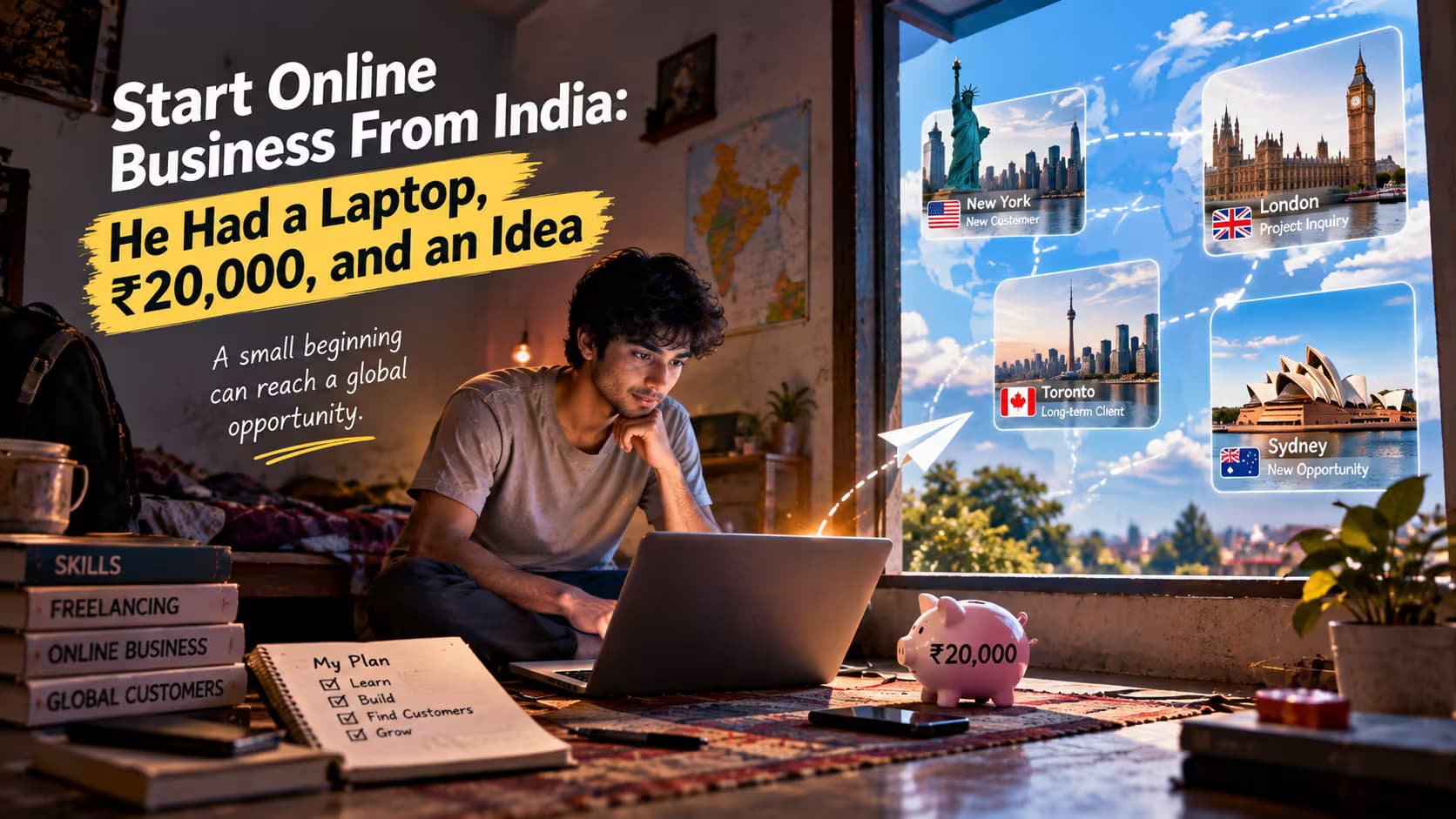
Start Online Business From India: He Had a Laptop, ₹20,000, and an Idea

Tousif Akram
IRS CAA | Founder, FormLLC
Start Online Business From India: He Had a Laptop, ₹20,000, and an Idea
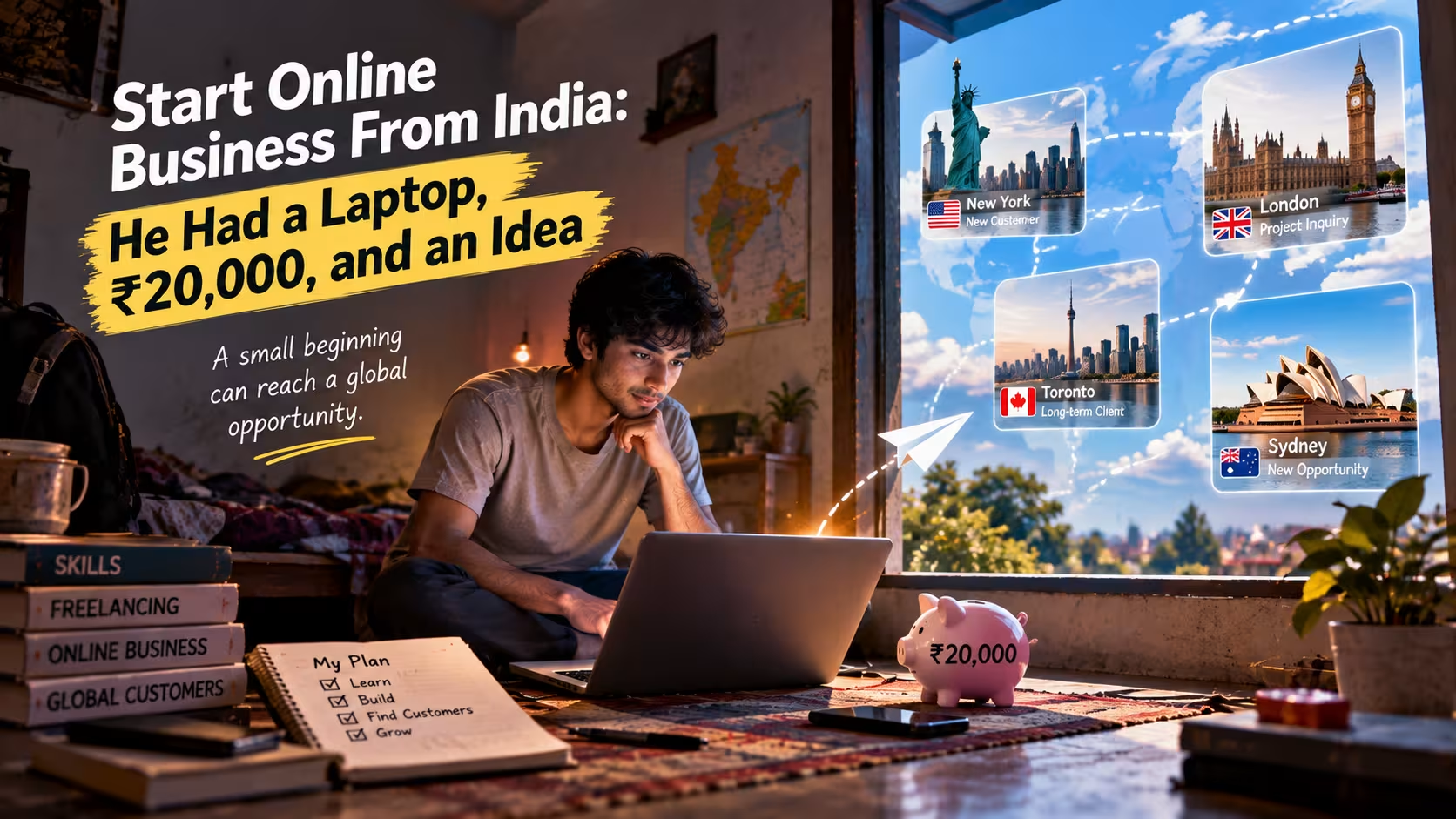
There is a version of entrepreneurship that begins with a business plan, investors, an office, and a team. My story started very differently. I had a laptop, around ₹20,000, and an idea. I didn't have a large team or a big budget. I also didn't know exactly where the journey would lead. What I did have was access to the internet, and that changed everything.
Looking back, I think that is one of the biggest reasons I believe someone can start online business from India without waiting until they have a huge amount of money, a perfect office, or everything figured out. The internet can give a person access to customers, skills, information, and markets that may be thousands of kilometres away.
But there is something else I learned along the way. Starting is only the first part. Building something that lasts is the real challenge.
I Didn't Start With a Global Business
When people hear about an entrepreneur eventually working with international customers, they often imagine that the business was designed to be global from the beginning. Mine wasn't.
Like many young entrepreneurs, I was simply looking for an opportunity to earn, learn, and build something of my own. I discovered freelancing and online platforms and slowly realized that the person sitting in India didn't necessarily have to sell only to people in India.
That was a completely different way of thinking about work. A customer could be in another city, then another country. The work could be delivered online. Communication could happen through a laptop. Payment could arrive digitally.
Suddenly, the idea of an online business from India didn't seem so strange. It seemed possible.
And once you realize that your customer doesn't have to live near you, the size of the opportunity changes.
The Laptop Was More Important Than the Money
₹20,000 may sound like a very small amount compared with what people sometimes think they need to start a business. But I learned that the most important asset wasn't the money. It was the ability to use what I already had.
A laptop gave me access to the internet. The internet gave me access to skills and customers. Customers gave me experience. Experience created confidence. And confidence made it easier to take the next step.
That is one reason I think the conversation around how to start online business from India should focus less on how much money someone has and more on what they can actually do with the resources available to them.
You don't need to begin with a multinational company. You need to begin by solving a problem someone is willing to pay you to solve.
Start With a Skill You Can Turn Into Value
If I were starting from the same position again, I would first look at the skills I already had or could develop quickly. A service business can often be a practical starting point because you can begin by selling your knowledge or ability before investing heavily in products, technology, or a large team.
The goal would not be to build something that looks impressive immediately. The goal would be to create something useful enough that another person is willing to pay for it.
That mindset also shaped how I eventually thought about building businesses beyond freelancing. I learned that starting a global business is less about appearing international and more about finding customers whose problems you can genuinely solve.
The First International Customer Changes Your Thinking
There is something psychologically different about earning your first money from someone in another country.
It makes the world feel smaller.
You realize that someone who doesn't know you, doesn't live near you, and may never meet you in person is willing to pay you because they believe you can solve a problem.
That realization was important for me. It changed the way I looked at opportunity.
India was where I lived, but it didn't have to be the limit of the market I could serve. That is the foundation of what I now think of as international entrepreneurship.
It isn't necessarily about moving abroad. It is about learning to create value across borders.
My own journey reinforced this idea. The opportunity to work with international customers showed me that geography and market are not always the same thing. You can build from one place while serving people somewhere completely different.
How to Start an Online Business From India Without Thinking Too Small
If I were starting again today with a laptop and limited money, I would not begin by asking, "What company should I register?"
I would ask four more practical questions: What problem can I solve? Who has that problem? Can I reach those people online? Can I deliver the result remotely?
Those questions come before logos, offices, business cards, and even company formation.
The first goal should be validation. Find someone who has the problem. Help them. Get paid. Learn from the experience. Then repeat it.
That is how an Indian online business can begin turning into something much bigger.
Get the First Customer Before Overbuilding
One of the easiest mistakes for a new entrepreneur is spending too much time preparing to launch instead of actually testing whether anyone wants the offer.
I would rather have a simple service with one paying customer than a sophisticated website with no customers. The first customer gives you information that planning alone cannot provide.
You learn what people actually value, what questions they ask, what they are willing to pay for, and what needs to change in your offer.
That feedback can become the foundation for everything you build later.
From an Indian Online Business to a Global Business
There is an important difference between having an Indian entrepreneur global business mindset and simply trying to look international.
You don't become global because your website says "global." You become global when customers outside your home market genuinely value what you provide.
That can happen gradually.
Maybe your first customers are in India. Then you get one customer from another country. Then you discover that the same problem exists in the United States. Eventually, you start building systems specifically for those customers.
This is how a global online business can develop.
It doesn't have to happen overnight. In fact, I think gradual expansion is often healthier because every new market teaches you something about pricing, communication, customer expectations, payments, delivery, and trust.
Let Customer Demand Drive International Expansion
I wouldn't try to enter five countries at once just because the business is online. I would first understand where the strongest demand is coming from.
If customers from a particular market consistently respond well to the offer, that gives you a reason to learn more about that market and build around it.
This is one of the lessons I've carried into my work with international entrepreneurs. The objective isn't to create the appearance of a global company. The objective is to build a business that genuinely works across borders.
When Your Customers Are in the United States
Eventually, some entrepreneurs reach a point where they are not simply doing occasional international work. They are intentionally building an online business for US customers.
That is a different stage.
Your customers may expect professional contracts, reliable support, clear invoicing, consistent delivery, and a business structure that fits your commercial model.
This is where a U.S. entity may become part of the conversation.
A US LLC for online business can be useful in some situations, but it shouldn't be treated as the starting point for everyone. The appropriate structure depends on the business, ownership, activities, and other circumstances.
That is why I always tell entrepreneurs that forming the company is not the same thing as building the company.
A registration document doesn't create customers. It doesn't automatically create trust. And it doesn't replace the work required to deliver a good product or service.
Starting a US Business From India Is a Different Decision
There is a reason start US business from India is such a popular idea among entrepreneurs today.
An Indian founder can potentially build from India while targeting customers in the United States. But the decision to form a U.S. company should come from the business model, not from the assumption that every international founder needs one.
If your business is already serving American customers and your commercial needs justify a U.S. structure, it may be worth exploring.
But don't create a U.S. company simply because someone told you that it automatically makes your business global.
The company is infrastructure. The customer is the business.
For entrepreneurs who are considering a U.S. structure, understanding the difference between registration and ongoing operations is important. My US LLC guide for non-residents explains some of the considerations founders should understand before making that decision.
What I Learned About Money and Growth
Starting with ₹20,000 also taught me something that became increasingly important as the business grew.
Money can accelerate a good business. It cannot rescue a bad one.
You can spend more on advertising. You can build a better website. You can hire more people. You can buy better software.
But if you haven't figured out who your customer is and why they should buy from you, spending more money simply makes the wrong process more expensive.
That lesson has stayed with me.
When I think about helping someone start online business from India, I don't want them to believe that they need a huge investment before they can begin. I would rather see them spend carefully, learn quickly, and reinvest when they have evidence that something works.
Spend Money Where It Creates Learning or Growth
If I had limited capital, I would prioritize expenses that help me learn about customers, deliver the service, or generate revenue.
That could mean paying for an essential tool, improving the customer experience, learning a valuable skill, or testing a specific acquisition channel.
I wouldn't spend heavily simply to make the business look bigger than it is.
A lean business gives you room to experiment. It also gives you more time to discover what actually works before committing to larger expenses.
The Internet Doesn't Remove the Hard Work
There is a temptation to look at online entrepreneurship and think it is easy.
It isn't.
The internet removes some geographical barriers, but it doesn't remove the need to sell, communicate, deliver, support customers, manage money, and keep learning.
An online business still needs discipline. It still needs good records. It still needs clear financial tracking. It still needs systems.
As a business becomes more international, those responsibilities can become more complicated. You may have customers in different countries, different payment methods, different expectations, and potentially different regulatory requirements.
This is one reason I believe entrepreneurs should think about business infrastructure early enough to avoid unnecessary problems later.
Build Systems as the Business Grows
When you're working alone, you can keep many things in your head. As customers increase and other people join the business, that becomes much harder.
You need processes for customer communication, delivery, financial tracking, documentation, and other recurring tasks.
I've learned that building a business isn't just about finding more customers. It's also about creating a system that can serve those customers consistently.
That is why I increasingly think about global business infrastructure as part of the larger challenge of building an international company.
What I Would Do If I Had to Start Again
If you gave me a laptop, ₹20,000, an internet connection, and told me I had to start again, I wouldn't spend the first month designing a perfect brand.
I would choose a skill. Then I would find a problem. Then I would find people who have that problem. Then I would try to get the first customer.
Once I had proof that someone would pay, I would improve the offer. Then I would build systems around it.
Only after the business started showing signs of becoming something bigger would I spend more time thinking about structures, hiring, automation, international expansion, and other infrastructure.
That sequence matters.
Customer first. Infrastructure second.
Your First Business Doesn't Have to Be Your Final Business
One of the biggest lessons I've taken from entrepreneurship is that the first thing you build doesn't have to be the thing you build forever.
Your first freelance service can lead to an agency. An agency can lead to software. A local business can discover international customers. An online business from India can eventually become an international company.
And a skill you learned simply to earn money can eventually become the foundation for something much larger.
That is why I don't think entrepreneurs should obsess over having the perfect idea on Day 1. Sometimes the idea becomes clearer only after you start.
Let the Business Teach You What to Build Next
Your customers can show you which problems are worth solving. They can show you what they value, what they don't understand, and what they would pay more for.
That information can influence the next version of the business.
I've found that some of the most important opportunities become visible only after you begin doing the work. You don't always know what the business can become before you have real customers and real experience.
The Bigger Opportunity Is Beyond India
India has millions of talented people who can build products, services, software, agencies, brands, and businesses for customers around the world.
The opportunity is not simply to create more businesses in India. It is to create more businesses from India that can compete globally.
That is where I see the real potential.
An entrepreneur doesn't necessarily need to leave India to access international opportunity. They may be able to build from home, hire locally, learn globally, and sell internationally.
That is the future I find exciting.
And it is why I believe an Indian online business can be much more than an online source of income. With the right execution, it can become the foundation for an international company.
A Laptop, ₹20,000, and an Idea
When I look back, the laptop and ₹20,000 were not enough to build a large company by themselves.
But they were enough to begin.
The rest came later.
The skills came later. The customers came later. The mistakes came later. The systems came later. The team came later. The international opportunities came later.
That is probably the most useful lesson I can share with someone thinking about entrepreneurship today.
You don't need to have everything before you start. You need enough to take the first step.
If you are trying to start online business from India, don't wait until your business looks like the finished version in your head.
Start with what you have. Solve one problem. Find one customer. Learn from that customer. Then build the next version.
Because sometimes, a laptop, ₹20,000, and one idea really can be enough to begin a much bigger journey.
This article is for general informational purposes only and does not constitute legal, tax, or financial advice. Tousif Akram and FormLLC are not a law firm or CPA firm. Consult a licensed professional for advice specific to your situation.
Ready to Form Your US LLC?
Free 30-minute consultation with no obligation and no sales pressure.
Book Free Call