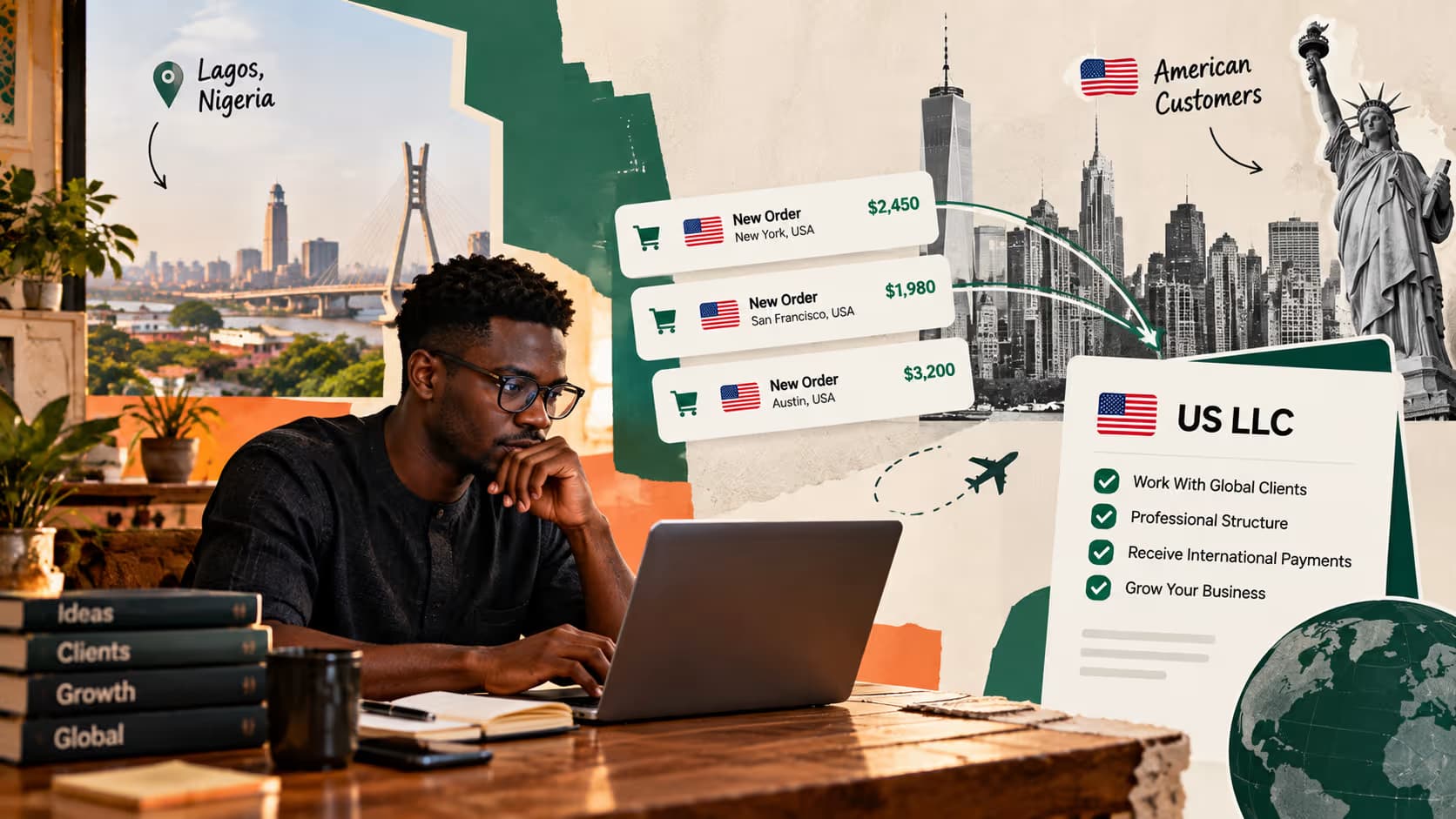
US LLC From Pakistan: He Started His Business in Lahore. His First Big Customers Were in America.

Tousif Akram
IRS CAA | Founder, FormLLC
US LLC From Pakistan: He Started His Business in Lahore. His First Big Customers Were in America.
When I think about how the internet has changed entrepreneurship, I often think about founders who build businesses from places the world does not immediately associate with American customers.
A founder can sit in Lahore, Karachi, or Islamabad, work with a team in Pakistan, and still sell software, consulting, design, development, ecommerce products, or other services to customers in the United States.
I have seen this shift repeatedly while working with entrepreneurs building companies for international customers. The founder's location is no longer necessarily the limit. The bigger question is whether the business is structured and presented in a way that can support the market the founder wants to serve.
That is one reason I get questions about a US LLC from Pakistan so often.

US LLC From Pakistan: The Business Can Start in Lahore
A Pakistani founder does not need to move to the United States simply because the majority of their customers are American.
For many entrepreneurs, the business may actually begin in Pakistan. They build the product there, hire their first employees there, develop their skills there, and find their first customers online. Then, as the business grows, they start asking a different set of questions.
How do I work with more international customers? How should I invoice them? How do I separate my personal finances from the business? What company structure makes sense for what I am trying to build?
This is where a US LLC for Pakistani entrepreneurs can become part of the conversation.
The important thing, however, is not to look at a US company as a shortcut. A company is a structure. It does not automatically create customers, revenue, banking access, or credibility.
Those still have to be earned.
Why a US LLC From Pakistan Gets So Much Attention
For a founder selling internationally, a US company can sometimes make the commercial side of the business easier to organize.
A founder may want to contract with American companies through a US entity, separate business finances, build relationships with international payment providers, or create a company structure that fits their long-term plans.
That is why people search for terms such as US company from Pakistan, US business from Pakistan, and US LLC for Pakistanis.
But I always tell founders to start with the business rather than the entity.
If you are a freelancer in Lahore with two American clients, your first question should not be, "Which state should I form my LLC in?"
It should be, "What am I actually building, who owns it, where is the work performed, where are my customers, and what will this business look like two years from now?"
Once you answer those questions, the company structure becomes much easier to evaluate.
For a broader perspective on what international founders actually need after formation, starting a global business is about much more than simply creating a US company. The business still needs trust, infrastructure, customers, and systems.
A US Company Can Be Useful for a Pakistani Freelancer — But It Is Not Magic
I have spoken with many entrepreneurs who started as freelancers and gradually became agencies, software companies, consultants, or product businesses.
That journey matters.
A person searching for a US company for Pakistani freelancers may initially just want a better way to handle international business. But if the business grows, the questions become bigger: contracts, employees, ownership, accounting, taxes, payments, intellectual property, and compliance.
The same applies to someone looking for a US business for Pakistani entrepreneurs.
A US entity can be one part of an international business strategy. It should not be mistaken for the strategy itself.
This distinction is important because I have seen founders spend too much time thinking about incorporation and not enough time thinking about what happens after incorporation.
The LLC is Day 1. Building the business is everything that comes after.
What Does It Actually Mean to Start a US Business From Pakistan?
The phrase start a US business from Pakistan sounds simple, but there are several separate pieces behind it.
You need to decide what entity you are forming, choose the appropriate state, provide the required information, appoint a registered agent where required, and then handle the federal identification and ongoing compliance side of the business.
The IRS recognizes LLCs as entities that can receive different federal tax classifications depending on their ownership and elections. A foreign-owned LLC therefore needs to be looked at based on its actual structure and activities, not simply because its owner lives outside America.
For a Pakistani founder, this is where I would slow down.
Don't choose a structure because someone on social media said it is "tax-free." Don't choose a state because somebody promised that it is automatically the best state for every foreign founder. And don't assume that forming a company means your compliance responsibilities are finished.
If you want to understand the broader process for non-resident founders, the US LLC guide for non-residents explains the formation, EIN, banking, and compliance pieces that come after deciding to create the company.
The EIN Is Important — But It Is Only One Piece
One of the next questions I commonly see is about an EIN for Pakistani entrepreneurs.
The EIN is the federal tax identification number issued by the IRS, and the application process depends on the applicant and the entity's circumstances. Foreign-owned businesses can have specific considerations, so the process should be approached carefully rather than treated as an automatic step with a guaranteed outcome.
This is another area where I prefer accuracy over promises.
If someone tells you, "Don't worry, you'll definitely have your EIN tomorrow," I would be careful.
Government processes can take time, and foreign-owned businesses can have additional considerations. A good service provider should explain what is actually happening rather than making a promise simply because the promise sounds good.
And Then Comes Banking
This is where many founders discover that forming a company was the easy part.
Someone may successfully create a US LLC and obtain an EIN, and then assume that opening a US bank account for a Pakistani business will automatically follow.
It doesn't.
Bank and financial-platform approval is a separate decision. Providers have their own eligibility, verification, compliance, and risk requirements. Your ownership, residence, business activity, website, expected transactions, documentation, and other factors can matter.
So if you are considering a US LLC from Pakistan, I would think about banking before you form the company, not after.
The goal isn't to find someone who promises an account.
The goal is to build a legitimate business profile that a financial institution can actually understand and verify.
Don't Forget That You Are Still a Non-US Founder
A lot of the content online makes the process sound as if a foreign founder becomes an American business owner the moment an LLC is formed.
That is not how I think about it.
You may own a US company while continuing to live and work in Pakistan. You may be a non-resident owner. You may have customers in America while your actual operations remain elsewhere.
That is why the phrase US LLC for non-residents is relevant to this entire discussion.
And taxes are not something to answer with one sentence.
The United States has an income tax treaty with Pakistan, but treaty benefits depend on the specific type of income, the facts of the taxpayer, and the applicable treaty provisions. Your US obligations and your Pakistani tax obligations are also not necessarily the same question.
A founder should understand both sides before making decisions based on something as broad as "foreign-owned LLCs don't pay tax."
That sentence can leave out a lot.
For international founders who want to understand the difference between common assumptions and actual tax responsibilities, the guide on whether a US LLC is really tax-free provides another useful perspective.
Compliance Is Part of Building the Company
One mistake I see repeatedly is treating company formation as the finish line.
The company may be registered, but the business still has ongoing responsibilities. Depending on the ownership, tax classification, transactions, and activities involved, there may be federal reporting requirements and other compliance obligations.
This matters particularly for foreign-owned US businesses.
A founder may be focused on getting the first American customer, opening a financial account, or sending the first invoice while overlooking the administrative responsibilities that come with operating the company.
That is why I often tell entrepreneurs that forming the LLC is the easy part. Maintaining accurate records, understanding reporting requirements, tracking deadlines, and keeping the business properly organized can be much more important over the long term.
What I Would Tell a Founder Sitting in Lahore Today
If you are building a business from Pakistan and most of your customers are in America, I would not start with the question, "How quickly can I get a US LLC?"
I would start with five questions.
What exactly am I selling? Where am I actually doing the work? Who are my customers? How will the business receive and send money? And what will my business look like when it is no longer just me freelancing from my laptop?
Those questions are much more valuable than simply choosing an LLC package.
If the answers point toward a US entity, then forming a company can make sense as part of the next stage of the business.
But the company should support the business — not become the business.
Geography Has Changed. Business Responsibility Hasn't.
One of the things I find most interesting about entrepreneurship today is that a founder's physical location is becoming less important to the market they can reach.
Someone in Lahore can build software for New York.
Someone in Karachi can run an agency for California.
Someone in Islamabad can sell a digital product to customers across America.
That is the opportunity.
But global entrepreneurship also comes with responsibility. International customers, payment providers, banks, tax authorities, and business partners still expect accurate information and a properly maintained company.
So when someone asks me about forming a US LLC from Pakistan, my answer is not simply "yes."
Yes, it can be possible for a Pakistani entrepreneur to own and operate a US LLC without living in the United States. But the more important question is whether that structure actually fits the business you are building.
A US LLC Should Support the Business You Want to Build
I think this is the part that gets lost when people focus too heavily on company formation.
The goal isn't to have a US company sitting on paper.
The goal is to build something real.
Maybe that starts with two clients in America. Maybe it starts with freelance work from Lahore. Maybe it begins with a small development team in Pakistan and eventually becomes an international software company.
The starting point can be small.
The ambition doesn't have to be.
A US LLC may become useful as the business develops, but the structure should be chosen because it supports the company's actual needs.
The company is infrastructure. The business is what you build with it.
And that is why the story of a founder starting in Lahore and finding major customers in America is so interesting to me.
The founder didn't have to move to America before creating value for American customers.
He started where he was.
He learned how to serve an international market.
And then, as the business grew, he had to think more carefully about the structure that could support where he wanted to go next.
— Tousif Akram *Founder, FormLLC*
This article is for general informational purposes only and does not constitute legal, tax, or financial advice. Tousif Akram and FormLLC are not a law firm or CPA firm. Consult a licensed professional for advice specific to your situation.
Ready to Form Your US LLC?
Free 30-minute consultation with no obligation and no sales pressure.
Book Free Call