AI for Solo Founders: Building What Once Took a Team

Tousif Akram
IRS CAA | Founder, FormLLC
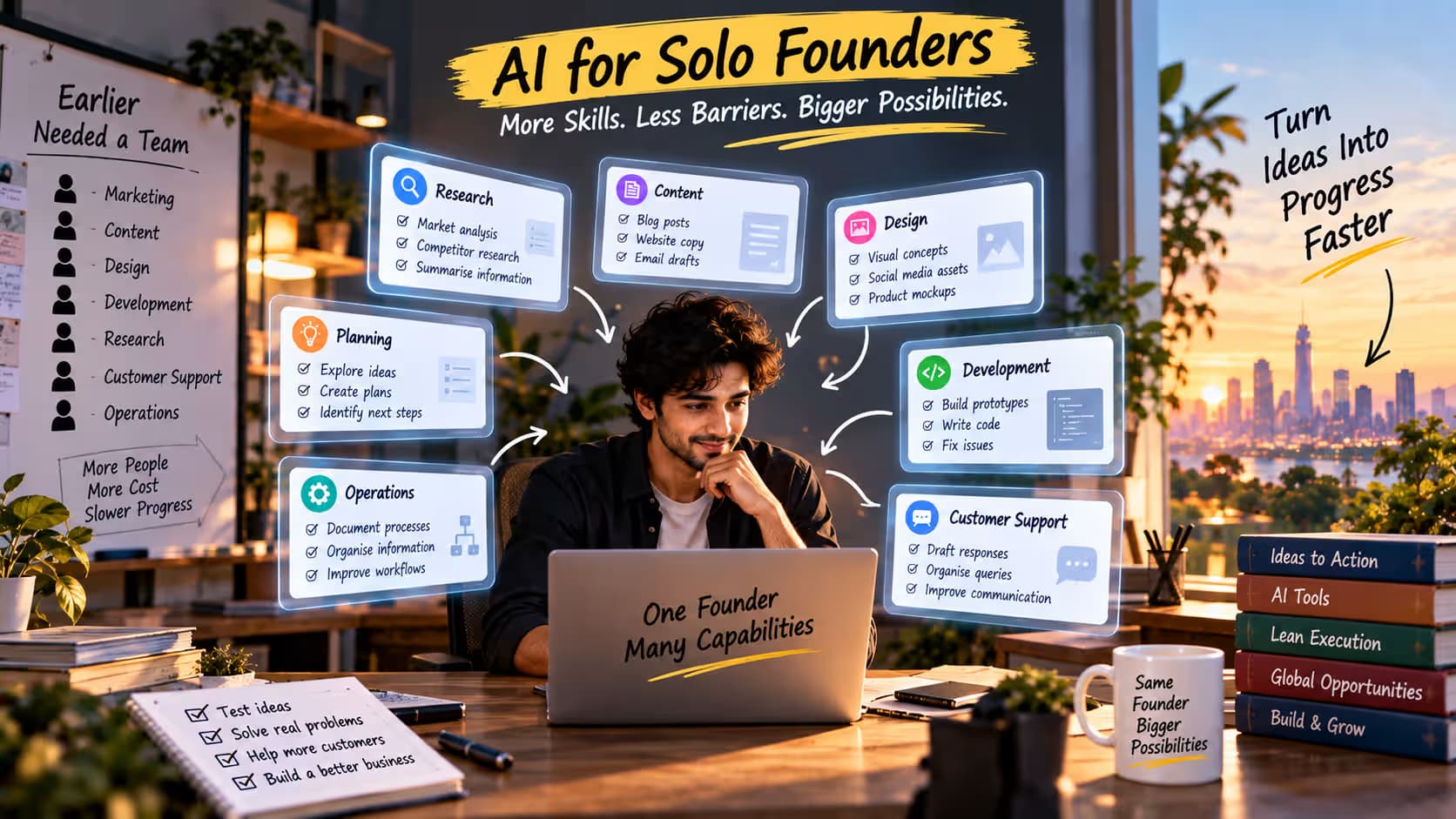
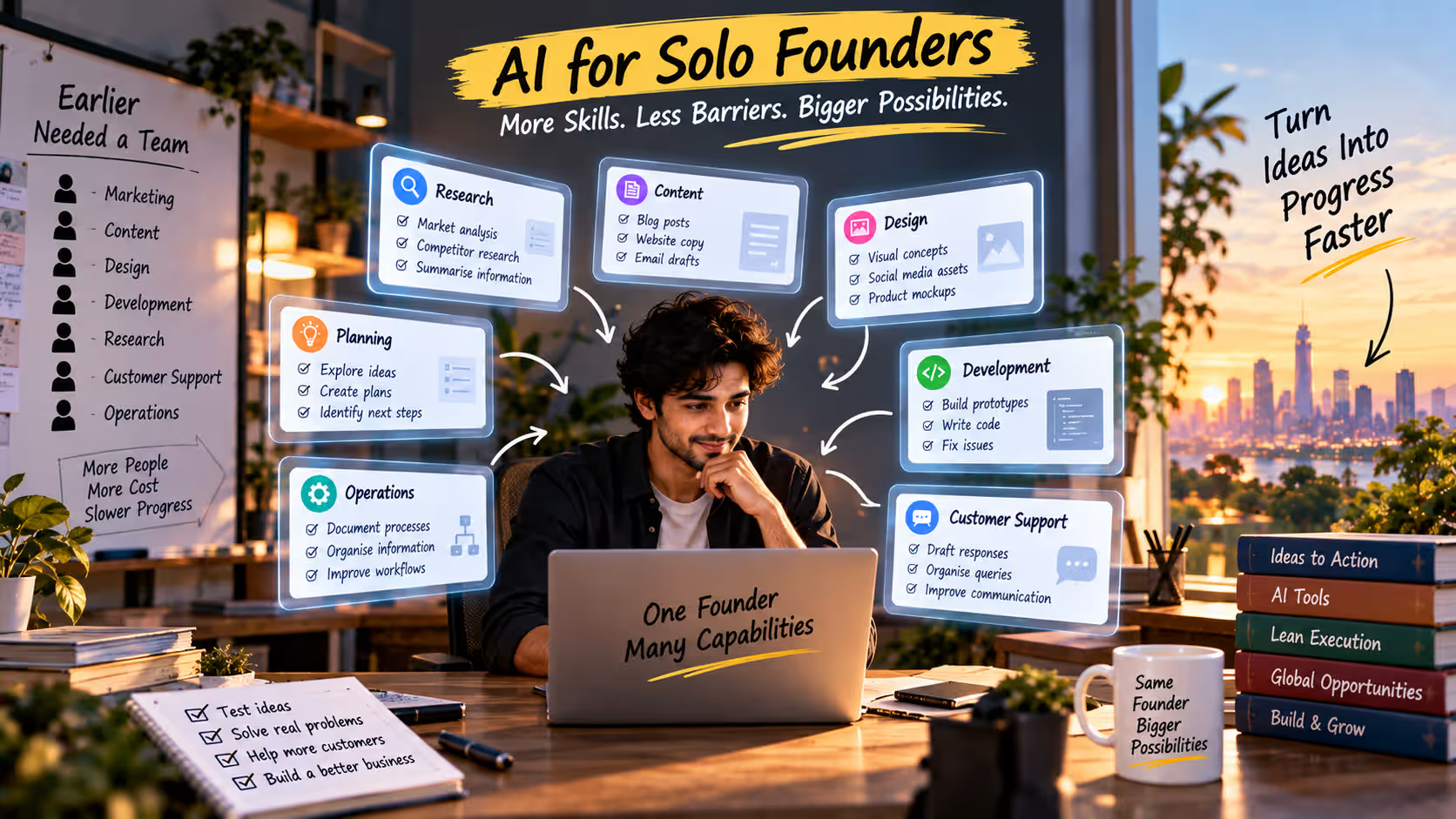
For a long time, building a serious business required more than a good idea. You needed people to handle marketing, content, research, customer support, design, technology, and operations. Today, AI for solo founders is changing how entrepreneurs approach these responsibilities. One founder can use AI to research a market, prepare content, explore product ideas, write code, analyse information, and improve customer communication.
I believe AI is making it possible for one person to start, test, and manage work that once required several people. This doesn't mean every founder should work alone or that AI can replace an entire company. It means the starting point has become much more accessible, especially for entrepreneurs who don't have the resources to hire a large team from day one.
Why AI for Solo Founders Is Changing Access to Skills
How AI Helps Founders Overcome Early Skill Gaps
One of the biggest challenges for a new founder is not always a lack of ideas. It is the lack of resources to execute them. You may understand your customers but not know how to write effective marketing content. You may have a product idea but lack the technical skills to build the first version. You may want to serve international customers but cannot afford specialists for every business function.
AI can help close some of these gaps. It can help a founder organise research, create an initial marketing plan, draft website content, explore design concepts, analyse customer feedback, and understand unfamiliar topics. These tools don't automatically make someone an expert, but they can make it easier to get started and identify where specialist help is still needed.
The OECD's 2025 research on generative AI and small businesses found that 65% of SMEs already using these tools reported improved employee performance. The research also found that some businesses used AI to address skill gaps and reduce workloads. These findings reflect surveyed businesses, not a guarantee that every founder will see the same results, but they help explain why smaller companies are paying attention.
For a founder, this matters because access to certain capabilities no longer has to begin with hiring someone full-time. A person with a clear understanding of a problem can use AI to explore possible solutions, prepare early materials, and make progress before investing in a larger team. One of the biggest benefits of AI for solo founders is having access to capabilities that previously required multiple specialists.
Why Solo Founders Should Build AI-Powered Systems Before Hiring
Using AI to Make Business Operations More Efficient
Building FormLLC has shaped how I think about business operations. Company formation is only one part of the customer journey. There are questions, documents, communication, follow-ups, operational processes, and responsibilities that continue long after a company is registered.
As a business grows, these activities can become difficult to manage. Adding people is one way to handle the workload, but it isn't always the first answer. Some processes can be simplified, documented, or supported by technology. I've written about this broader lesson in what helping 5,000 entrepreneurs taught me about starting a global business.
If I were building a new business today, I would look at every repetitive activity and ask whether AI could help me complete it faster or more consistently. I would use it to organise research, create first drafts, analyse feedback, document processes, and support routine workflows. I would still review important work, especially anything involving customer commitments, legal requirements, or financial information.
For example, AI could help prepare a first draft of a customer email, but I would review it before sending it. It could help organise information from customer conversations, but I would make the final decisions about what the feedback means. It could help document a process, but I would check that the instructions accurately reflect how the business operates.
The goal would not be to use AI everywhere. It would be to remove unnecessary work so I could spend more time understanding customers and improving the business. I would rather build a small business with clear systems than create a large team just to manage processes that could be made simpler.
AI tools for solo founders can help simplify repetitive business activities, organise information, and create more consistent workflows. The important part is knowing which processes actually need improvement rather than introducing technology just because it is available.
How AI Helps Solo Founders Test Business Ideas for Less
Testing Business Ideas Before Making Bigger Investments
Another important change is the cost of testing an idea. Previously, a founder might need to hire a designer, developer, writer, and marketing specialist just to explore whether a product had potential. Now, AI can help create early versions of websites, landing pages, content, prototypes, and internal tools.
That doesn't mean the first version will be perfect. It means you can learn faster before making larger investments. A founder can use AI to prepare a basic landing page, explain a product concept, create sample content, or build a simple prototype. They can then put that work in front of potential customers and learn whether the idea addresses a real problem.
Research published by the National Bureau of Economic Research, based on more than 5,000 customer support agents, found that access to a generative AI assistant increased productivity by 14% on average in the setting studied. The impact varied across workers, which is an important reminder that results depend on the task and the person using the tool.
For me, the bigger business lesson is that founders should use technology to shorten the distance between an idea, a real customer, and useful feedback. Instead of spending months trying to build something based only on assumptions, they can create an early version, show it to potential customers, and use what they learn to decide what to improve.
This connects with something I have learned through my own entrepreneurial journey: building a business is not about creating everything at once; it is about solving a real problem, learning from customers, and improving what you offer. My experience of building a global business from India reinforced how important it is to start with the opportunity and the customer rather than waiting for perfect resources.
This makes AI particularly useful for solo founders who want to validate a business idea before investing heavily in development or hiring. The aim should be to learn whether customers actually need the solution, not simply to produce something quickly.
Why AI Cannot Replace Human Responsibility in Business
Trust, Accuracy, and Accountability Still Need Human Judgment
There is one thing I would never forget: a business is built on trust, not just output. AI can generate a response, but it cannot automatically understand every customer's situation. It can help prepare information, but someone must verify whether that information is correct. It can assist with customer support, but the founder remains responsible for the promises the business makes.
This is particularly important in industries where mistakes can create real financial or compliance problems. Faster work is valuable only when quality and accountability remain intact. For example, AI might help organise information about company formation or prepare a general explanation of a process, but that doesn't mean its output should be treated as professional legal, tax, or financial advice.
In my work with FormLLC, accuracy and clarity matter because founders rely on information to make decisions about their businesses. A useful tool should help make complex processes easier to understand, not create false confidence or hide important responsibilities. This is also why I believe founders need to understand what comes after forming a US LLC, rather than assuming that completing registration takes care of everything.
I also believe founders should be careful not to build more features simply because AI makes them easy to create. It is easy to invest time and resources in things customers don't actually need. Technology should help solve a real problem, not give us more ways to become distracted.
How AI Is Changing the Role of the Solo Founder
From Managing Every Task to Making Better Decisions
I don't believe the future belongs only to founders who can code, design, write, and market everything themselves. I believe it will create more opportunities for people who can identify valuable problems, make good decisions, understand customers, and bring different tools together.
The founder's role may increasingly involve deciding what needs to be built, which tasks can be supported by AI, where human expertise is essential, and how the different parts of the business should work together. These decisions require an understanding of customers and the business itself. Having access to more tools doesn't remove the need to think carefully about what deserves attention.
A small team will still matter when a business needs specialised expertise, human relationships, complex operations, or greater capacity. AI doesn't remove those needs. It can help a small business reach a stage where it can make those investments more thoughtfully. A founder might use AI to test a product concept, then bring in a developer when the product needs deeper technical work. They might use AI to prepare marketing drafts, then work with a specialist when the business needs a more developed strategy.
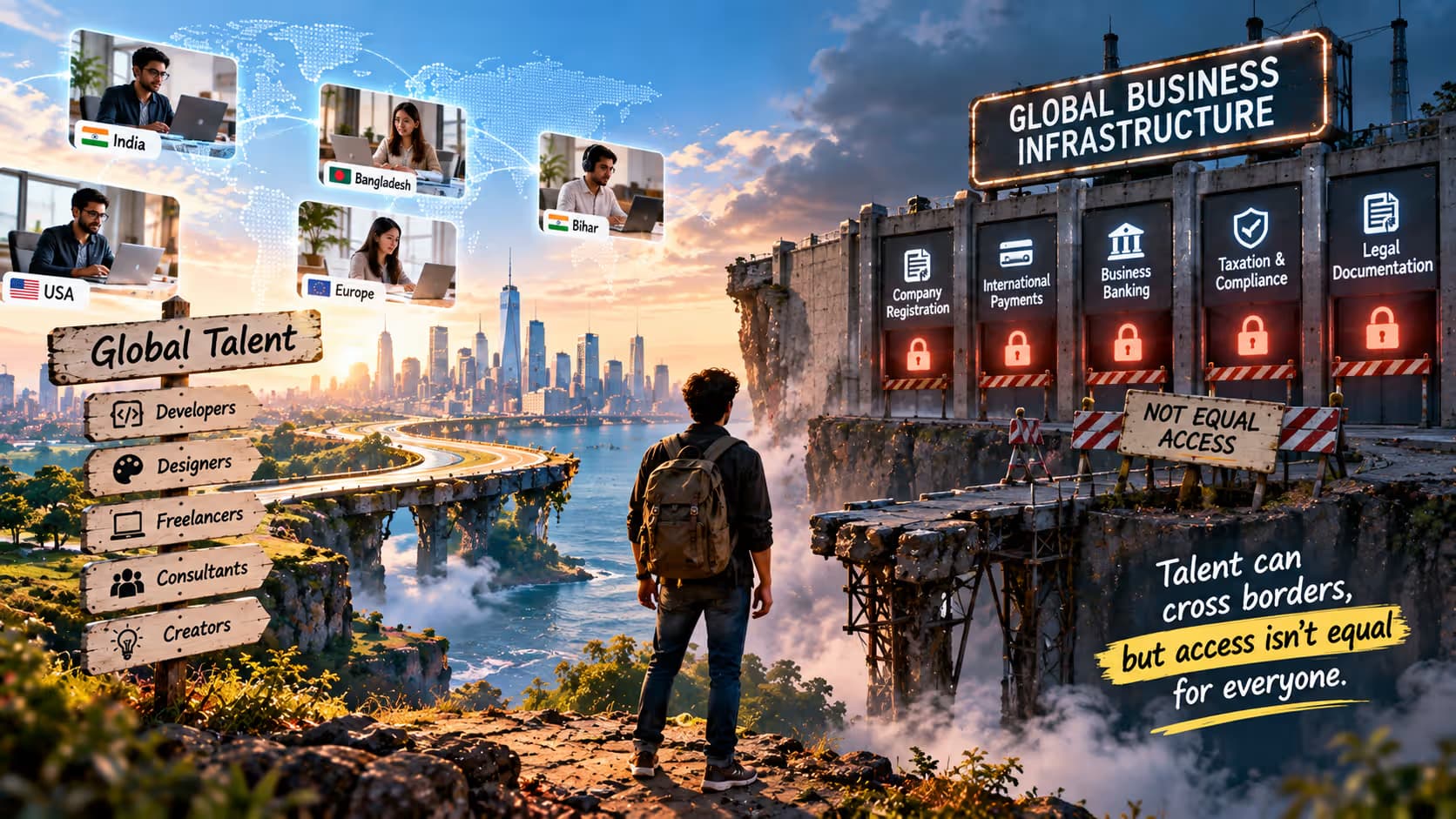
This is similar to how I think about building internationally. You don't need to create every part of a global business on the first day. You need to understand what the business actually requires and add the right infrastructure as it grows. My article on geography and opportunity explores why access to tools and opportunities can change what founders are able to build, even when they start far from traditional business centres.
Why AI for Solo Founders Matters When Starting With Limited Resources
For someone starting from a small town, a developing country, or without access to large amounts of capital, this change is especially meaningful. A founder may not have the budget to hire a full team, but they may still have an idea, an internet connection, and the willingness to learn. AI can help that person explore an opportunity, prepare an early product, communicate with potential customers, and organise the work involved in getting started.
That doesn't mean the journey becomes effortless. Founders still need to understand their markets, earn customer trust, deliver what they promise, and take responsibility for their decisions. AI can support the work, but it cannot replace the founder's commitment to building something useful.
My view is simple: the next generation of founders may not need a large team to get started, but they will need the ability to think clearly, use technology intelligently, and take responsibility for what they build.
Ultimately, AI for solo founders isn't about avoiding people or building everything alone. It's about having more ways to turn an idea into a working business with the resources available. The opportunity is not that AI will build the business for you. The opportunity is that fewer things will stand between you and the ability to build it yourself.
This article is for general informational purposes only and does not constitute legal, tax, or financial advice. Tousif Akram and FormLLC are not a law firm or CPA firm. Consult a licensed professional for advice specific to your situation.
Ready to Form Your US LLC?
Free 30-minute consultation with no obligation and no sales pressure.
Book Free Call