US Bank Account for Non Residents: A Founder’s Guide

Tousif Akram
IRS CAA | Founder, FormLLC
US Bank Account for Non Residents: A Founder’s Guide
The message usually comes after the celebration. The LLC has been approved. The founder has the formation documents, the company has a name, and the state has accepted the filing. Then comes the question I have heard from international founders again and again: “Now, how do I open a US bank account?”
It sounds like the obvious next step. But this is where many founders discover something important: forming a US company and getting approved for a business bank account are two different processes. I have seen founders spend days thinking about the LLC and almost no time thinking about what happens after it is formed. That is why I always tell people that company formation is Day 1. Banking is part of Day 2.
Can You Get a US Bank Account for Non Residents?
Yes, international founders can potentially open business accounts for US companies, but approval depends on the financial institution or provider and its eligibility requirements. A founder may live in India, Nigeria, Pakistan, the UAE, Bangladesh, the UK, or somewhere else and own a US company. But the financial institution still needs to understand who owns the company, what the company does, where it operates, what transactions it expects, and where its money will come from and go.
This is why finding a US bank account for non residents is more complicated than simply finding a provider that says it accepts international founders. Banking is a separate process from company formation, and the financial institution ultimately decides whether the company meets its requirements.
If you are still at the company-formation stage, my guide to starting a US LLC from India explains the broader process of creating a US company as an international founder.
The LLC Approval Doesn't Mean the Bank Will Approve You
This is probably the most important thing I would tell an international founder. Your LLC can be perfectly valid and still be declined by a particular bank or financial platform.
Why? Because the financial institution is making its own decision. A provider may look at your business model, ownership, identification, principal business address, expected transactions, and whether you have operations in the United States. Different providers can also have different eligibility rules for international founders.
That is why I don't like blanket statements such as “Get a US LLC and you'll automatically get a US bank account.” That's not how it works.
The LLC establishes the legal entity. The bank or financial provider decides whether it is comfortable establishing a financial relationship with that entity. Those are separate decisions.
What Does a US Business Bank Account for Foreigners Actually Require?
The exact requirements depend on the bank or provider, but international founders should generally be prepared to explain the business clearly. You may need your formation documents, EIN documentation, passport or other government identification, ownership information, and details about where your business operates and what you expect to do with the account.
Some providers may also ask additional questions during their compliance review. This is why a US business bank account for foreigners shouldn't be treated as a product you simply purchase. It is an application, and the financial institution decides whether the business meets its requirements.
Your company information should also be consistent. The information you provide during banking should make sense alongside your formation documents, EIN information, ownership records, website, and business explanation.
If you are still working on your EIN, you can also read my guide on EIN Without SSN: How to Get a US EIN.
The Business Address Question
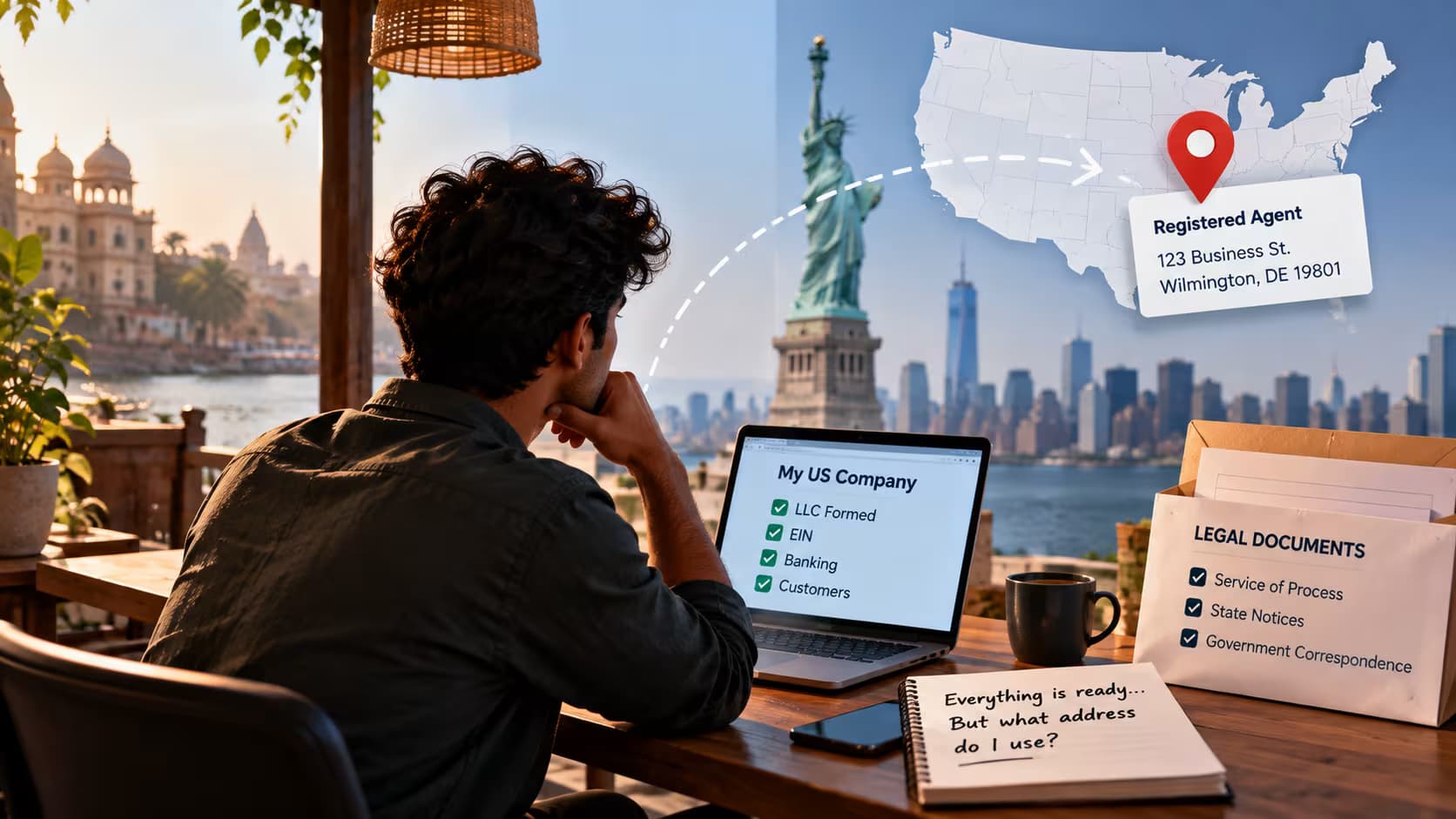
This is where the banking conversation connects directly with another important part of forming a US company: understanding the difference between a registered agent, mailing address, virtual address, and principal business address.
A founder may have a registered agent in Wyoming, Delaware, or another state. That does not necessarily mean the registered-agent address can be used as the company's principal business address for banking. Different providers can have specific rules about the type of address they accept.
This is why I tell founders not to buy an address simply because someone says, “The bank requires a US address.” First find out what kind of address the provider actually requires.
A registered-agent address and a principal operating address can serve very different purposes. Understanding that distinction before applying can save you from unnecessary costs and confusion.
US Bank Account for International Founders
The opportunity for international entrepreneurs is real. A founder doesn't necessarily have to move to America before building a US company or exploring business banking options.
But international founders should expect more questions.
A US bank account for international founders can be useful for receiving customer payments, paying business expenses, managing subscriptions, paying contractors, and keeping company finances separate from personal finances. But the account should be connected to a real business.
If you're selling software, explain the software. If you're running an agency, explain your services. If you're selling physical products, explain your supply chain. If you're building a SaaS company, explain the product, customers, pricing, and expected transaction activity.
The clearer the business is, the easier it becomes for a financial institution to understand what it is being asked to support.
US Business Banking for Non Residents Is Not About Finding a Shortcut
I've seen international founders become frustrated because somebody promised them an account and the provider later asked for additional documents. This is where expectations matter.
US business banking for non residents isn't about finding a magic shortcut around compliance. Banks and financial institutions have their own customer-identification and risk-review processes. You should expect questions, and that's not necessarily a bad thing.
A serious financial institution should want to know who you are and what your company does.
What I don't like is when service providers make banking sound guaranteed before they even know enough about the founder or the business. There is a big difference between saying, “We can help you prepare for a banking application,” and saying, “We guarantee your account.”
The first is realistic. The second can create completely unnecessary expectations.
What About a US Business Account for Foreigners?
The same principle applies when someone searches for a US business account for foreigners. Being a foreign founder doesn't automatically mean you cannot apply. But being foreign also doesn't mean every provider will accept you.
Some online financial providers are specifically designed to support international founders. Traditional banks may have different onboarding procedures, and some may require an in-person visit or additional documentation.
So I would never choose a company structure solely because somebody told you that one particular bank will accept it.
Build the company first. Then evaluate the financial providers that actually fit your situation.
If you want to understand what happens after formation beyond banking, my article on what customers really want after forming a US LLC looks at the infrastructure international founders often need after the company itself is created.
Banking a Foreign-Owned LLC
For founders who own their company from outside America, the question becomes even more specific: Can I get a US bank account for a foreign-owned LLC?
Potentially, yes. But again, the provider's eligibility requirements matter.
The financial institution will generally want to understand who ultimately owns or controls the company. That information should be consistent with the company's formation documents and tax records.
This is one reason I always tell founders to keep their company information consistent. Your LLC documents, EIN information, ownership records, banking application, website, and business explanation shouldn't tell five different stories.
For international founders, this consistency becomes even more important as the company grows and its banking, tax, and compliance obligations become more connected.
US Banking for International Entrepreneurs
This is the bigger picture.
A US bank account isn't useful simply because it has “US” in the name. It is useful if it fits the way your business operates.
If your customers pay you in US dollars, a US account may make operational sense. If your company pays US-based vendors, it may be useful. If you're building a SaaS company with recurring American customers, having appropriate financial infrastructure can simplify parts of your operations.
But the account should support the business you already have—or genuinely plan to build.
That is how I think about US banking for international entrepreneurs. Not as a shortcut. As infrastructure.
This broader idea is also part of what I discuss in What Helping 5,000 Entrepreneurs Taught Me About Starting a Global Business.
What Documents Should a Founder Have Ready?
Before applying for a business bank account for non residents, I would make sure the basic company information is organized.
Your company formation documents should be accessible. Your EIN documentation should be ready where required. Your passport or other accepted identification should be current. Your ownership information should be clear. Your website should accurately describe what the company does. And you should be able to explain your expected business activity.
A financial institution may ask additional questions depending on its review. The more organized you are, the easier it is to answer those questions without creating confusion.
Your US LLC Operating Agreement for Non-Residents can also be part of the broader documentation framework you maintain for the company, depending on your structure and circumstances.
Can You Open a US Bank Account for Non Residents From Abroad?
This is probably the question behind the entire topic.
A US bank account from abroad sounds almost contradictory to someone who has never worked with international companies. But it is increasingly normal for US companies to have founders who live elsewhere.
Some financial providers accept applications from founders who are not physically in the United States. The important word is accept—not guarantee.
A founder can apply from abroad. The company still has to meet the provider's requirements, and the provider still has to approve the application.
That's a much more accurate way to think about international business banking.
Your US LLC Bank Account Is Part of a Bigger System
Once the founder understands this, the process becomes much easier.
The LLC is one piece. The EIN is another. The registered agent is another. The banking relationship is another. Then there are payments, bookkeeping, taxes, compliance, contracts, and everything else that comes with running the company.
That's why I don't like treating company formation as the finish line.
For an international entrepreneur, it is usually the beginning of a much longer journey.
A US LLC bank account can be an important part of that journey, but it shouldn't be the reason you form an LLC in the first place. Form the company because it makes sense for the business. Then build the financial infrastructure around the business honestly.
Banking is only one part of that infrastructure. For foreign-owned companies, ongoing compliance can matter just as much, which is why I also recommend understanding Form 5472 for Foreign-Owned US LLCs.
The Question I Would Ask First
When an international founder asks me, “How do I get a US bank account?” I don't immediately want to recommend a bank.
I want to understand the business.
Where do you live? Where is the company formed? What do you sell? Who are your customers? Where is the work performed? Who owns the company? Where do you expect the money to come from? And where will the money go?
Once those questions have answers, the banking conversation becomes much more practical.
Because the goal isn't simply to get an account.
The goal is to build a financial setup that can support the company for the next few years.
The LLC Was Approved. That's When the Real Questions Begin.
The LLC was approved.
That's good.
But for an international founder, that is where the real questions begin.
A US company can give you a legal structure for operating internationally, but the company still needs the right infrastructure around it. Banking, payments, documentation, compliance, bookkeeping, contracts, and tax responsibilities all become part of the journey.
So when someone asks me about a US bank account for non residents, my answer is simple: don't start with the bank.
Start with the business.
Understand what you're building, who owns it, where the business operates, how money will move through the company, and what infrastructure the company actually needs.
Then choose the financial setup that fits.
— Tousif Akram Founder, FormLLC
This article is for general informational purposes only and does not constitute legal, tax, or financial advice. Tousif Akram and FormLLC are not a law firm or CPA firm. Consult a licensed professional for advice specific to your situation.
Ready to Form Your US LLC?
Free 30-minute consultation with no obligation and no sales pressure.
Book Free Call